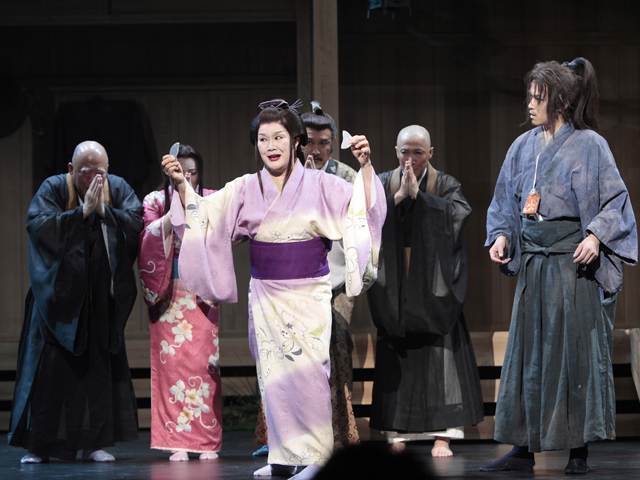
Director Yukio Ninagawa’s brilliant MUSASHI is a splendid choice to open the Lincoln Center Festival
David H. Koch Theater
20 Lincoln Center Plaza
Columbus Ave. at 63rd St.
July 7-10, $20-$100
www.lincolncenter.org
 The year is 1612, and master swordsmen Musashi Miyamoto (Tatsuya Fujiwara) and Kojiro Sasaki (Ryo Katsuji) are in the midst of a duel that leaves the latter near death. Instead of finishing him off, Musashi calls for a doctor to save Kojiro. Six years later, with Musashi seeking a more peaceful life during a meditation retreat at a newly constructed Buddhist temple in the middle of nowhere, Kojiro shows up, bloody revenge on his mind. Based on historical accounts, a 1930s serialized novel by Eji Yoshikawa, and Hiroshi Inagaki’s mid-1950s film trilogy starring Toshirō Mifune, the Ninagawa Company’s MUSASHI is a brilliant three-hour morality play running July 7-10 at the Lincoln Center Festival. Written by Hisashi Inoue (who tragically died suddenly in April) and directed by Yukio Ninagawa, MUSASHI is a stirring tale filled with very funny scenes and poignant drama. At the retreat, the priest, Takuan (Naomasa Musaka), sermonizes, the temple founder, Heishin (Keita Oishi), tells stories, patrons Otome Fudeya (Anne Suzuki) and Mai Kiya (Kayoko Shiraishi) make donations, and Musashi and Kojiro continually look over their shoulders, not trusting one another to wait until the end of the retreat to finish what they started. Early on, the production features a wonderfully choreographed dance of trees and pieces of the set as the temple is put together to a jazzy noir score, hinting at a later dance between the characters. Discussions of war and peace and the role of the samurai in a changing Japanese society abound but never get mundane or pedantic; the relatively spare English supertitles keep things simple and to the point. The three hours, with one intermission, breeze by swiftly, with several fascinating surprises that are simply sensational. Tickets are still available for this dazzling production, which combines elements of Noh and Kyogen theater with Zen philosophy and Bushido theory in supremely satisfying ways.