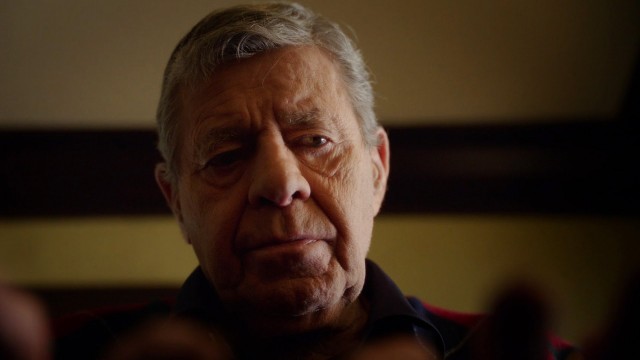
Jerry Lewis stars as a newly widowed octogenarian who becomes obsessed with a mystery about his late wife in MAX ROSE
MAX ROSE (Daniel Noah, 2016)
Landmark Sunshine Cinema
143 East Houston St. between First & Second Aves.
September 2-9
212-330-8182
www.landmarktheatres.com
www.facebook.com/MaxRoseMovie
 In his first starring role in more than twenty years, Jerry Lewis is superb in the otherwise clichéd and maudlin melodrama Max Rose. Lewis plays the title character, an eighty-seven-year-old former jazz pianist whose just lost his beloved wife of sixty-five years, Eva (Claire Bloom). While dealing with his sudden loneliness, Max finds a small compact that a man named Ben gave to Eva on November 5, 1959, with an inscription declaring his secret love. Max becomes obsessed with finding out who the man is and determining whether his marriage was a fraud. Meanwhile, his granddaughter, Annie (Kerry Bishé), is helping Max through this difficult time, even though her own marriage might be in trouble, and Annie’s father, Max’s son, Christopher (Kevin Pollak), is experiencing his own family dilemmas. Christopher tries to reestablish a relationship with Max, but the father keeps pushing the son away. Writer-director Daniel Noah’s feature-film debut has all the hallmarks of, well, a Hallmark movie of the week, laden with genre clichés that the talented cast fights to rise above. Bishé (Argo, Halt and Catch Fire) is absolutely lovely as Max’s dedicated granddaughter, but Pollak isn’t given enough to do as Max’s beat-upon son. A scene in which Max cavorts with a group of new elderly friends has a bittersweet joy to it, at least partially because all four actors — Lewis, Rance Howard, Lee Weaver, and Mort Sahl — were in their eighties when it was filmed. Dean Stockwell, who recently turned eighty, makes a strange appearance near the end, and Bloom is an octogenarian as well.
The plot jumps around, as does the emotional manipulation, heightened by Michel Legrand’s overly sentimental score, and Noah throws in a few odd references, including one to Kurt Vonnegut, which harkens back to Lewis’s appearance in the critically despised Slapstick of Another Kind, an adaptation of Vonnegut’s 1976 novel, Slapstick, that earned Lewis a Golden Raspberry nomination for Worst Actor. (He lost to Sylvester Stallone in Rhinestone.) Noah also has a thing about flowers, from Max’s last name, Rose, to the name of the social administrator, Ms. Flowers (Illeana Douglas), at the assisted living facility he moves into, but that never quite reaches full bloom, like the rest of the narrative. But throughout the film’s eighty-three minutes, it is impossible to take your eyes off Lewis; the director, and the camera, love him, and for good reason. Sitting in his favorite chair in his red sweater, legs spread, rising pants revealing long white socks that approach his knee, Lewis recalls his role as Jerry Langford in Martin Scorsese’s The King of Comedy, when he was kidnapped and tied up, the look in his eyes revealing all you need to know about his character, only now much sadder and forlorn. Best known as a slapstick comedian and muscular dystrophy telethon host, Lewis is a graceful and talented actor, his every movement filled with the knowledge gained over a long life. An early version of the film premiered at the Cannes Film Festival in 2013; the movie is finally getting its theatrical release, playing a short one-week run at the Landmark Sunshine. Deduct a star if Lewis is just not your thing.