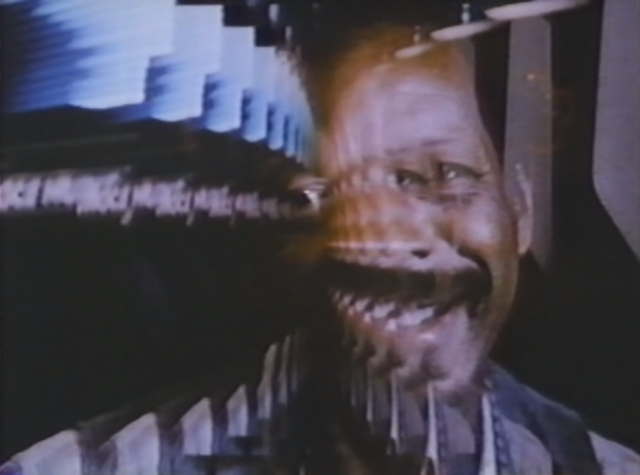
Shirley Clarke’s portrait of free jazz legend Ornette Coleman is screening in Brooklyn in a beautiful 35mm restoration
ORNETTE: MADE IN AMERICA (Shirley Clarke, 1985) & CHAPPAQUA (Conrad Rooks, 1966)
Spectacle
124 South Third St. between Bedford Ave. & Berry St.
July 17-23, $5
212-924-7771
www.spectacletheater.com
www.milestonefilms.com
 In September 1983, innovative saxophonist and Fort Worth, Texas, native Ornette Coleman received a key to the city of his hometown and then helped open the new Caravan of Dreams arts center by performing the world premiere of “Skies of America,” a specially commissioned work that teamed Coleman and his band, Prime Time, with the Fort Worth Symphony. Director Shirley Clarke uses this celebratory event as the central focus of her 1985 documentary, Ornette: Made in America, which was recently released in a beautiful new 35mm restoration overseen by Milestone Films as part of its continuing Project Shirley, which began with a dazzling new print of Clarke’s 1962 film about jazz and drugs, The Connection. In Ornette: Made in America, Clarke combines footage she shot of Coleman back in the 1960s for a never-completed film with new material that offers an inside look at Coleman and his relationship with his son, Denardo, a musical prodigy who has played drums with his father for decades, since he was a young boy. Clarke also includes staged scenes of young versions of Coleman wandering through his old neighborhood of Fort Worth, then turning to the camera to deliver determined stares, in addition to shots of a theater troupe dancing joyously down the street, Coleman performing through the years in San Francisco, New York City, and Nigeria, and interactions with such prominent figures as music critic Robert Palmer, artist Brion Gysin, writer William S. Burroughs, and architect Buckminster Fuller, who had a profound influence on Coleman’s unique free jazz sound. “As Buck says, you can’t see outside yourself, but we do have imagination,” Coleman explains inside a geodesic dome. “The expression of all individual imagination is what I call harmolodics, and each being’s imagination is their own unison, and there are as many unisons as there are stars in the sky.” Clarke puts the film together like one of Coleman’s free jazz compositions, filled with harmolodics, going from black-and-white to color and back again, cutting between interviews and live performances, moving from relaxing images to propulsive moments, and regularly bordering on the goofy, including talking heads in an animated television set, brief explanatory text in marquee scrolls, and shots of Coleman riding a spacecraft over the surface of the moon. Despite such silliness, Ornette: Made in America is a thrilling portrait of a national treasure, a one-of-a-kind musician who was still playing his unique brand of music into his eighties, right up until his death last month.
Brooklyn’s Spectacle Theater is paying tribute to Coleman with the special presentation “Something Else: A Celebration of Ornette Coleman on Film,” running July 17-22 and consisting of daily screenings of Ornette: Made in America along with Pierre Hébert’s 1968 fourteen-minute short, Population Explosion, with a score by Coleman, and Conrad Rooks’s 1966 forty-eight-minute cult film, Chappaqua, which was supposed to use Coleman’s specifically commissioned “Chappaqua Suite,” but Rooks decided to replace it because it was too good; however, Spectacle will be showing the film with Coleman’s original composition. In addition, a separate program will feature Andrew Lampert’s 2012 film, All Magic Sands/Chappaqua, which pairs Coleman’s “Chappaqua Suite” with footage from producer Al Gannaway’s never-completed religious adventure story.