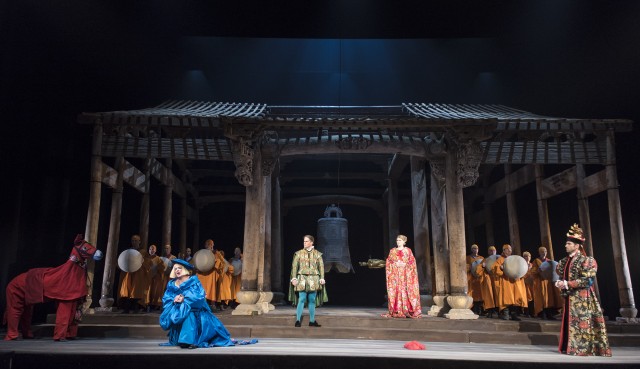
Zhang Huan has transported a 17-ton, 450-year-old Ming Dynasty temple as setting for SEMELE (photo by Jack Vartoogian / Frontrowphotos)
BAM Howard Gilman Opera House, Peter Jay Sharp Building
230 Lafayette Ave.
March 4, 6, 8, 10, $35-$170
718-636-4100
www.bam.org
www.coc.ca
When Belgium’s Théâtre Royal de la Monnaie and China’s KT Wong Foundation approached Shanghai-based visual and performance artist Zhang Huan to make his directorial debut in a production of composer George Frideric Handel and librettist William Congreve’s Semele, they were clearly seeking something different, a unique interpretation of the Baroque opera by John Eccles, based on Ovid’s Metamorphoses. And Zhang certainly delivers, bringing his complex sensibility to this mythical tale of love gone wrong. Semele takes place in and around a 17-ton, 450-year-old Ming Dynasty ancestral family temple that Zhang had previously purchased in a small village near Shanghai, then disassembled, transported, and reconstructed for the three-hour work, which is being performed by the Canadian Opera Company at BAM March 4-10. The fascinating details behind the history of the temple, including recent poverty, infidelity, and murder that relate to the Greek myth from which the opera is adapted, are communicated through a short black-and-white film that opens the program. Then Zhang dives into the tragic narrative of Semele (soprano Jane Archibald), the daughter of Cadmus, the king of Thebes (bass-baritone Kyle Ketelsen), who has been promised to Prince Athamas (countertenor Lawrence Zazzo) but is actually beloved by the god Jupiter (tenor Colin Ainsworth). That infuriates Juno, Jupiter’s wife (contralto Hilary Summers), who solicits the help of Somnus, the god of sleep (Ketelsen), and her messenger, Iris (soprano Katherine Whyte), to trick Semele and send her to her mortal doom. But not surprisingly, Zhang — who once covered his body with raw meat and walked to the Whitney Museum — brings it all together in surprising ways, using creative staging, gorgeous costumes (by fashion designer Han Feng), unusual props, and fire, breathing compelling life into this exciting production while combining Eastern and Western elements.
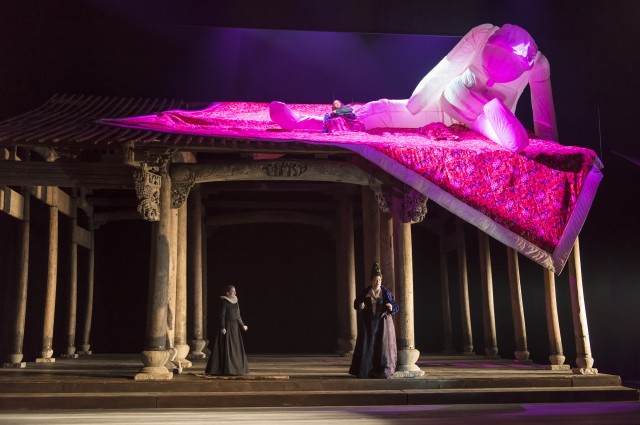
Somnus looks down from above in Zhang Huan’s visually dazzling production of SEMELE (photo by Jack Vartoogian / Frontrowphotos)
In the program notes, Zhang explains, “The fact that the roots of pain introduced in a Western opera can reappear in the East in the fate of a single peasant family in the countryside makes us continually ponder the redemptive qualities of humanity. . . . The human race has to continuously and eternally develop as it regresses.” Zhang explores that concept by incorporating into the opera a pair of sumo wrestlers (Americus Abesamis and Byamba Ulambayar), a huge blow-up god, two actors portraying a donkey showing off an enormous phallus, a twisting dragon, a chorus of men and women dressed as Buddhist monks, a Tibetan singer (Amchok Gompo Dhondup), characters that ascend and descend on wires, an orgy, nudity, and a shimmering magic mirror. (And it doesn’t take too much imagination to see the temple pillars as phallic objects either.) Handel’s score is beautifully conducted by Christopher Moulds, leading the COC Orchestra; the cast, singing in English (with English surtitles), features standout performances by Ainsorth, Whyte, and particularly Archibald in the title role, who dazzles in a late aria. In merging Eastern and Western philosophies, Zhang has infused this Greek myth with the four noble truths — aging, arising, cessation, and the path — while also relating it to modern-day China, resulting in a wholly satisfying, nontraditional, extremely entertaining multimedia experience.