Radical terrorist group is reexamined in Oscar-nominated drama
DER BAADER MEINHOF KOMPLEX (Uli Edel, 2008)
Cinema Village
22 East Twelfth St. between Fifth Ave. & University Pl.
212-924-3363

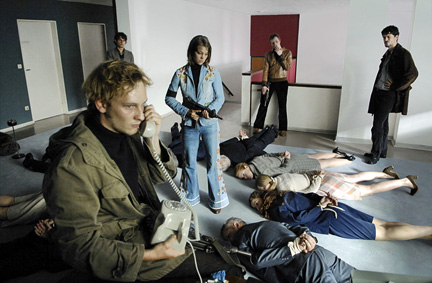
Born out of the student-protest movement of the late 1960s, the Baader-Meinhof Group, also known as the Red Army Faction, comprised a collective of urban guerrillas who were enraged by Germany’s refusal to take action against U.S. involvement in Vietnam as well as American support of Israel and the Shah of Iran. The growing gang, named after radical activist Andreas Baader (Moitz Bleibtreu) and left-wing journalist Ulrike Meinhof (Martina Gedeck), were anti-capitalist, anti-imperialist, and anti-fascist, taking up arms, planting bombs, and robbing banks to promote their political agenda. Director Uli Edel (LAST EXIT TO BROOKLYN, BODY OF EVIDENCE) re-creates the story of this violent period primarily through the eyes of Gudrun Ensslin (Johanna Wokalek), Baader’s girlfriend who shows no mercy, and newspaper columnist Meinhof, a mother whom Ensslin convinces must turn her written words into action. Citing Ho Chi Minh, Che Guevara, and Mao Zedong as influences, the group — which also includes Holger Meins (Stipe Erceg), Petra Schelm (Alexandra Maria Lara), Peter Boock (Vinzenz Kiefer), and Astrid Proll (Katharina Wackernagel) — continues its fight even as many of its members are imprisoned and killed, battling to the very end as the head of the federal police, Horst Herold (Bruno Ganz), tries to understand their motives and not just think of them as evil terrorists. Reminiscent of such recent films as Steven Spielberg’s MUNICH and Marco Bellocchio’s BUONGIORNO, NOTTE, both of which also depict radical organizations committing political kidnappings and murder, DER BAADER MEINHOF KOMPLEX is a fascinating study of individuals who choose violent action over nonviolent protest. The screenplay, cowritten by Edel and Bernd Eichinger based on the book by Stefan Aust, lapses in the latter parts of this long two-and-a-half-hour drama, as unfamiliar, poorly identified characters take center stage and events whirl by at a maddening pace, but the film is still a chilling tale of a group of homegrown revolutionaries who captured the attention of a restless public in Germany and around the world — until they started to go too far.