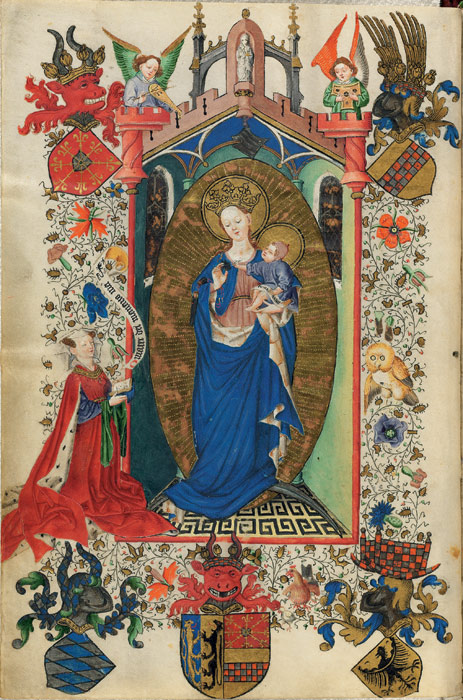
“Catherine of Cleves Praying to the Virgin and Child,” Hours of Catherine of Cleves, in Latin, Netherlands, Utrecht, Illuminated by the Master of Catherine of Cleves, ca. 1440
THE HOURS OF CATHERINE OF CLEVES
Morgan Library & Museum
225 Madison Ave. at 36th St.
Tuesday – Saturday through May 2, $12 (free Fridays 7:00 – 9:00)
212-685-0008
www.themorgan.org
Betrothed at six, married at thirteen, and the mother of a half dozen children by the time she was twenty-three, Catherine of Cleves dealt with her life by delving into prayer. In 1440 she moved away from her husband, Arnold of Egmond (duke of Guelders and count of Zutphen), later getting involved in a struggle for power that tore the family apart. But she sought solace (and probably magnified her status) around 1440 by commissioning what would become one of the world’s most majestic illuminated manuscripts, “The Hours of Catherine of Cleves.” Gorgeously designed by the Master of Catherine of Cleves, who incorporated Dutch painting techniques into his ornate style, nearly one hundred pages from the Hours are on view, in sequence, at the Morgan Library, including the Hours of the Virgin, Penitential Psalms, the Hours of the Passion, Suffrages, the Office of the Dead, and assorted biblical scenes.
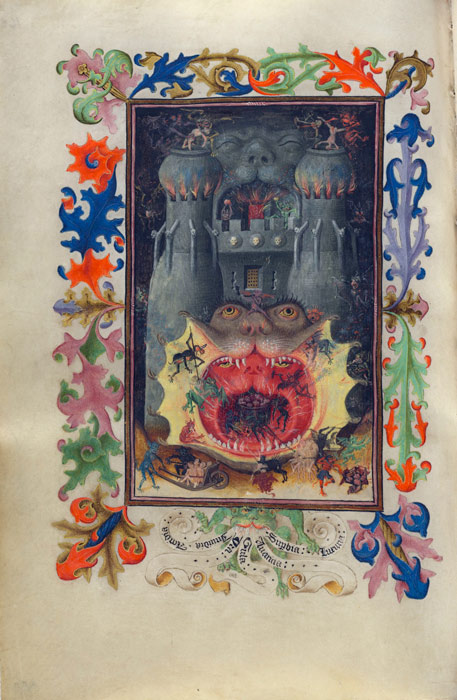
“Mouth of Hell,” Hours of Catherine of Cleves, in Latin, Netherlands, Utrecht, Illuminated by the Master of Catherine of Cleves, ca. 1440
The Master’s creative iconography spreads into the margins of each page, and Catherine herself appears in several works, as well as her reviled husband, shown praying to Jesus. (Perhaps she thought he had better be praying, considering the family division.) Among the most impressive sections is the Hours and Masses for the Seven Days of the Week, particularly Monday, which is devoted to the Dead and features “Deathbed,” “Burial,” and “Souls Released from Purgatory,” three spectacular examples of the Master’s skill. The “Holy Family at Work” shows a unusual and touching domestic scene: the baby Jesus stands in a walker perhaps made by his dad, the carpenter Joseph, hard at work at right, while Mary is busy at a loom, all three cozy in a room whose style would be instantly familiar to a reader. Each page deserves to be pored over carefully as narratives flow and symbolism runs rampant. It’s a thrilling, one-of-a-kind exhibit, as the pages will soon be bound together back into book form, so this is a rare opportunity to see each beautiful pieces spread out. The show is supplemented with illustrations from the Master’s contemporaries, placing it in context; also on display at the Morgan is “Rome After Raphael,” “Palladio and His Legacy: A Transatlantic Journey,” and “Flemish Illumination in the Era of Catherine of Cleves.”