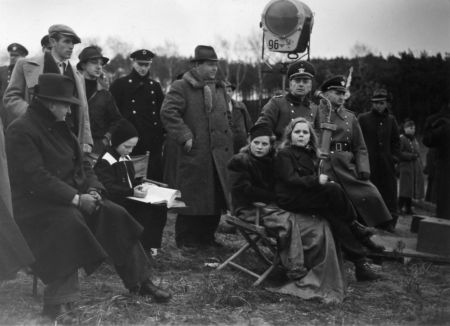
Veit Harlan, wife Kristina Soderbaum, and high-ranking Nazis on the set of THE GREAT KING (courtesy Zeitgeist Films)
HARLAN — IN THE SHADOW OF JEW SÜSS (Felix Moeller, 2009)
Film Forum
209 West Houston St.
March 3-16
212-727-8110
www.filmforum.org
 In 1940, popular German director Veit Harlan made JEW SÜSS, a hate-filled anti-Semitic screed commissioned by Joseph Goebbels, the Nazis’ minister of propaganda. JEW SÜSS instantly became required viewing for the military, and the German public flocked to see the manipulative melodrama as well, helping shape the country’s thoughts and feelings about the Jewish question. Nearly seventy years later, Felix Moeller revisits the film in the compelling documentary HARLAN — IN THE SHADOW OF JEW SÜSS. Moeller combines footage of Harlan’s films, including extensive clips from JEW SÜSS, with home movies and old and new interviews with Harlan’s family, from the German writer-director’s wives, children, and grandchildren to niece and actress Christiane Kubrick, longtime wife of master filmmaker Stanley Kubrick. The reaction of the relatives, several of whom are led to a Munich museum exhibition about the film and its place in German history, is fascinating to watch — some defend Harlan and say he was forced into it all, others claim that Goebbels’s editing made the work seem worse than Harlan intended, and still others have changed their name to avoid being identified with the notorious filmmaker, but nearly all insist he himself was not anti-Semitic, pointing out that his first wife was Jewish (although she did leave him for unspecified reasons). WhIle Leni Riefenstahl is much more well known today for such Nazi propaganda films as TRIUMPH OF THE WILL (1935) and OLYMPIA (1938) — at least partly because she is a far more accomplished director — Harlan, who made such films as THE RULER (1937), YOUTH (1938), and THE IMMORTAL HEART (1939) before JEW SÜSS and THE GOLDEN CITY (1942), IMMENSEE (1943), and KOLBERG (1945) afterward (all told, he made twenty films under the Third Reich), was the one tried (twice) for war crimes, showing the impact his work had on the Holocaust. But Moeller, son of German director Margarethe von Trotta, doesn’t concentrate on JEW SÜSS itself or even its effect on the German people; instead, he focuses his attention directly at the film’s relationship to Harlan’s family, who discuss such themes as forgiveness, responsibility, and legacy through a unique historical lens.