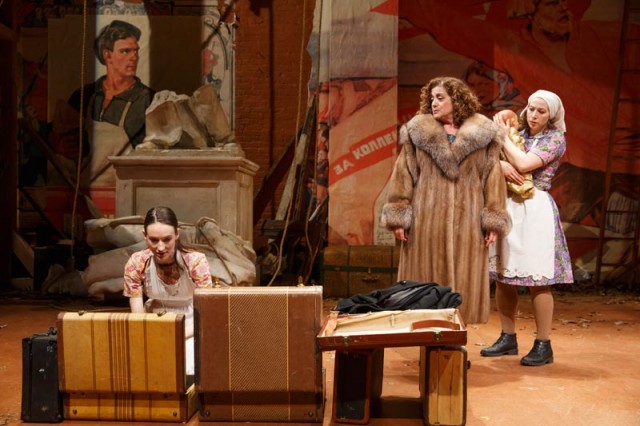
The fur-clad governor’s wife (Mary Testa) has more on her mind than her baby in Brecht revival (photo by Joan Marcus)
Classic Stage Company
136 East 13th St. between Third & Fourth Aves.
Tuesday – Sunday through June 23, $65
212-677-4210
www.classicstage.org
There’s a whole lot going on in Classic Stage Company’s inconsistent yet involving production of Bertolt Brecht’s The Caucasian Chalk Circle, including a brief prologue in Russian, a self-referential play-within-a-play, seven actors performing twenty-four roles, a convergence of multiple Russian/Soviet periods, an eerie big-headed doll/dummy used to portray a child, and even an audience sing-along. Not all of it works, and some of it causes confusion, but at its center is a story that is beautifully compelling. In the city of Nukha in Grusinia, the governor has been beheaded, and his wife (Queen of the Mist’s Mary Testa, who will be replaced by Lea Delaria beginning June 11) is more concerned with her furs than the revolution that is going on all around her, or even than her own newborn son, whom she thoughtlessly leaves behind as she is hustled to safety. A young maid, Grusha (Elizabeth A. Davis), rescues the infant, risking her own freedom as all hell breaks loose. Although she has accepted a proposal of marriage from soldier Simon Chachava (Alex Hurt), she is chased by a trio of Ironshirts led by a creepy corporal (Tom Riis Farrell) who is determined to reclaim the governor’s child in order to have the kid put to death. In the second act, Azdak (Christopher Lloyd), a wild and unpredictable menial clerk, unknowingly offers shelter to the Grand Duke (Jason Babinsky), then ends up being granted a judgeship and having to decide, ultimately, who the baby belongs to. Inspired by Li Xingdao’s Yuan dynasty masterpiece Circle of Chalk, Brecht’s play tackles such subjects as war, power, wealth, politics, and justice in the face of love.
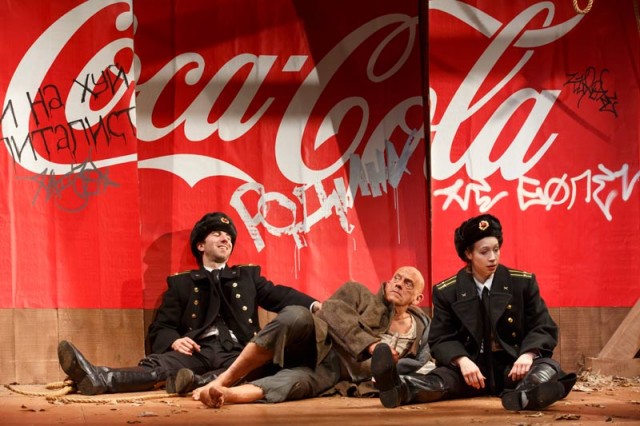
Azdak (Christopher Lloyd) finds himself in a new position in postrebellion Russia (photo by Joan Marcus)
Adapting James and Tania Stern’s translation, with lyrics by W. H. Auden and original music by Duncan Sheik (Spring Awakening), director Brian Kulick incorporates unique creative flourishes into the production, including using old suitcases as multiple props, depicting rain by having actors squeeze wet sponges into buckets, staging a wedding/funeral with glowing candles and a mysterious song, and having characters tear down a statue of Lenin. But the play-within-a-play aspect grows tiresome, especially when the characters specifically mention Classic Stage Company (and when they speak in untranslated Russian), and the acting is hit-or-miss; Davis, who was nominated for a Tony for Once, is terrific as Grusha, wonderfully combining dedication and desperation with a touching vulnerability. Farrell severely overplays the Fat Prince and the Corporal, while Hurt underplays Simon. Lloyd spends the first act as the Singer, serving as narrator (but never actually singing), then is allowed to cut loose in the second act, which he does with great fervor and madness, melding his two iconic roles, Jim Ignatowski from Taxi and Doc Brown from the Back to the Future trilogy. Tony Straiges’s set design features chairs and rope hanging from the ceiling and red-and-white posters that equate Marx and Lenin with Coca-Cola a little too easily and obviously. But Brecht’s populist parable still manages to shine through, examining the state of the world as well as theater itself.