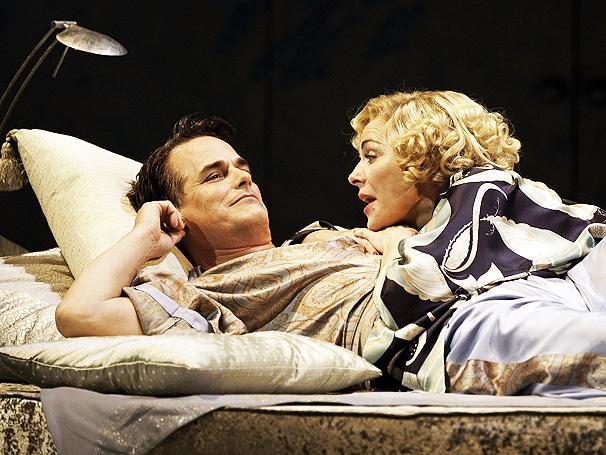
Paul Gross and Kim Cattrall are the latest pair to take on the roles of Elyot and Amanda in Noël Coward’s PRIVATE LIVES (photo by Cylla von Tiedemann)
Music Box Theatre
239 West 45th St. between Broadway & Eighth Aves.
Through February 5, $46.50 – $176.50
www.privatelivesbroadway.com
Following in the footsteps of such Broadway duos as Alan Rickman and Lindsay Duncan (2002), Simon Jones and Joan Collins (1992), Richard Burton and Elizabeth Taylor (1983), and Brian Bedford and Tammy Grimes (1969) — as well as the 1931 cinematic pairing of Robert Montgomery and Norma Shearer — Due South’s Paul Gross and Sex and the City’s Kim Cattrall are now taking on the roles of Elyot and Amanda in Noël Coward’s 1930 battle of the sexes, Private Lives, which opened November 17 at the Music Box Theatre. On a hotel terrace in Deauville, newlyweds Elyot and the younger, somewhat naive Sybil (Anna Madeley) can’t stop talking about his ex-wife, Amanda, who, it turns out, is in the next room, celebrating her marriage to the older and stuffy Victor (Simon Paisley Day), unable to stop talking about her ex-husband. While their initial impulses are to run away, it is clear that Elyot and Amanda belong together — or at least deserve each other — and soon they are flitting off to Paris, hiding away in Amanda’s Art Deco love nest. But in director Richard Eyre’s (Mary Poppins on Broadway, the film Notes on a Scandal) new production, the heat generated in the first act dissipates in the second, as the idea of Elyot and Amanda in love is more electric and exciting than their actual coupling, which quickly becomes tiresome to watch, the earlier promised spark reduced to an occasional flicker. It’s a combination of both a dated script, which includes lighthearted talk of men hitting women, and a lack of physical chemistry between the two leads. Individually, Gross and Cattrall turn in more than respectable performances, but they fizzle in the middle of the play.
Fortunately, things turn around in the third and final act when the slapstick level rises with the return of Sybil and Victor and all heck breaks loose. The show does feature several minor distractions that get in the way: In the first act, David Howe’s lighting of Gross and Madeley on the right side of the stage casts shadows on the left side that sometimes makes it look as if a character is about to enter (when they’re not), and in the second act, a tattoo is evident on one of Gross’s ankles, which does not fit with his character. (There wasn’t much that could have been done about the dead goldfish floating on top of the three-part fishtank, and it certainly wasn’t the production’s fault that an older gentleman in the orchestra continually let out deep throat rumblings that echoed throughout the theater during the entire two-hour-plus show.) Despite the shortcomings of the second act, the current version of this classic comedy of manners — which in 1930 made its London debut with Coward himself as Elyot, Adrianne Allen as Sybil, Gertrude Lawrence as Amanda, and Laurence Olivier as Victor — is a pleasurable and enjoyable experience, if not quite the success it could have been.