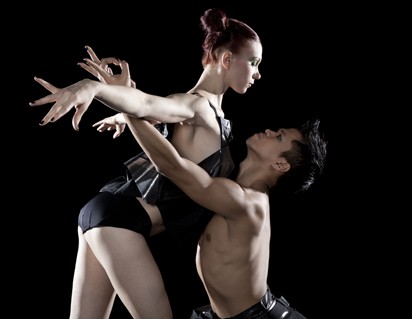
Karole Armitage’s GAGA-GAKU has its world premiere at the Joyce this week (photo by Julieta Cervantes)
The Joyce Theater
175 Eighth Ave. at 19th St.
Through May 8, $10-$39
212-691-9740
www.joyce.org
www.armitagegonedance.org
New York–based choreographer Karole Armitage describes her company’s current two-week run at the Joyce as “the culmination of ten years of intense work . . . the crescendo of a wild, exciting ride,” as Armitage Gone! Dance turns its attention more to multidisciplinary theatrical pursuits in the future. If that’s the case, they’re going out with quite a bang. Armitage is presenting two programs at the Joyce, the first of which consists of three very different works that combine to form a thrilling night of dance. The evening begins with the world premiere of GAGA-Gaku, which incorporates ancient Japanese court music, Cambodian court dance, Japanese Noh theater, and Balinese dance. AG!D members are joined by three guest dancers from the Dance Theatre of Harlem on a miniaturized dark stage, a red curtain cutting the space by more than half, the lights dangling just over their heads. Evoking Balinese puppet theater and Southeast Asian and Indonesian statuary, the dancers exhibit unusual poses emphasizing the long lines of arms and legs, traditional hand positions (mudras), and right-angled knees and ankles. Feet pound rhythmically on the floor, adding percussion to the mesmerizing guitar-heavy score by Lois V Vierk. Reflections from the silvery ground send shadowy patterns up their skin, adding another facet to Issey Miyake’s intriguing costumes for the women, three-dimensional sculptural origami camisoles made of recyclable fibers and developed through mathematical algorithms with the help of a computer scientist. Near the end of the piece, as Vierk’s “Red Shift” threatens to explode, Matthew Mottel, listed in the program as a character named Mushroom, comes out from behind the curtain and starts talking about zombies from Albuquerque; it’s utterly bewildering and infuriatingly out of place in a piece that otherwise was reaching a dazzling conclusion. The bizarre intrusion was the talk of intermission; we’re sure Armitage had her reasons, but two days later, we’re still scratching our head.
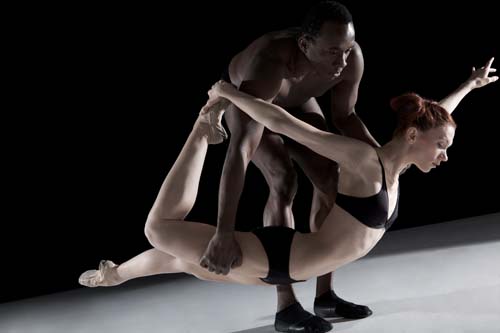
LIGETI ESSAYS is one of four pieces featured in Armitage Gone! Dance season at the Joyce (photo by Julia Cervantes)
GAGA-Gaku is followed by the beautiful Ligeti Essays, a 2005 work set to a trio of song cycles by twentieth-century Hungarian composer György Sándor Ligeti. On the full stage, icy white light falls from the ceiling, illuminating a Roxy Paine-like metallic tree with bare branches in the far left corner, shining against the black backdrop. The floor is illuminated by a large rectangle of fluorescent lights as dancers appear primarily in a series of solos and duets that range from silly and playful to sexy and serious. Marlon Taylor-Wiles and Masayo Yamaguchi are stand-outs as a couple that keeps returning to the alter-Edenesque site, designed by David Salle and Clifton Taylor (who designed the GAGA-Gaku set as well), to explore their relationship. Program A concludes with the all-out frenzy of Armitage’s 2009 revival of her 1981 breakthrough, Drastic-Classicism, in which all eleven members of the company cut loose on the open stage as if in a 1980s club, running and jumping around in Deanna Berg MacLean’s ripped, tight-fitting black costumes, hanging out in pseudo-cool poses against the exposed brick wall in the back, and interacting with the four guitarists and drummer powering away at Rhys Chatham’s commissioned punk score. It feels like an encore both for the audience and the dancers, who get to improvise within the piece, as well as a coda as Armitage looks to a changing future. (The three-part Program A is scheduled for April 29 & 30 and May 4, 5, and 7. Program B features Armitage’s 2010 work Three Theories, which the company performed last year at Cedar Lake as part of the World Science Festival. You can read our review of the sixty-five-minute piece, which delves into the Big Bang, the Theory of Relativity, Quantum Theory, and String Theory, here.)