
Alana Raquel Bowers delivers another strong performance in the ripple . . . (photo by Marc J. Franklin)
the ripple, the wave that carried me home
Playwrights Horizons, Peter Jay Sharp Theater
416 West 42nd St. between Ninth & Tenth Aves.
Through November 29, $33.50-$113.50
playwrightshorizons.org
“I don’t like water,” Janice (Alana Raquel Bowers) says near the beginning of Christina Anderson’s gently titled the ripple, the wave that carried me home, standing next to a table with a glass and a pitcher on it. “I hate the way it feels against my skin.”
Water takes center stage throughout the play, which follows two generations of a Black aquatic activist family. In Beacon, Kansas, in the late 1950s, 1960, and early 1970s, Janice’s parents, Edwin (Biko Eisen-Martin) and Helen (Crystal Lucas-Perry), are leading the fight to integrate local public pools, especially since three boys, two Black and one white, drowned in a lake the previous year after they weren’t allowed to go into a pool together. When a Black child did sneak into the segregated pool, it had to be closed for three days in order to sanitize it. In Ohio in 1992, Helen and her sister, Gayle (Marinda Anderson), are following the Rodney King trial that is happening in Los Angeles.
In 1992, Janice, a married mother who works as a college administrator, keeps getting phone calls from Young Chipper Ambitious Black Woman (Marinda Anderson), who wants her to give a speech at a ceremony renaming the public pool of her youth in Beacon after her father. However, Janice is having none of it; not only does she have no desire to revisit her past, but she is upset that her mother, who worked valiantly alongside Edwin during the pool protests, is not being honored as well.
The action moves between time periods like swimming laps in a pool, as scenes reveal how Helen and Edwin met and fell in love; detail an incident involving a powerful slap; and hint at something horrific that happened when a police officer pulled Helen over and asked her to step away from the car while a young Janice watched and waited as her mother and the cop disappeared for too long.
Several of these events have haunted Janice, but soon she is considering returning to Beacon to participate in the renaming, much to her aunt’s glee. “Water is a complicated element,” Janice explains. “It heals, destroys, rescues, erases. It drowns. It saves. It holds memory. It washes away pain.”
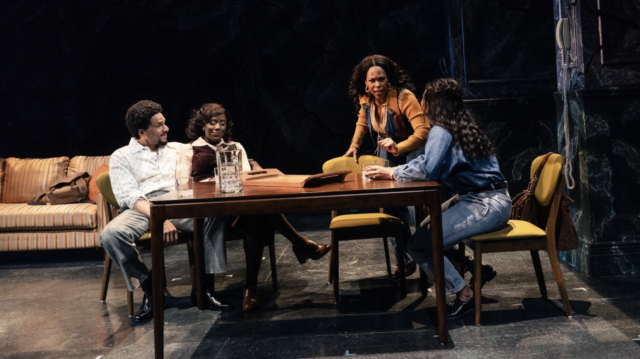
Two generations of a family of aquatic activists fight for their rights in Christina Anderson memory play (photo by Marc J. Franklin)
Tony nominee Anderson’s (How to Catch Creation, pen/man/ship) the ripple . . . is a moving story of the complicated weight of water, a beautifully acted memory play in which water, which makes up sixty percent of the human body, is used as a device to explore issues of racism. In a program note, Anderson admits that she can’t swim; she didn’t feel the need to learn because, as a child, she “didn’t consistently see or know anyone who looked like me playing or swimming safely in the water. . . . For this play, I was inspired by the spiritual, essential, poetic power of water and the characters’ relationship with it.” That extends to Lawrence E. Moten III’s set, which evokes the inside of a marble pool, with Lap Chi Chu’s lighting occasionally adding shimmers throughout the theater, as if we’re being immersed in small, rippling waves.
Obie-winning director Tiffany Nichole Greene (Covenant, Ohio State Murders) navigates through occasional choppy waters and long patches of exposition, as some scenes don’t flow smoothly together. Bowers (Chicken and Biscuits, Cold War Choir Practice) portrays Janice with sophisticated layers and complex motivations that don’t always endear her to the audience. Marinda Anderson (Yellow Face, Merry Me) is a hoot as Gayle and Young Chipper Ambitious Black Woman, Tony nominee Lucas-Perry (The Great Privation, Pericles) provides balance as Helen, and Eisen-Martin (Table 17, soft) is steadfast as Edwin.
“Water literally slips between our fingers,” Janice says. “Why do I need it? Why should I want it?”
Because water is life. Because water holds memory. Because water washes away pain. Because water can carry you home.
[Mark Rifkin is a Brooklyn-born, Manhattan-based writer; you can follow him on Substack here.]