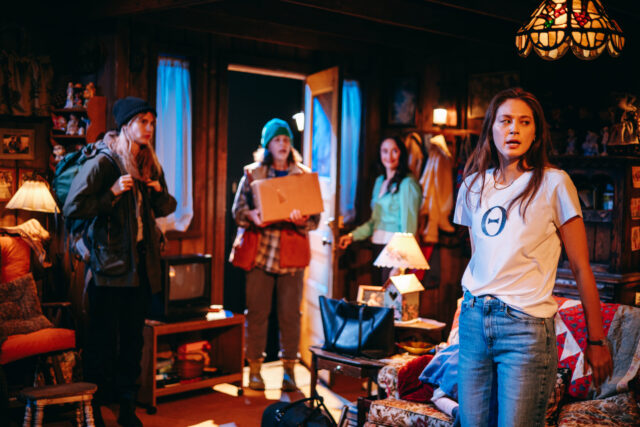
Jen Diamond’s The Morbs is set in a cabin in the woods during an infection outbreak (photo by Geve Penn)
THE MORBS
A.R.T./New York Theatre
Jeffrey and Paula Gural Theatre
502 West Fifty-Third St. between Tenth & Eleventh Aves.
Monday – Saturday through November 21, $31.75-$62.75
eggandspoontheatre.org
art-newyork.org
Jen Diamond’s The Morbs is billed as a cabin-in-the-woods comedy-thriller, but it is much more than that; it is a deeply touching and affecting story of female friendship amid the outbreak of a disease that forces people to reevaluate who they are and what their place in the world is.
In an indistinct time that feels like the present but with no smartphones — the script refers to it as “today, yesterday, or tomorrow” — three Theta sorority sisters are celebrating their fifth college reunion. Theta not only is the eighth letter of the Greek alphabet but also refers to the rate of decline of an option value as it approaches its expiration date, not unlike how human beings begin to decay at a certain time of life, starting at different ages and deteriorating at different paces.
Tatum (Emma Kikue), Trish (Rachel Ravel), and Wendy (Alexandra Templer) were at a reunion mixer when word came down that a man in Rhode Island had contracted the Morbs, an infection with no cure that leaves its victims either Hollow (empty inside but not a zombie) or Lethal (violently murderous). To get away, they hopped in Tatum’s Mercedes-Benz and drove through an oncoming snowstorm to her family’s cabin in the New Hampshire woods.
Tatum had lived there when she was younger, so it is filled with objects from her past as well as many memories. Her mother’s sister, Harriet (Jennifer Regan), a Hollow woman, stays up the hill, alone after her husband, Bill, went Lethal and ultimately died. She’s neither a zombie nor a simpleton; she basically just exists day by day, completing her tasks but with no emotion, no cares or woes.
Mimicking Covid, particularly at the beginning of the pandemic, there is controversy over how the disease spreads; Trish points out, “Our Council still thinks you can get the Morbs through the phone lines, sewers, photographs, dreams . . . stupid.” Meanwhile, Tatum is hoping it will be contained within a day or two. Of course, that’s not gonna happen.
Chris and Justin Swader’s kitchen / living room set is ripe for chills, overstuffed with photos, furniture, tchotchkes, and a general creepiness, highlighted by Tatum’s rather large ragdoll, Mary. On one side is a jukebox, on the other a tiny television that doesn’t get any channels but can play VCR tapes; the movie atop a small pile is Joseph Mazzuca’s 1976 not-quite-cult-classic, Sisters of Death, which features the tagline “An invitation to six beautiful women . . . for a deadly sorority reunion.” To up the ante, there is no bathroom in the cabin; instead, there is an outhouse near the water pump, meaning that the three young women are occasionally going to have to step into possible danger.
Tatum, described in the script as “a rich bitch,” has faith that her multimillionaire father, who has made tons of money off the Morbs, will be able to save the three of them by paying off guards at checkpoints so that she and her father can wait everything out in Aspen. Trish is a smart, sensible married mother of a two-year-old; this is the first time she’s been apart from her daughter and worries that “my mom friends in my mom group are gonna judge me so hard for this.” A high-powered professional, she also has a major deal to negotiate the next day. Wendy, who stuffed her backpack with cans of soup, seems to be in the middle of a personal crisis, living by herself and possibly jobless.
Wendy and Tatum were very close in college, but they have not been in touch much since then; Tatum is surprised that Wendy even came to the reunion, and now she is concerned about her mental health.
“Like, this whole trip she’s been so weird, right? Acting like a fucking stranger. It’s like, I’m here for you. I want to help — just let me,” Tatum tells Trish, who responds, “Our little hermit.”
As the days pass, things get only weirder and stranger, in wickedly delicious ways.
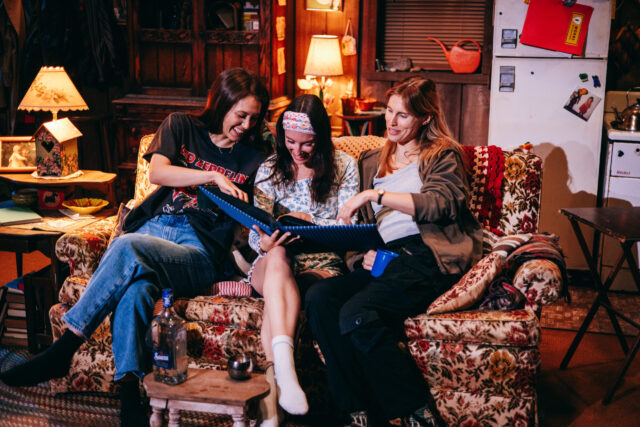
Tatum (Emma Kikue), Trish (Rachel Ravel), and Wendy (Alexandra Templer) look back at the past while facing an uncertain future in The Morbs (photo by Geve Penn)
Named after the Victorian-era slang for temporarily feeling depressed or melancholy, The Morbs is about a lot more than three women trapped in a cabin in the woods, facing a possible apocalypse.
Soon after the three Theta sisters arrived in the cabin, Wendy had them all do a Commitment. “I swear I am Whole, to the best of my knowledge. I carry no infection, nor suspect I was exposed. I am making a Commitment to myself and to society. I am making a Commitment to humanity itself,” they recite in tandem. “This Commitment’s not a burden, but a sacred contribution. This commitment’s not a sin, but a gift to those I love. If I am infected, I will give my life to protect the others. If others are infected, I will take their lives with love and grace.”
It’s a promise to maintain the social order, to take a stake in the world, to help when necessary, even in the extreme. It’s also a promise to be strong women; there are no men in the cast, and the only ones mentioned are either sick, dead, greedy, or not what they appear to be.
The play is anchored by an unforgettable scene in which Tatum, Trish, and Wendy get a little tipsy and start dancing wildly to the Cranberries’ 1992 hit “Dreams” from the album Everybody Else Is Doing It, So Why Can’t We?; it’s absolutely exhilarating, a moment of pure freedom as lead singer Dolores O’Riordan sings, “Oh, my life is changing every day / In every possible way / And oh, my dreams / It’s never quite as it seems / Never quite as it seems . . . / I want more, impossible to ignore / Impossible to ignore / And they’ll come true / Impossible not to do / Possible not to do.” (O’Riordan died in 2018 at the age of forty-six from drowning by intoxication in a London hotel room.)
Diamond (Someone Buried Polynices, Porn: A Love Story) and director Lily Kanter Riopelle (The Slow Dance, The Collision and What Came After, or, GUNCH!) slyly play with genre tropes, enhanced by Paige Seber’s eerie lighting and Brandon Bulls’s ominous sound, which ranges from the the whistling wind and snowstorm outside to the music from the jukebox. There are a few curious choices; for example, the jukebox is sometimes on in the background, but it’s so low the audience, and maybe the characters as well, can’t really hear it. When the women come back in from the outside, there is never any snow on them. And it’s unclear why Trish doesn’t ask Tatum to have her father’s assistant try to contact Trish’s husband to let him know where she is. But those minor missteps do not detract from the overall strength of the play.
Kikue (Disruption, God Said This), Ravel (benevolent, Fiddler on the Roof), and Templer (Entangled, The Strangers Came Today) are electrifying as the three sorority sisters, who, in college, had their whole lives in front of them but have already, in a mere five years, learned a lot more about the real world. Regan (The Wind and the Rain: A story about Sunny’s Bar, Who’s Afraid of Virginia Woolf) is heartbreaking as Harriet, a woman robbed of her personality and individuality. The disease she has is not the equivalent of Alzheimer’s, but it’s similar, and something that terrifies the three younger women.
About halfway through the play, Harriet shows Wendy what’s inside her memory box. “Memories. Memory box. Lotta things in here. Things from me. Things from dead people,” she says. “Bill. Lynn. Lotta papers. Lotta old tapes. My old dad. Uncle Rob. The Dog.”
The Morbs is steeped in memories, those that haunt us, those that delight us, those that we’ve forgotten, and those that we hopefully still have time to make.
[Mark Rifkin is a Brooklyn-born, Manhattan-based writer; you can follow him on Substack here.]