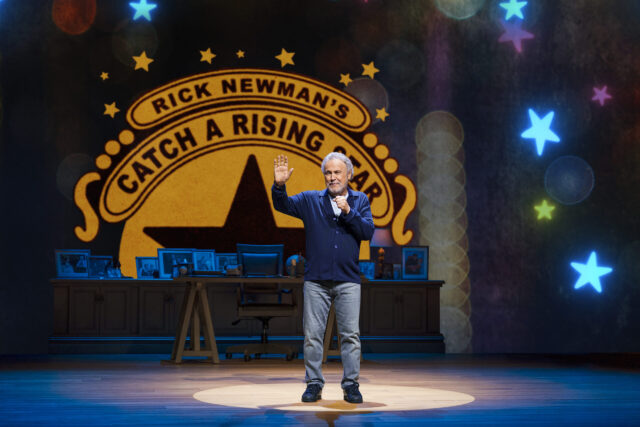
Billy Crystal shares intimate stories of his life and career in 860 (photo by Avery Brunkus)
860
Imperial Theatre
249 West 45th St. between Broadway & Eighth Ave.
Tuesday – Sunday through February 14, $84-$499
billycrystal860.com
At first glance, it would seem that Billy Crystal’s 860 and Mona Pirnot’s I Became We could not be more different. The former is a solo performance written by and starring one of the most popular American entertainers of his generation, a Jewish comedian from Long Island, in a one-hundred-minute multimedia production with an exquisite set, playing to sold-out houses of approximately 1,450 seats on Broadway through February 14. The latter is written by a rising playwright from Sarasota, Florida, who put on original Christmas plays as a child and whose latest work is a seventy-minute relatively sleek and streamlined production featuring a choir of sixteen robed singers standing on risers, with a conductor and a pianist, running through November 22 in a Gothic Revival building that used to be an Episcopal church, to no more than 199 people.
But they are strikingly similar, two hilarious, profoundly moving, and intimate first-person true monologues about home and family.
Billy Crystal won a special Tony Award for his 2004 Broadway debut, 700 Sundays, recounting the too-short time he spent with his father, jazz buff Jack Crystal, who died in 1963 when Billy was fifteen. The play was revived in 2013–14 at the Imperial and filmed for HBO. Crystal returned to Broadway in 2022 with Mr. Saturday Night, a musical adaptation of his 1992 film, earning Tony nominations for Best Actor and Best Book.
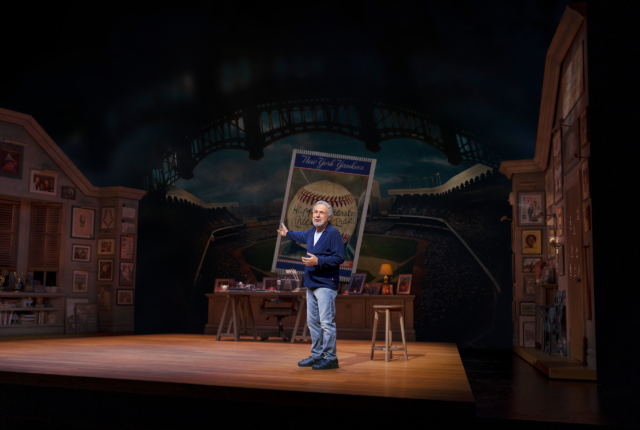
Billy Crystal’s 860 takes place in a re-creation of his home office in Pacific Palisades (photo by Avery Brunkus)
He’s now back at the Imperial with 860, named after the address of his house at 860 Chautauqua Blvd. in Pacific Palisades, California, which burned to the ground during the January 2025 wildfires. Crystal uses the tragic event as a frame to look back at the building of his career and his relationship with Janice Goldfinger; the two met when they were teenagers, married in 1970, and have two daughters, Jennifer and Lindsay, who he calls “my little deductions” as a family Chanukah video is projected on the back wall. The set, by Scott Pask, is a re-creation of his office at 860, featuring a long desk, photos of him with family and famous celebrities, and treasured keepsakes, a room he refers to as “my sanctuary.”
He talks about college (“I majored in film directing at NYU School of the Arts — it had not yet been Tisched.”), his early days in comedy clubs (particularly Catch a Rising Star, where he met Richard Lewis, Andy Kaufman, Freddie Prinze, Richard Belzer, Elaine Boosler, Jimmy JJ Walker, Jay Leno, and others); his first paid gig, opening for Blood, Sweat & Tears in Scranton (which became a turning point in his approach to his craft as well as an unforgettable story in itself because of the bizarre antics of BSW lead singer David Clayton Thomas); his days on Soap and Saturday Night Live; making such films as When Harry Met Sally, The Princess Bride, and City Slickers; his dedication to the national pastime; and his long friendships with Muhammad Ali, Rob Reiner, Robin Williams, and Mickey Mantle. He regularly tosses in political bon mots, such as this one about the Vietnam draft, which is another powerful scene in the show: “I didn’t dodge the draft, the draft dodged me, not like those cowardly rich bastards who would pay off a podiatrist to lie that his son has crippling bone spurs in both feet and can barely walk.” Sure, it’s an easy, safe target for his audience and is probably not necessary, but you can never laugh too much.
But Crystal always circles back to his beloved house, from the naches he and Janice experienced when they first laid eyes on it to how it immediately was family itself. “Over the years, the house became part of us, growing and aging with us . . . literally. Every inch of 860 was something Janice and I added,” he says as video of a fancy Japanese toilet appears. “And the best thing . . . it’s heated. And not by the person who sat there before me.” The show is a technical triumph, with projections by Hana S. Kim and Kylee Loera, lighting by Jen Schriever, sound by Dan Moses Schreier, and original music and adaptations by Marc Shaiman; we are not merely watching Crystal deliver a stand-up routine.
He also shares some extraordinary coincidences about the house, including that among the previous residents were the Usher sisters, who now lived next door, leading Crystal to christen it the House of Usher, which also had an unfortunate end. “Was it luck that we found this house? Or is it fate?” he asks.
Crystal, who has won Emmys for hosting the Oscars and the Grammys, is, well, mahvelous as he sweeps across his life, in both celebratory and self-deprecating ways, understanding how fortunate he has been, though he worked hard for everything he has achieved. Director Scott Ellis, who helmed the 2022 revival of the baseball-set play Take Me Out, keeps it all flowing smoothly as Crystal steps up to the plate again and again, smacking singles, doubles, triples, and plenty of homers. The concluding scenes are heartbreaking as the family returns to the house after the fires, but Billy, Janice, Jennifer, and Lindsay continue to try to find the bright side amid such horrific destruction.
I am generally not a crier, but I had tears in my eyes, from laughing and weeping, as Crystal proves himself yet again to be an American treasure, revealing an infectious love of life in all its pain and joy.
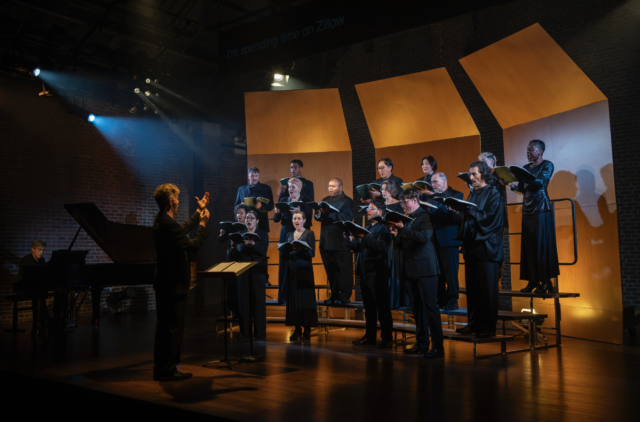
A sixteen-person classical choir portrays playwright Mona Pirnot in I Became We (photo by Ahron R. Foster)
I BECAME WE
Atlantic Theater Company
Linda Gross Theater
336 West 20th St. between Eighth & Ninth Aves.
Tuesday – Sunday through November 22, $25-$131.50
atlantictheater.org
Mona Pirnot’s three most recent plays have been intriguing twists on the conventional solo monologue presentation, employing what she has called “avatars and theatrical ventriloquism.”
In 2024’s I Love You So Much I Could Die at the 199-seat New York Theatre Workshop, Pirnot sat at a desk on a sparse stage, her back to the audience as a Microsoft text-to-speech tool, a disembodied male AI voice, read her deeply personal story, interspersed with five songs she sang on acoustic guitar, without ever turning around.
In 2025’s I’m Assuming You Know David Greenspan at the Atlantic’s 99-seat Stage 2, downtown legend David Greenspan portrayed four women playwrights, including a version of Mona herself, as they contemplate the lousy financial prospects of independent theater versus making big bucks in television; as my friend and colleague Loren Noveck so eloquently wrote about it in exeunt, “Mona . . . is not a true representation of the playwright of the play for which we have all shown up and suspended our disbelief, according to the prologue delivered from the playwright’s POV as a narrator one step closer to herself. . . . You wouldn’t go if you didn’t want to see the endless hall of mirrors that is theatrical polymath Greenspan playing himself playing Mona Pirnot playing four playwrights, one of whom also is and is not Mona Pirnot.”
And now comes the sensational I Became We at the Atlantic’s 199-seat Linda R. Gross Theater, in which Pirnot is played by an exquisite sixteen-voice classical choir, accompanied by Blair McMillen on piano and conducted by Jack D. Coen, who wrote the music and cowrote the lyrics with Pirnot. The intimate subject of the narrative originated after Pirnot watched a segment on Jimmy Kimmel Live! called “What Do You Know About the Female Body?” in which a woman asked men on the street questions about the female reproductive system. (In another convergence between Pirnot and Billy Crystal, the latter appeared on Kimmel on September 30 to promote 860.)
Lovingly directed by Obie winner Sarah Benson (The Welkin, Fairview), the show begins with the choir singing about the sketch, explaining, “I was laughing and not at all surprised by / What was unknown to these full grown children. / I mean it’s only the creator of their lives / yet / What do they know about the / They don’t know shit about the / They don’t think twice about the female body.”
The chronicle then focuses on how Pirnot and her husband, the extremely successful Obie-winning playwright and director Lucas Hnath, attend a backyard barbecue in Brooklyn, and they’re the only couple there without children. The choir sings, “Good thing I never wanted children. / Good thing I never wanted children. / Good thing my husband doesn’t either. / Good thing my husband feels the same. / Good thing we’ve always been so sure that we don’t want kids. / And that / will / never / change.” Soon Pirnot and Hnath are reconsidering several choices they’ve made regarding home and family in both poignant and hilarious ways.
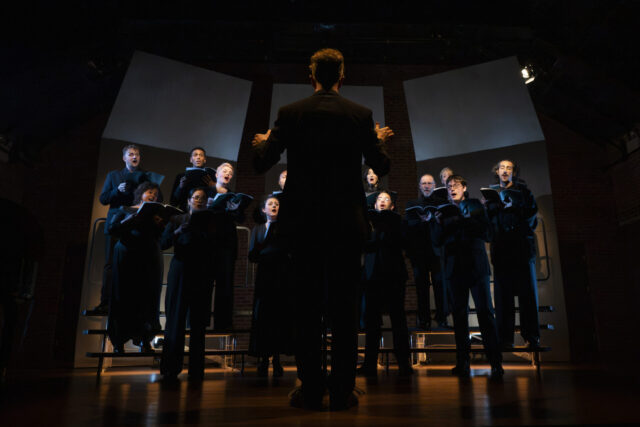
Jack D. Coen, seen here with his back to the audience, serves as conductor, musical director, orchestrator, arranger, and co-lyricist of I Became We (photo by Ahron R. Foster)
The extremely successful Hnath has written such highly praised works as A Doll’s House, Part 2 and The Thin Place as well as the solo shows A Simulacrum, starring actor, magician, and illusion designer Steve Cuiffo and which Hnath also directed and appears in as a prerecorded voice, and Dana H., a true story told via Deirdre O’Connell sitting in a chair and lip-syncing to a recording of Hnath’s mother describing her kidnapping. In addition, Hnath directed I Love You So Much I Could Die.
So Pirnot and Hnath are used to putting their lives out there for people to see, and Pirnot digs deep in I Became We, sharing stories about crying at the Adam Sandler movie Click and her mother retiring to Bolzano. The choir explains, “Look around at what you have. Look at where you are. / You have hit the sweetest spot, in demand but independent, you have come so far. / Interest but no pressure in what comes next from you / You’re wanted by so many people, needed by so few.” As they grow older — Pirnot is thirty-five, Hnath forty-seven — she feels like something is missing from their lives and that they still have time to make important decisions that will impact their future.
In the play, Pirnot calls her mother “a genius.” Well, so is Pirnot. I Became We is a wonderfully touching, beautiful evocation of life and art and the choices we have to confront, particularly women but their partners too, even if they don’t know how many eggs a woman is born with or where the cervix is. (Pirnot admits that she didn’t know the answers to all of Kimmel’s questions either.)
The choir, standing on risers and wearing dark robes, is magnificent, singing in unison and breaking out into a few solos, with lyrical details that will often have you roaring with laughter and nodding in understanding. (It’s worth celebrating each member the night I attended: Alison Cheeseman, Nathan Fletcher, Mark Hanke, Oliver Holt, Heather Jones, Helen Karloski, Kathryn McCreary, Neil Netherly, Lily Hazel Nussbaum, Logan Pitts, Carrie Quarquesso, AnnMarie Sandy, Michael Steinberger, Gregório Taniguchi, Tyler Tejada, Elizabeth van Os, and Zen Wu, with set by Mimi Lien, costumes by Louisa Thompson, lighting by Tuce Yasak, and sound by Palmer Hefferen.) Coen also does a glorious job as musical director, orchestrator, and arranger.
Pirnot is a fascinating writer; like Billy Crystal, she is not shy about sharing her personal and professional thoughts and feelings about home and family, but in her case she hides her face or entire body from view, finding new ways to create heartwarming, entertaining, moving, and unusual theatrical experiences.
At several points in I Became We she laments constantly being asked, “What’s next??”
I won’t pose that question to her, but I can’t wait to see where she and Crystal take us, well, next.
[Mark Rifkin is a Brooklyn-born, Manhattan-based writer; you can follow him on Substack here.]