
Lauren Yee’s semiautobiographical King of the Yees is set in San Francisco’s Chinatown (photo by HanJie Chow)
KING OF THE YEES
The Pershing Square Signature Center
The Alice Griffin Jewel Box Theatre
480 West 42nd St. between Tenth & Eleventh Aves.
Tuesday – Sunday through November 22, $56-$167
signaturetheatre.org
A disappointing play is like an unsatisfying meal. While it’s possible that the appetizer, entrée, or dessert may be pleasing, it’s frustrating when you planned a big night out but the experience as a whole did not live up to your expectations, even more so if it was a costly evening. Lauren Yee’s semiautobiographical King of the Yees is one of several current productions that were promising but in the end didn’t cut the mustard.
I’ve seen four of Yee’s plays, and each of them had an intriguing premise that drew me in. The Great Leap delves into the intersection of sports and politics, inspired by her father’s real-life involvement in a 1980s “friendship game” between America and China. Cambodian Rock Band, was inspired by the true story of the California band Dengue Fever and math teacher turned brutal Khmer Rouge prison head Kang Kek Iew. Mother Russia explores Russia’s conversion to capitalism following the 1991 collapse of the Soviet Union. Each got off to a good start before veering off into fantastical situations that didn’t hold up, though Mother Russia fared the best.
King of the Yees, continuing at the Signature through November 22, has a tempting amuse-bouche and appetizer, but the main course heads off into strange tangents that had me scratching my head in disbelief, only exacerbated by the awkward dessert. The story takes place in San Francisco’s Chinatown, where one actor (Maureen Sebastian) playing Lauren Yee and another portraying her father, Larry Yee (David Shih), introduce the audience to the Yee Fung Toy Family Association. The “real” Larry (Tony winner Francis Jue) walks onto the set, on his phone, explaining, “I can’t talk right now. I’m in Lauren’s play. Lauren’s play!” Then the “real” Lauren (Kelly Marie Tran) stops the action, and father and daughter have a personal discussion focused on Lauren’s having moved to Germany with her husband and, eventually, whether she is Chinese enough. Soon Larry gets caught up in a political scandal and goes missing, leading Lauren to investigate her roots.
I loved the opening, was all-in, but Yee and director Joshua Kahan Brody get lost in tangents, inexplicable subplots, and cultural overkill as they bring up such issues as identity, assimilation, and the importance of one’s name. There is occasional magic — for example, the scene with the model ancestor (Jon Norman Schneider) — but not nearly enough. There’s a potent story in there, as well as a terrific cast, but it disappears in the curious, excess confusion.
On his phone, Larry says about the play, “How is it? Eh, you know.”
I know.
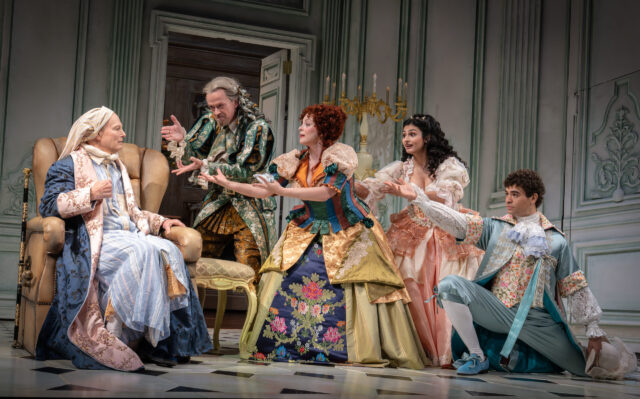
Bill Irwin adapted and stars in Broadway revival of Molière’s The Imaginary Invalid (photo by Joan Marcus)
THE IMAGINARY INVALID
Todd Haimes Theatre
227 West Forty-Second St. between Broadway & Eighth Ave.
Tuesday – Sunday through November 22, $65-$180
roundabouttheatre.org
Molière has been undergoing a kind of renaissance lately; in the past two years, there have been two productions of Tartuffe, Symphony Space hosted a screening last month of the National Theatre production of The Misanthrope, Molière in the Park presented The Miser at L’Alliance and Don Juan in Prospect Park, and now we have the third revival of the French playwright’s final show, the 1673 farce The Imaginary Invalid, previously staged by Molière in the Park and Red Bull in 2025.
The first major Broadway revival since 1917, this iteration of The Imaginary Invalid is adapted by and stars America’s master clown, Tony winner Bill Irwin, who previously adapted Molière’s Les Fourberies de Scapin. Directed by Brandon J. Dirden, the show gets off to a magical beginning and has a fanciful conclusion, but everything in between is hit or miss as Irwin decries the state of health care in twenty-first-century America, particularly affordability and charlatans.
Irwin is Argan, a wealthy hypochondriac who is dependent on doctors to inject him, bleed him, and have him take enema after enema after enema after enema after enema. His duplicitous second wife, Beline (Crystal A. Dickinson), can’t wait for him to die so she can live in luxury with her lover, the notary Bonnefoy (Hiram Delgado). Argan is planning on marrying off his daughter, Angelique (Ava Lalezarzadeh), to Thomas (Delgado), the inept son of one of Argan’s doctors, Diafoirus (Brooks Ashmanskas), but Angelique is in love with the none-too-swift Cleante (Daniel Croix Henderson). Watching it all unfold with delight is Argan’s endlessly clever maid, Toinette (Rachel Bloom). Later they are joined by Argan’s brother, Beralde (Dylan Baker), who wants to get rid of the nonsense emanating from his sibling.
In my review of Red Bull’s production, I wrote, “If I never hear another word about buttocks and enemas, it will be too soon.” For me, this Imaginary Invalid is too soon. As much as I adore Irwin, too many of the gags are repetitive or miss their target, and the modern-day references grow tiresome. One of the best moments in the play occurs when Irwin goes for a third try at a very funny joke involving his chair but is talked out of it because we’ve already seen it twice; that advice might have helped in other scenes as well.
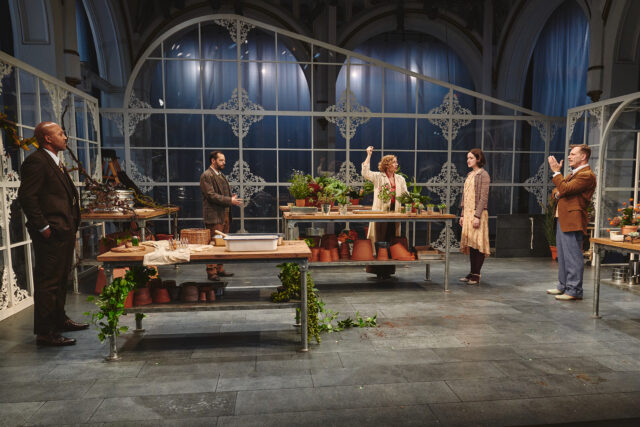
Miriam Silverman (center) is electric in The Verge (photo by Valerie Terranova)
THE VERGE
LuEsther Hall, the Public Theater
425 Lafayette St. at Astor Pl.
Tuesday – Sunday through November 29, $99
publictheater.org
Fiasco is one of my favorite theater companies. I’ve marveled their stagings of such plays as Shakespeare’s Pericles and The Two Gentlemen of Verona, Francis Beaumont’s The Knight of the Burning Pestle (with Red Bull), and Stephen Sondheim and James Lapine’s Into the Woods, so I was looking forward to their collaboration with the Public Theater for their revival of the little-known play The Verge, a tale of love, madness, and botany written by the somewhat forgotten Pulitzer Prize winner and Provincetown Playhouse founder Susan Glaspell.
Miriam Silverman is electric as Claire, a complicated, deeply intelligent, intriguing scientist who is attempting to add fragrance to the Breath of Life plant, a metaphor for how she approaches her daily existence. She lives with her stuffed-shirt second husband, aviator Harry Archer (Noah Brody), and they are currently being visited by Dick Demming (Devin E. Haqq), whom Claire has apparently had an affair with, and Tom Edgeworthy (Paco Tolson), whom she flirts with. Yes, the trio is Tom, Dick, and Harry, three ordinary men undeserving of the remarkable, and brutally honest, Claire. She also has a strange relationship with her daughter, Elizabeth (Amara Leonard); once Elizabeth became an adult, Claire considered herself done with her. Also on hand are Claire’s loyal assistant, Anthony (Paul L. Coffey), Claire’s sister, Adalaide (Emily Young), and the family maid (Young).
The first half of the play works splendidly as the characters traipse about the greenhouse (much to Claire’s consternation) and discuss birth, eggs, motherhood, the buddha, salt, heat, refinement, smoking, and how Claire treats her plants better than she does her friends and relatives. “I want to give fragrance to Breath of Life — the flower I’ve created that is outside what flowers have been. What has gone out should bring fragrance from what it has left. But no definite fragrance, no limiting enclosing thing,” Claire says. “I call the fragrance I am trying to create — Reminiscence. Reminiscent of the rose, the violet, arbutus — but a new thing — itself. Breath of Life may be lonely out in what hasn’t been. Perhaps some day I can give it reminiscence.”
The “enclosing thing” is a key aspect of the play, which is filled with doors opening and closing and being locked and unlocked, separating the inside from the outside in multiple ways that echo how people shut others out or let them in. Claire speaks in a captivating Shakespearean grandeur with a tinge of Oscar Wilde, an independent-minded woman who is not shy about saying what she thinks, regardless of the possible consequences. But then, in the second act, there is a scene that turns everything around, robs Claire of her individuality and uniqueness, and goes against everything that had been built up earlier. In addition, the greenhouse has been awkwardly transformed into an attic where characters have to walk under a ladder to get upstairs to a platform.
What had been an engaging journey of an extraordinary woman becomes a Hallmark melodrama, sucking all the breath out of it.
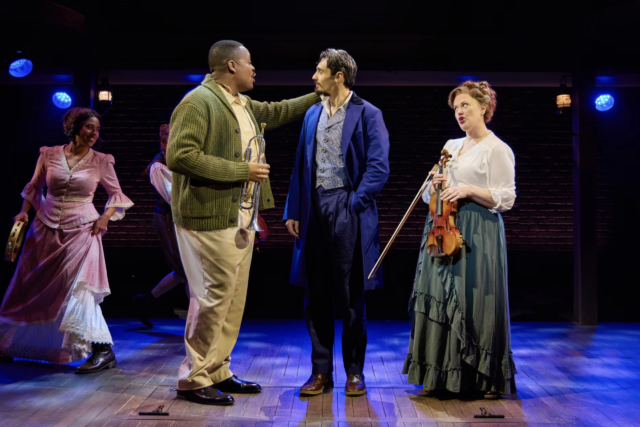
Copperfield! The New Musical features a multipurpose ensemble re-creating Dickens masterpiece (photo by Jeremy Daniel)
COPPERFIELD! THE NEW MUSICAL
The Duke on 42nd Street
229 West Forty-Second St. between Seventh & Eighth Aves.
Wednesday – Monday through December 6, $59-$99
copperfieldthemusical.com
When I was a kid, I was obsessed with George Cukor’s 1935 adaptation of Charles Dickens’s 1850 autobiographical bildungsroman, David Copperfield, in which Freddie Bartholomew portrayed the title character, who experiences a series of traumatic hardships as he goes through life. So I was looking forward to Jeffrey Scharf’s new musical version, directed and choreographed by Gabriel Barre at the Duke on 42nd Street. Alas, there is no magic to be found in Copperfield!
“Whether I shall turn out to be the hero of my own life, or whether that station will be held by anybody else, these pages must show,” David, played as a child by Calvin Knegten or Henry Witcher (I saw the former) and as an adult by Bobby Conte (Company, The Who’s Tommy), says at the outset. There are plenty of villains to be found, but as far as heroes go. . . .
The adult David is onstage for all two and a half hours (except intermission), either watching the proceedings and interacting with his younger self or being the center of attention later. All the other characters are played by the eleven-piece band, who take on multiple roles, including his mother, Clara; his stepfather, Edward Murdstone; the family servant, Clara Peggotty, her brother, Daniel, their niece, Em’ly, and their nephew, Ham; creaky headmaster Mr. Creakle; the sturdy James Steerforth; the friendly Micawbers; the wicked Uriah Heep; and the Wickfields, whose daughter, Agnes, is close to David. Nearly every one of them is turned into a cliché; by throwing so much into the mix instead of streamlining the extensive plot, Scharf and Barre are unable to fully develop the characters, most of whom the audience don’t care enough about.
There is no sense of a timeline and little chemistry among the performers as they trudge through songs with music that rarely evokes the Victorian Era. The night I went, there were numerous empty seats, and there was usually only tepid applause — if any — after several of the musical numbers.
It just doesn’t feel like David Copperfield in the slightest.
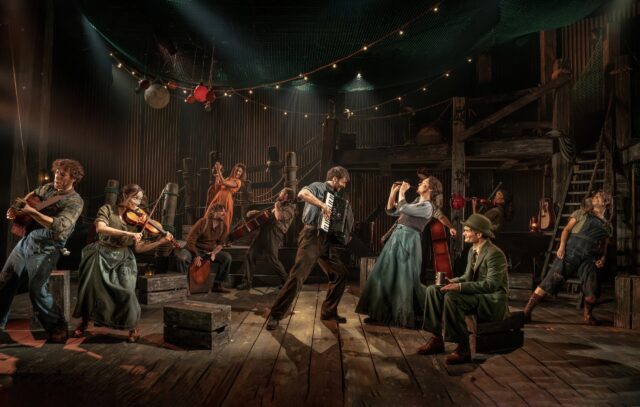
The Curious Case of Benjamin Button is a rousing production at the Public Theater (photo by Joan Marcus)
THE CURIOUS CASE OF BENJAMIN BUTTON
LuEsther Hall, the Public Theater
425 Lafayette St. at Astor Pl.
Tuesday – Sunday through December 20, $149
publictheater.org
Like Copperfield! The New Musical, Jethro Compton and Darren Clark’s The Curious Case of Benjamin Button is about searching for home as the protagonist goes on a series of adventures, some seafaring, with all the other characters portrayed by a ten-piece band. But also like Copperfield, it never finds its own home.
Based on the 1922 F. Scott Fitzgerald short story, which was turned into a hit 2008 David Fincher film starring Brad Pitt, Benjamin Button is a rousing yet utterly confounding conundrum; the production is fabulous, as are the performers. Compton’s dilapidated wooden harbor set is inviting. The music is an intoxicating mix of Celtic folk ballads, sea chanteys, and drinking songs. Andrew Durand, on quite a roll with Shucked, Dead Outlaw, and Rocky Horror, is a fine Benjamin Button, who falls in love with barmaid Elowen Keene, beautifully played by Kelsee Kimmel. He is born as a seventy-year-old man, complete with full suit, top hat, cane, and knowledge of the world. However, it is soon realized that he is aging backward, something that he at first does not admit to the devoted Elowen or anyone else.
The show explores the tides and the moon, love and family, and, primarily, time, but the plot line makes no sense, filled with (port)holes that only get bigger as the musical moves on while repeating itself again and again (and again). It has so much going for it that I started to get aggressively angry at it for not taking advantage of its numerous strengths as it spread itself too thin, wandering into scenes that couldn’t stand on their own or as part of the overall narrative. This Button is still in need of significant tailoring.
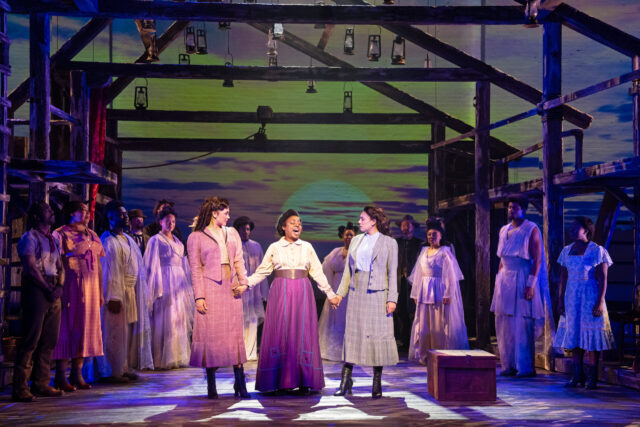
Wanted tells the mostly true story of Black twin sister outlaws in 1893 Texas (photo by Julieta Cervantes)
WANTED
James Earl Jones Theatre
138 West Forty-Eighth St. between Sixth & Seventh Aves.
Tuesday – Sunday through March 31, $59-$349
wantedmusical.com
I truly wanted to love Wanted. A mostly true story about Mary and Martha Clarke, Black twin sister outlaws passing for white on a rampage through 1893 Texas, on a mission of revenge, retribution, and reparations? Yee-hah!
Be careful what you wish for.
Featuring music by Ross Baum and book and lyrics by Angelica Chéri, the great-grandniece of the Clarke twins, Wanted follows the trials and tribulations of Mary (Solea Pfeiffer) and Martha (Liisi LaFontaine), who pick cotton on a Texas plantation owned by the racist Mr. Billingsley (Nathan Quay Thomas) as their mother, Tallulah (usually Ledisi, but I saw Jennie Harney-Fleming), does washing and cleaning. When Billingsley refuses to sell land to the Clarkes, who have saved enough to rise out of generations of slavery and poverty, and instead sends them deeper into debt, Mary and Martha arm themselves and head out to get the money necessary to protect their mother. Gaining fame along the way, they eventually meet up with the wealthy Jesse (Bradley Jaden), who falls for Mary, while one of Jesse’s employees, Elijah (Luke James), takes a liking to Martha.
Directed by Tony nominee and Obie winner Stevie Walker-Webb, Wanted gets off to a thrilling start, led by a glorious six-piece Gospel choir (Melody A. Betts, Aaron Arnell Harrington, Harney-Fleming, Rayshun LaMarr, Hailey Thomas, Harris Matthew) that serves as a high-spirited Greek chorus. But it unravels quickly, especially in the second act, amid gaping plot holes, a score that is all over the place (except the American West), inconsistent acting, and fizzling romantic elements that drain any energy and momentum that were building.
Aurelia Williams and Awa Sal Secka steal the show — without weapons — as a pair of hilarious gossiping maidservants, but that’s not enough to rescue everything else. Wanted ends up shooting far too many blanks, leaving us hungry for something else.
[Mark Rifkin is a Brooklyn-born, Manhattan-based writer; you can follow him on Substack here.]