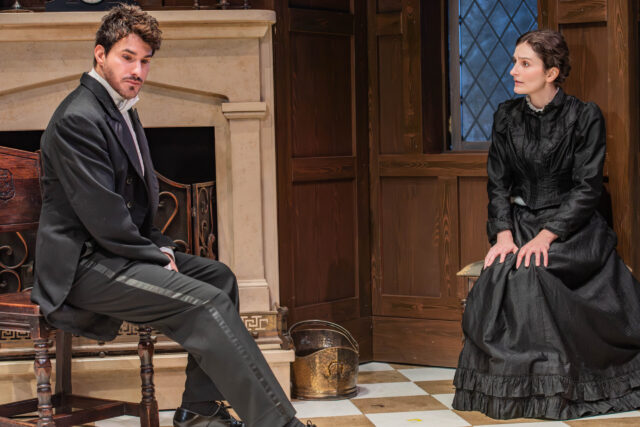
Jack (Anthony Michael Martinez) and Phyl (Lily Ganser) consider Edwardian morality in Cicely Hamilton’s Phyl (photo by Todd Cerveris)
PHYL
The Mint Theater at Theatre Row
410 West 42nd St. between Ninth & Tenth Aves.
Tuesday – Sunday through November 7, $79-$95
minttheater.org
theatrerow.org
Phyl is a shining example of what the Mint Theater does best: find a long-lost play and exquisitely bring it back to life on a gorgeous set with lovely period costumes and a fine acting ensemble.
In 1913, London-born playwright, activist, journalist, actress, suffragist, and feminist Cicely Hamilton was scheduled to premiere her latest play, Phyl, at Oxford. Despite having been approved by the Lord Chamberlain, it was banned by the vice chancellor because of its scandalous content. “It really does not matter. All those Oxford small boys can run up to London any time they like and see something much worse,” Hamilton said. “The vice chancellor is merely expressing his own opinion of the play. He does not like it, and he is supposed to be entitled to exercise his mediaeval privileges in keeping it out of his preserve. At Oxford as soon as you cease to be an Oxonian and show a sense of humor you are barred.”
The play was briefly staged in Brighton, Edinburgh, Manchester, and Chicago before disappearing for more than a century.
The Mint, which presented Hamilton’s Diana of Dobson’s in 2001, searched for Phyl, which had not been published; the company eventually found the Lord Chamberlain’s copy in the British Library.
Hamilton shows a sense of humor and more in the fancifully written play, which begins in a posh country house and moves to a luxury hotel in the second act. In her off-Broadway debut, Lily Ganser is enchanting as Phyllis “Phyl” Chester, an unhappy governess serving as a teacher to two spoiled brats, Betty (Tessa Blimes) and Olive (Charlotte Van Ledtje), who thrive on being mean to her. Their mother, Mrs. Ponsonby (Katie Firth), is a snooty, wealthy woman who treats Phyl with disdain. Mrs. Ponsonby is trying to make a match between rich, handsome bachelor Jack Folliott (Anthony Michael Martinez) and her daughter Mabel (Livvy Marcus), but Mabel has eyes for Captain Maloney.
After Phyl’s older sister, Cathy (Jennifer Blood), an ultraserious and dour office worker, pays a quick surprise visit, urging her to keep her job and put away some money, Jack comes down to say hello and make peace between Phyl and the young girls. The kids go to bed, and just as Phyl declares to Jack about her sister, “I want more! And I can’t have it. I’ve got to live as she does, and grow to what she is. I’ve got to —,” Mrs. Ponsonby enters, upset that Jack and Phyl are spending private time together. Jack leaves, and Mrs. Ponsonby coldly dismisses Phyl, but not before Phyl gets her say, scandalizing the older woman with her outspoken response.
Jack returns, apologizes for causing a problem, and sensually feeds Phyl some pudding as they come up with a plan to rid themselves of the Ponsonbys, which gets complicated almost immediately.

Phyl (Lily Ganser) and Jack (Anthony Michael Martinez) think about their future in recently rediscovered feminist play (photo by Todd Cerveris)
Phyl is a delightful romantic comedy that deals with class, manners, and gender stereotypes. “I am sick of the proper attitude,” Phyl proclaims near the end of the first act. The play evokes Henry James, Edith Wharton, and Downton Abbey while feeling fresh and alive in 2026. It follows in the footsteps of such other excellent female-centric Mint productions written by women as Elizabeth Baker’s Partnership, Hazel Ellis’s Women without Men, and Betty Smith’s Becomes a Woman, the last also splendidly directed by Britt Berke. In Phyl, Berke expertly guides the characters around Brittany Vasta’s elegant sets, from a dark and cramped downstairs room where a window blocks out the sun to a wide-open hotel suite with a balcony where life goes on in the street below, teasing and tantalizing Phyl.
Alicia J. Austin’s costumes are basically black and white in the first half, then bursting with color in the second as Phyl’s relationship with the outside world fills with potential. The mostly female crack crew also includes lighting by Mary Louise Geiger, sound by Jane Shaw, dramaturgy by Amy Stoller, and casting by Stephanie Klapper.
Throughout the show, Jack calls Phyl “little woman,” not realizing that it can be construed as being demeaning. But Phyl does not feel like a little woman as she slowly gains agency while learning how to assert herself and say what she wants, fully understanding the situation she is in. The plot threatens to approach Pretty Woman territory but cleverly sidesteps it.
Ganser (Stereophonic) commands the stage as Phyl, whether dressed in mournful black or colorful haute couture. She represents a kind of everywoman, both in Edwardian times and today. Martinez (Titus Andronicus) stirs things up as Jack, a gentleman of privilege who is more than just intrigued by Phyl.
Hamilton, a former teacher who never married, died in 1952 at the age of eighty, having penned more than thirty plays, novels, and travelogues, including the influential 1909 How the Vote Was Won, which ran on Broadway in 1910, as well as the lyrics to the 1910 protest song “The March of the Women.” She focused on women’s economic freedom (for example, in her 1909 book Marriage as a Trade), an issue at the heart of Phyl, which kicks off the Mint’s “Let’s Talk About Sex” season; next up is Miles Malleson’s The Fanatics in February.
I’m ready for more pudding; how about you?
[Mark Rifkin is a Brooklyn-born, Manhattan-based writer; you can follow him on Substack here.]