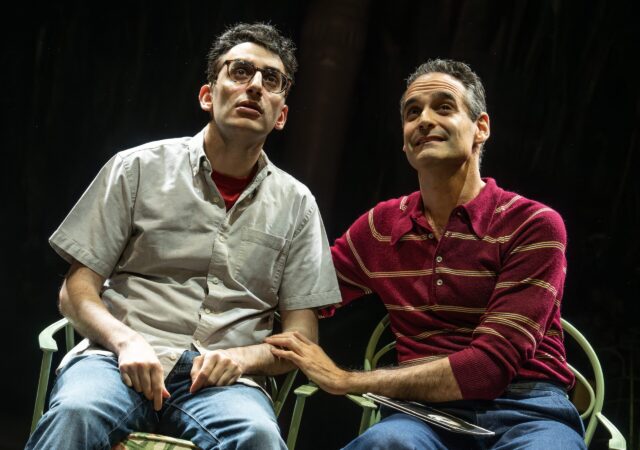
Ryan J. Haddad pays tribute to his beloved uncle in Good Time Charlie at the Public (photo by Joan Marcus)
GOOD TIME CHARLIE
The Public Theater, Martinson Hall
425 Lafayette St. by Astor Pl.
Tuesday – Sunday through October 25, $99
www.publictheater.org
Ryan J. Haddad has made his mark as the solo performer of such evocative, graphic, and compelling autobiographical shows as Dark Disabled Stories, Hold Me in the Water, and Hi, Are You Single? He reaches the next level with the evocative, graphic, and compelling Good Time Charlie, his first multicharacter, multigenerational play, one that offers audiences a damn good time.
Haddad is still at the center of it all, even though it’s about his real-life relation, Uncle Charlie (Jonathan Raviv), who actually is his father’s first cousin. At the beginning, Haddad says to us, “Hello, all you beautiful people out there in the dark. My name is Ryan J. Haddad. Thank you for coming out to the Public Theater and our production of Good Time Charlie. If you know my work, you probably know me as an autobiographical performer, usually a solo performer. But I’ve been putting my family in plays for decades. From the ages of five to thirteen, I was the artistic director of the Haddad Theater, and together with my family, we put on plays of my favorite movies and musicals. We started in the living room, then moved to the backyard.”
It’s a smart way to start the show; not only does it introduce Haddad to audience members who might not know much about him, but it also lets everyone see that he uses a metallic reverse posture-control walker; he later explains that he has cerebral palsy. The premise of Good Time Charlie is that Ryan is now putting on a play about and starring his family in an expensive re-creation of the Japanese-inspired garden at the home of Charlie and his longtime partner, Lou (Timothy Bagley). In addition, it sets up an ongoing subplot in which writer-actor Haddad battles for control with Charlie, who is not always fond of where Haddad takes the narrative.
Charlie: Remember, doll, it’s my play.
Ryan: Our play.
Charlie: They’re here to see me. My name is in the title.
Ryan: They don’t know who you are.
Charlie: They’re about to find out!
Throughout the 135-minute production (including intermission), there are constant interruptions in which the characters ask Ryan questions about their parts and suggest changes to the script, none of which makes Ryan happy. It’s a wonderfully multilayered meta as the actors portray characters portraying their younger selves, who remember certain things differently or don’t want to relive painful memories.
The deeply personal tale travels between 1976 and the present, with stops in 1976 Ohio, where Charlie is attending Heidelberg College, to 1983, when he meets Lou in a gay bar in Cleveland, to 1998, when Ryan is six and is staging his third show, an adaptation of the TV movie Cinderella starring Brandy. Ryan is the prince, of course; his cool lesbian aunt, Janice (Beth Malone), is Cinderella; his great-aunt Joan (Artemis Pebdani), Charlie’s mother, is the evil stepmother; and Charlie Sr. (Nael Nacer) is the king. Their repartee helps establish the characters’ relationship with one another as well as the pacing of Good Time Charlie itself.
Haddad introduces his own parents, Bob (Nacer) and Judy (Pebdani), when they all start arguing over who got Ryan interested in theater in the first place. Bob and Judy let their son know that they’re not thrilled that the play is not about them.
Bob: We’re the ones who clothed you, fed you, wiped your ass.
Janice: Hey, I did that, too.
Judy: It really is better to write about your parents before we die.
Bob: He can’t. He’s always writing about gay people.
Ryan furthers his love of theater and especially old movies under the tutelage of Sheldon (Michael Cristofer), the artistic director of a local repertory movie house and a close friend of Lou’s; they talk about Judy Garland, Bette Davis, Barbra Streisand, Tennessee Williams, and other gay icons.
There are also critical and insightful discussions about coming out, loneliness, and aging as several of the older characters fall ill.
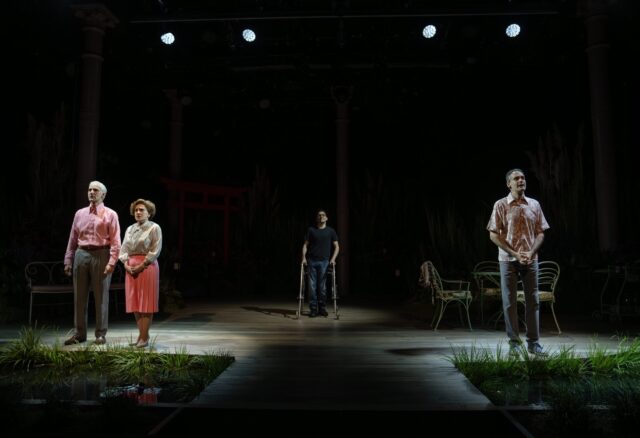
A terrific cast becomes a second family for Ryan J. Haddad in autobiographical play (photo by Joan Marcus)
The Lebanese American Haddad is a fierce storyteller, driven by a brutal honesty that is central to his shows. In Hold Me in the Water, his descriptions of his first sexual encounters with men are the most graphically specific I’ve heard in theater, whether gay or straight. In Hi, Are You Single?, he is so in need of companionship and closeness that he brings up a volunteer from the audience to dance with, despite a disability that requires him to keep his walker within arm’s reach at all times. And in Dark Disabled Stories, which focuses on his fraught relationship with public transportation, he tells the audience early on, “I try to make disability funny so that nondisabled people can understand it and open themselves to it and realize that it’s not so scary, so dark. And make it more accessible for them. Not tonight. I don’t feel like it. I’m not saying I won’t make you laugh at all. I’ll probably make you laugh a lot. I’m a naturally comedic person, but . . . not everything is accessible to us, so why should we try to make our experiences accessible to you?”
In Good Time Charlie, Haddad is not afraid to share his intense theatrical ambition. In one of the play’s most powerful scenes, Haddad gets angry when Charlie, who became a dentist instead of pursuing his artistic dreams, starts tearing pages out of the script. “Like it or not, this is the material we have. Either you want to play it or you don’t,” Ryan tells his beloved uncle, who replies, “Honey, I know what a good script looks like. I’ve been seeing theater my entire life.” Ryan shoots back, “And I’m the one who’s actually doing it.”
When one of the characters suffers a major health problem and needs a walker, the effect on Haddad is palpable. Yes, the person is more than twice Haddad’s age, but while the character moves painfully slowly, Haddad often puts his walker aside as he sits in chairs, dances with his aunt, and — well, I don’t want to give away the surprise, even though Haddad lets us know what’s coming. When he is without his walker, Haddad needs help standing, and the other actors/characters assist him, but Haddad is not seeking sympathy. He is just revealing what his everyday life is like.
Affectionately directed by Danny Sharron (Hold Me in the Water, Okay) on Afsoon Pajoufar’s lovely garden set (beautifully lit by Barbara Samuels, with expert sound and music by Ryan Gamblin), the play does veer toward sentiment and melodrama in the second act, but otherwise it is a triumph. The cast, in Enver Chakartash’s warm, occasionally flashy contemporary costumes, is so involved that they feel like members of your own extended family: Malone (Fun Home) is delightful as a gay woman who is completely comfortable with the choices she’s made, Cristofer (The Shadow Box) is endearing as the fair but firm friend, Nacer (Meet the Cartozians) and Pebdami (Wish You Were Here) find the right balance in portraying two very different sets of parents, Bagley (No Actors Allowed) is gentle as the man who often serves as mediator, and Raviv (The Bands Visit) is so believable as the title character that it’s hard to believe he’s not really Ryan’s uncle.
Nearly ten years in the making, Good Time Charlie is a love letter to the arts, to the people who are important to us, and to the Public Theater itself (through several funny inside jokes), where Haddad has found a second home.
[Mark Rifkin is a Brooklyn-born, Manhattan-based writer and editor; you can follow him on Substack here.]