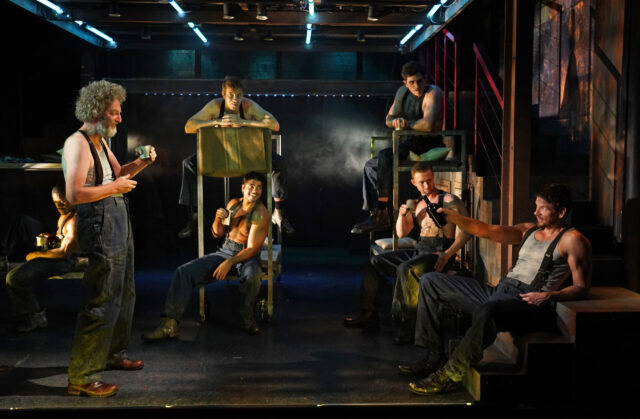
Seven stokers are trapped in a hellish existence in Irish Rep revival of Eugene O’Neill’s The Hairy Ape (photo by Carol Rosegg)
THE HAIRY APE
Irish Repertory Theatre, Francis J. Greenburger Mainstage
132 West 22nd St. between Sixth & Seventh Aves.
Wednesday – Sunday through November 15, $55-$125
irishrep.org
“It takes a man to work in hell,” Yank (Jon Beavers) declares early on in the Irish Rep’s new production of Eugene O’Neill’s 1922 drama, The Hairy Ape.
Previously presented there in 2006, the ninety-minute play, again helmed by company producing artistic director Ciarán O’Reilly, is a fierce examination of class warfare, with a scintillating first half that loses some of its steam as it descends into didacticism in the latter scenes, although its subtitle is as relevant as ever: A Comedy of Ancient and Modern Life in Eight Scenes.
The show opens in the firemen’s forecastle of a transatlantic liner, where seven men, their bodies covered in glistening sweat and black smears, sleep in bunk beds and shovel coal into furnaces to keep the ship running. They are led by Yank, the alpha male who is quick to berate the others, particularly when they fail to recognize the truth of their situation, animals trapped in cages. Several of the stokers ask Paddy (John Keating) to sing a drinking song, and the older man serenades them with “Whisky Johnny,” singing, “Whisky took away all my clothes / Whisky, Johnny! / Whisky gave me this big red nose! / Whisky for my Johnny O!”
Yank, who was born and raised on the Brooklyn waterfront, decries, “Aw hell! Nix on dat old sailing ship stuff! All dat bull’s dead, see? And you’re dead, too, yuh damned old Harp, on’y yuh don’t know it. Take it easy, see. Give us a rest. Nix on de loud noise. Can’t youse see I’m tryin’ to t’ink?”
When Long (Ariyan Kassam) starts quoting the Bible and arguing that the ship is their home, Yank delivers a brief speech that gets to the heart of the matter:
“Sit down before I knock yuh down! De Bible, huh? De Cap’tlist class, huh? Aw nix on dat Salvation Army–Socialist bull. Git a soapbox! Hire a hall! Come and be saved, huh? Jerk us to Jesus, huh? Aw g’wan! I’ve listened to lots of guys like you, see? You’re all wrong. Wanter know what I t’ink? Yuh ain’t no good for no one. Yuh’re de bunk. Yuh ain’t got no noive, get me? Yuh’re yellow, dat’s what. Yellow, dat’s you. Say! What’s dem slobs in de foist cabin got to do wit us? We’re better men dan dey are, ain’t we? Sure! One of us guys could clean up de whole mob wit one mit. Put one of ’em down here for one watch in de stokehole, what’d happen? Day’d carry him off on a stretcher. Dem boids don’t amount to nothin’. Dey’re just baggage. Who makes dis old tub run? Ain’t it us guys? Well den, we belong, don’t we? We belong and dey don’t. Dat’s all. As for dis bein’ hell — aw, nuts! Yuh lost your noive, dat’s what. Dis is a man’s job, get me? It belongs. It runs dis tub. No stiffs need apply. But yuh’re a stiff, see? Yuh’re yellow, dat’s you.”
The concept of belonging is central to the narrative; Yank utters some form of the word forty times as he tries to establish his place in a world that refuses to acknowledge his existence, that he matters.
As the first scene ends, the platform-ceiling above the forecastle starts moving downward, at first trapping the men, then nearly crushing them before they exit. On top of the platform, the well-dressed Mildred Douglas (Elizabeth Teeter) and her aunt (Joanna Glushak) are relaxing in deck chairs, enjoying the glorious day.
“How the black smoke swirls back against the sky! Is it not beautiful?” Mildred says dreamily. Mildred is a twenty-year-old college student studying sociology; her father is the president of Nazareth Steel, which his father founded, and chairman of the board of directors of the shipping line. When Mildred expresses her interest in seeing how the other half lives, her pompous, pretentious aunt is offended. Mildred want to help them but doesn’t know how, feeling as if she’s confined by her family’s immense wealth, a victim of their millions.
“Pardon me for my outburst. When a leopard complains of its spots, it must sound rather grotesque,” Mildred says. “Purr, little leopard. Purr, scratch, tear, kill, gorge yourself and be happy — only stay in the jungle where your spots are camouflage. In a cage they make you conspicuous.”
Mildred is soon led into the stokehole by the second engineer (Nayib Felix). Everything comes to a sudden halt when Mildred, a vision in glowing white, sees Yank, and he, not knowing what the other men are staring at, whirls around, ready to attack with his shovel, until he and Mildred lock eyes. It’s a potent moment when everything comes into focus: men vs. women, rich vs. poor, heaven vs. hell, cleanliness vs. filth, the cultured elite vs. the dirty animal.
“Take me away! Oh, the filthy beast!” she declares, then faints.
In the next scene, a furious Yank and the ever-calm Paddy are discussing the incident. Yank asks, “Say, is dat what she called me — a hairy ape?” Paddy answers, “She looked it at you if she didn’t say the word itself.” Yank replies, “Hairy ape, huh? Sure! Dat’s de way she looked at me, aw right. Hairy ape! So dat’s me, huh? Yuh skinny tart! Yuh white-faced bum, yuh! I’ll show yuh who’s a ape!”
Three weeks later, Yank and Long, on shore leave, are on Fifth Avenue in New York City, in front of Saks, as Yank explores how the other half lives. But Yank doesn’t belong in this world as he is arrested and put behind bars, visits the local headquarters of the Wobblies, the Industrial Workers of the World (IWW), and goes to the monkey house at the zoo. There seems to be no escape for him from being treated like a caged beast, trapped by steel.
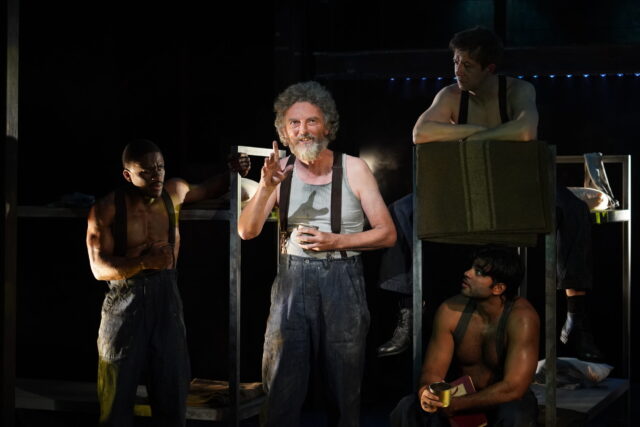
John Keating excels yet again as Paddy in The Hairy Ape (photo by Carol Rosegg)
The Hairy Ape was inspired by O’Neill’s experience as a merchant seaman and a stoker he met named Driscoll. “He was a giant of a man, and absurdly strong,” O’Neill explained. “He thought a whole lot of himself, was a determined individualist. He was very proud of his strength, his capacity for grueling work. It seemed to give him mental poise to be able to dominate the stokehole, do more work than any of his mates.” O’Neill was shocked when he heard that Driscoll had committed suicide by jumping off a ship.
O’Reilly’s (Ulster American, Philadelphia, Here I Come!) staging is powerful, with master set designer Charlie Corcoran literally reaching new levels with the moving platform, which is like a character unto itself; the jail scene is also clever with its use of two rows of cells with red bars. Michael Gottlieb’s lighting and Florian Staab’s sound, accompanied by Ryan Rumery’s original period music, emphasize the differences between the dark dense stokehole and the society above, which is furthered by Orla Long’s costumes, which range from the grimy work clothes of the stokers to the bright and fanciful suits and dresses worn by strolling New Yorkers.
Despite his lack of chest hair, Beavers is ferocious as Yank, a role previously performed onstage by Paul Robeson, Willem Dafoe, and Booby Cannavale and on film by William Bendix. Yank is a man out of time, unwilling to make compromises in a world that ignores him. He is constantly trying to think (or, as he says, “t’ink”), considering his options, occasionally evoking Auguste Rodin’s famous sculpture The Thinker. It may be 1922, but it could just as well be 2026, as the wealth gap in America continues to increase while issues of gender and religion are still front and center.
Keating (Autumn Royal, The Naturalists), one of our finest character actors, is superb as Paddy, an old timer who adds welcome doses of charm and comedy as he hold on to a past that is quickly disappearing, much like the men themselves. Yank might be extra hard on Paddy, but, in his final monologue, it’s Paddy’s words that come to him.
O’Neill overplays his hand in the later scenes; Yank’s encounter with the IWW and the repetition of the concept of belonging feel stale today. But the first half of the show, with its testosterone seeping throughout every crevice of the theater, is one that I’ll remember for a long time.
[Mark Rifkin is a Brooklyn-born, Manhattan-based writer; you can follow him on Substack here.]