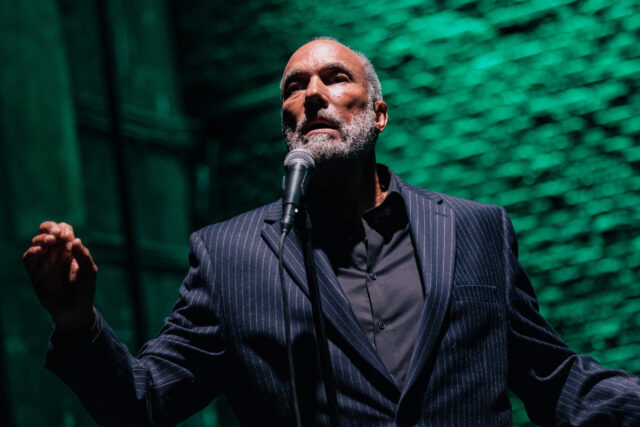
Roger Guenveur Smith remembers his friend and collaborator in solo show In Honor of Jean-Michel Basquiat (photo by Marc J. Franklin)
IN HONOR OF JEAN-MICHEL BASQUIAT
New York Theatre Workshop
83 East Fourth St. between Second & Third Aves.
Through October 10, $54-$99
www.nytw.org
I’m not sure I can fairly assess Roger Guenveur Smith’s latest solo show, In Honor of Jean-Michel Basquiat, a poetic tribute to his good friend and collaborator, the Brooklyn-born artist and musician who soared to fame in the 1980s before dying from a heroin overdose at the age of twenty-seven.
The night I went, a jazz performer and friend of Smith’s was in the audience, to my left in the row ahead of me, interacting with Smith throughout the sixty-minute show. He called out loudly twice, once when Smith was re-creating part of the 2017 auction of Basquiat’s untitled skull painting that went for $110.5 million, a record at the time for an American artist, and again when Smith was talking about Spike Lee’s Do the Right Thing, in which Smith portrayed Smiley, a character he based on Basquiat. During several moments, the man enthusiastically shook his calabash, a percussive gourd, drowning out Smith’s words. Smith seemed happy nonetheless; initially surprised by his friend’s appearance, he later shouted out for him to join in. The man also regularly boisterously voiced his acknowledgment and recognition (mm-hhmm, uh-huh), adding exclamation points to Smith’s calmly delivered dialogue. In general, such utterances are fine, but when offered again and again and again, with no joiners in the audience, well, it got to feel like a bit much, especially since it was happening so close to me.
In the show, which has been extended at New York Theatre Workshop through October 10, Smith stands stage right, at a slight angle, barefoot in a dark suit, an homage to how Basquiat often dressed. On the opposite side, Marc Anthony Thompson operates live sound design, from music to immersive sound effects that work better when not competing with noise from an audience member. In between them, a door in the back wall offers shadowy glimpses of another time and place. (The set is by Raphael Mishler, with soft lighting by Arlo Sanders.)
Smith relates biographical information with personal vignettes about both his and Basquiat’s lives, connecting them to other artists and public figures and historical occurrences. For example, after mentioning that Basquiat’s Haitian father came to Brooklyn in 1955, he points out that was also the year that Emmett Till was murdered, Disneyland opened, the Dodgers won the World Series, and Charlie Parker died. He notes that Basquiat was born six days after planes collided over Staten Island, one crashing into Prospect Park. He tells us that Basquiat got hit by a car and lost his spleen in 1968, the same year his mentor, Andy Warhol, was shot by Valerie Solanas. He says that Basquiat’s parents met at a Brooklyn dance hall, while he and Basquiat met at a Brooklyn dance hall.
Some of these comparisons are intriguing, but others seem like too much of a stretch. Also referenced are Charles Mingus, Bud Powell, Robert Rauschenberg, David Byrne, Michael Stewart, Eric Dolphy, Bob Marley, Frantz Fanon, Mark Twain, James Van Der Zee, and Marcus Garvey. In addition to the skull painting, Smith also brings up 1981’s Bird on Money, a tribute to Charlie Parker that includes a depiction of Green-Wood Cemetery, where Basquiat would be buried six years later, 1982’s The Pilgrimage, on which Basquiat wrote “twenty seven,” his age when he died, and 1983’s Defacement (The Death of Michael Stewart).
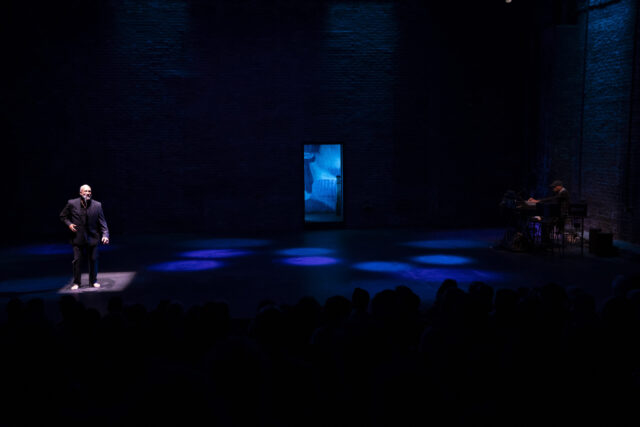
Roger Guenveur Smith and Marc Anthony Thompson honor Jean-Michel Basquiat at New York Theatre Workshop (photo by Marcus Middleton)
The show works best when Smith, known as the rapper Hollywatts when he met Basquiat, shares stories about his close relationship with the artist, as in scenes when they go clubbing, Smith takes Basquiat to a Jamaican barber, and they talk about his drug use. Smith’s previous nonfiction solo shows include A Huey P. Newton Story, about the cofounder of the Black Panther Party; Juan and John, which delves into the 1965 confrontation between San Francisco Giants pitcher Juan Marichal and Los Angeles Dodgers catcher John Roseboro; Rodney King, about the 1992 LA riots; and Frederick Douglass Now, in which Smith portrayed the abolitionist and orator — which premiered in 2011 at La MaMa, across the street from NYTW. Although he does change voices for some of the people in In Honor of Jean-Michel Basquiat, he mostly relies on his own tender and moving cadence:
“Resurrected as the ascendant dread / Jean-Michel Basquiat / Unbeknowest to me / Thought JMB / Was just a cool club kid / With an electronic hairdo / Little did I know / He was incognegro numero uno / Writing acrylic poems and philosophy / On concrete walls and canvas / And refrigerator doors / A feathered Icarus / Touched by the tarbrush / The big brother / Who had thrown snowballs / And flown kites / With his two little sisters.”
The play begins with Smith explaining that his father, a former elevator operator in DC (in fact, his father was a lawyer and judge), advised him to go to a trade school, saying that “power has its ups and downs,” and opining that, regarding Basquiat, “Hell, that boy didn’t live long enough / to see his shit really sell.” His dad also told him, “So you go ahead / You be an actor / But you’ll never act yourself out of this coffin / called the US of A. . . . And before it’s all over, son / Why don’t you / Act something out / For your friend Jean-Michel / And for me.”
Initially presented in 2004 in conjunction with a revelatory Basquiat exhibition at the Brooklyn Museum, In Honor of Jean-Michel Basquiat, fulfills that request. I only wish I hadn’t been so distracted through most of it.
[Mark Rifkin is a Brooklyn-born, Manhattan-based writer; you can follow him on Substack here.]