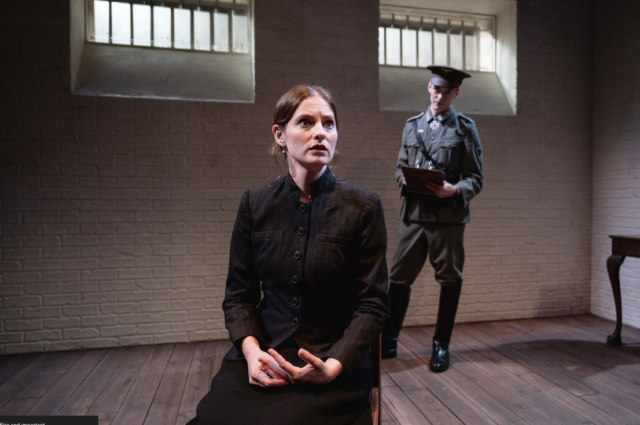
Hannah Stern (Ella Kaille) is watched by Gestapo officer Karl Frick (Brett Temple) in gripping play at 59E59 (photo by Valerie Terranova)
MRS. STERN WANDERS THE PRUSSIAN STATE LIBRARY
59E59 Theaters
59 East 59th St. between Park & Madison Aves.
Tuesday – Sunday through October 25, $76-$96
www.59e59.org
www.mrssternwanders.com
[Below is my review of Mrs. Stern Wanders the Prussian State Library when it ran at the WP Theater in 2024; I have made small changes to account for the current production at 59E59, where it continues through October 25, with the same cast, set, and director. There will be talkbacks following the performances on September 25 at 7:00, September 27 at 2:00, October 3 at 2:00, and October 10 at 7:00.]
Jenny Lyn Bader’s Mrs. Stern Wanders the Prussian State Library is one of the best dramas of the year, a taut, gripping tale inspired by the little-known 1933 arrest of Hannah Arendt by the Gestapo. The ninety-minute Luna Stage production opened in October 2024 at 59E59, where I saw an early preview, and moved to the WP Theater in an even better version, and now has returned for an encore engagement at 59E59. Bader is intimately familiar with Arendt’s life and career; her husband, Roger Berkowitz, founded the Hannah Arendt Center for Politics and Humanities at Bard College, where she has served on the board of advisers.
As the audience enters the space, they are instantly immersed in Arendt’s world in 1933 Berlin, through period music and Lauren Helpern’s stark set, a prison cell with two empty chairs, the white walls reaching out toward us. It feels like a warning that any of us could end up being interrogated under the dangling light fixture, then or now, especially given the rise of antisemitism across the globe. Barred, opaque windows do not promise hope.
A twenty-six-year-old burgeoning historian, philosopher, and author, Arendt (Ella Kaille) — whose married name at the time was Stern; she and her first husband, Günther Anders Stern, would divorce in 1937 — has been brought in by the Gestapo, along with her mother, who is in a separate cell. What Hannah thought would be just a brief questioning turns into several days of interrogation by Karl Frick (Brett Temple), an inquisitive Aryan guard who appears to be just as interested in her philosophy as in the identities of her dissident, Zionist friends.
After Hannah grimaces upon taking a sip of the coffee Karl has given her, he asks, “Do you not like the coffee?” She responds, “If I may speak freely? It’s terrible.” Karl: “Sorry to hear it. But at least I know you answer questions truthfully.” Hannah: “It wouldn’t occur to me to answer them any other way.” Karl: “That will make our time together easier.” It’s an intimate, critical moment that establishes the two characters and how they will relate to each other, Karl displaying genuine concern — it’s his first day on this new job, having been promoted from the criminal police to the political police — while Hannah plays a clever game of cat and mouse.
Karl grows suspicious when Hannah is visited by Erich Landau (usually played by Drew Hirshfield, although I saw his understudy this time, Jay DeYonker), a lawyer purportedly sent by the Zionists. “They are changing laws they made yesterday, then changing them again, by arbitrary police decree,” Hannah explains. Erich replies, “‘Arbitrary’? How can you say that? Laws create order!” Hannah answers, “In a classic dictatorship, yes. But the Nazis want chaos.”
Over the course of several days, Karl and Hannah discuss forced immigration, false idols, the arts, assimilation, love, the Bible, vegetarianism, German writer Rahel Varnhagen, and the Jewish Question as he tries to get information out of her while she cagily parries, brilliantly careful about everything she offers him.
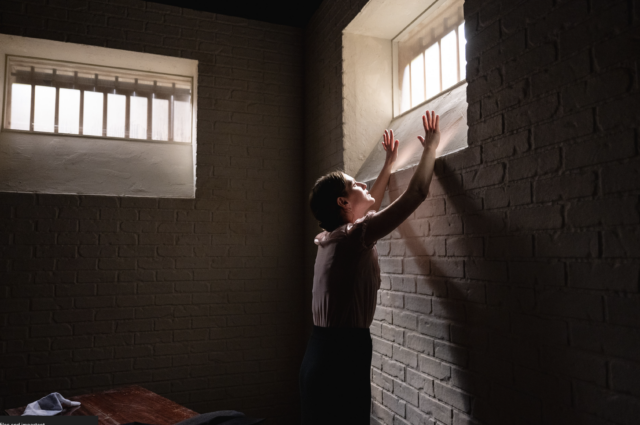
Ella Kaille excels as a young Hannah Arendt in Mrs. Stern Wanders the Prussian State Library (photo by Valerie Terranova)
In Mrs. Stern Wanders the Prussian State Library Bader (The Whole Megillah: A Purim Spiel for Grown-Ups, None of the Above, Manhattan Casanova) captures the fear that many Jews live with, whether in 1933 Germany or 2024 America as the rule of law grows ever more arbitrary — and purposefully vindictive. The show is expertly directed by Ari Laura Kreith (Heartland, 167 Tongues); even though we know what’s ultimately going to happen, in general if not in the specific details, we are kept on the edge of our seats like a tense thriller, each scene offering new surprises and philosophical insight about what happened then — and can happen again.
A dead ringer for Natalie Portman, Kaille (Connected, Can You Forgive Her?) — whose father, controversial lawyer Alan Dershowitz, once debated Arendt and has written extensively about her (unfavorably) and whose husband’s last name is Stern — portrays Arendt with an astute elegance, from the way she smokes a cigarette and holds a cup of coffee to how she climbs on a table to look out the window, freedom just out of her grasp. Temple (The Valley of the Shadow, Henry IV, Part One) imbues Karl with a gentle vulnerability and curiosity not usually associated with Gestapo officers, while DeYonker, a five-year member of the Prague Shakespeare Company, is effective in his small but key role as the lawyer.
“Personally I think that’s the first big mistake in the history of thought — that truth comes at the end. I think truth comes at the beginning of a thought,” Hannah tells Karl at one point. In her February 1967 New Yorker article “Truth and Politics,” Arendt wrote, “We must now turn our attention to the relatively recent phenomenon of mass manipulation of fact and opinion as it has become evident in the rewriting of history, in image-making, and in actual government policy. The traditional political lie, so prominent in the history of diplomacy and statecraft, used to concern either true secrets — data that had never been made public — or intentions, which anyhow do not possess the same degree of reliability as accomplished facts; like everything that goes on merely inside ourselves, intentions are only potentialities, and what was intended to be a lie can always turn out to be true in the end. In contrast, the modern political lies deal efficiently with things that are not secrets at all but are known to practically everybody. This is obvious in the case of rewriting contemporary history under the eyes of those who witnessed it, but it is equally true in image-making of all sorts, in which, again, every known and established fact can be denied or neglected if it is likely to hurt the image; for an image, unlike an old-fashioned portrait, is supposed not to flatter reality but to offer a full-fledged substitute for it. And this substitute, because of modern techniques and the mass media, is, of course, much more in the public eye than the original ever was.”
Watching Mrs. Stern Wanders the Prussian State Library in the context of current international politics is a chilling warning of what might lie ahead, especially if we cannot hear the voices from history, like Hannah Arendt’s.
[Mark Rifkin is a Brooklyn-born, Manhattan-based writer and editor; you can follow him on Substack here.]