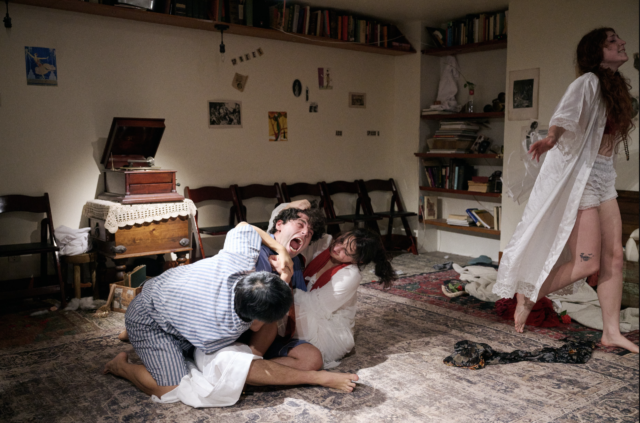
Michael Gardner’s adaptation of Jean Cocteau’s Les Enfants Terribles is a rowdy, intense extravaganza (photo by Kent Meister)
LES ENFANTS TERRIBLES
East Village Basement
321 East Ninth St. between First & Second Aves.
Thursday – Sunday through October 4, $16.88-$25.00
enfantsplay.com
As fortunate ticket holders enter the East Village Basement, a small, intimate downstairs space on Ninth St., the four actors in Michael Gardner’s adaptation of Jean Cocteau’s Les Enfants Terribles are already present, three moving around carefully, turning on a record player, or simply flitting about, while one hides in a corner on a windowsill.
One of the performers crawled over to me, looked up at me, and barked. I barked back. She seemed to enjoy the interaction. Other audience members were not sure what to do while the actors traversed the room, simply ignoring them as they continued their conversations or checking their phones.
Eventually, the play proper begins, and it is a rowdy extravaganza that makes clear why Cocteau’s 1929 novella caused quite a stir at the time. Agatha (Caroline Lina DeFazio), Gerard (Victor Gao), Elisabeth (Maysie Jane Kilgore), and Paul (Rutger Scott) are four teens immersed in decadent, degrading, somewhat deranged games of sex and war, love and death, education, health, Hollywood, high fashion, and religion. There are seats for only fifteen audience members for each show, on three sides of the basement. The walls are covered with photographs and newspaper and magazine clippings. Life-size fabric human dolls hang in one corner. A Victrola plays the kinds of songs that were heard in the ghost scenes of Stanley Kubrick’s The Shining. A steamer trunk holds numerous surprises.
Elisabeth recites lines from the Catholic responsory “Deliver Me.” She asks, “Where’s my bier?” Her brother, Paul, responds, “You can’t lie on a bier until you’re dead.” Paul grabs Elisabeth by the neck and she pulls out a gun. The siblings try to force one of the dolls to eat a communion wafer. “You have to eat the body, body!” Paul demands. Elisabeth says, “You’re going to hell if you don’t eat the body!” Paul declares, “I’m going to hell!” Elisabeth counters, “No, I’m going to hell!”
Gerard and Agatha enter the fray and a snowball fight breaks out. Elisabeth complains about having to take care of her sick mother, who is in another part of the house. Elisabeth offers to carve her name on Gerard’s tongue. Agatha is covered by a white sheet. Paul idolizes his friend Dargelos. They visit the seaside. The turn the trunk into a bathtub. Elisabeth makes Gerard do strange things with the doll she names Polly Pigtails. They perform creepy rituals.
They play a game called Terrorize the Children, in search of candy. They treat a crayfish like it’s a baby. When Agatha explains that she’s an orphan, Paul says that everyone is an orphan. There are no parents in this world; the kids have been left to fend for themselves, feral beings living like animals, the only rules the ones they make up.
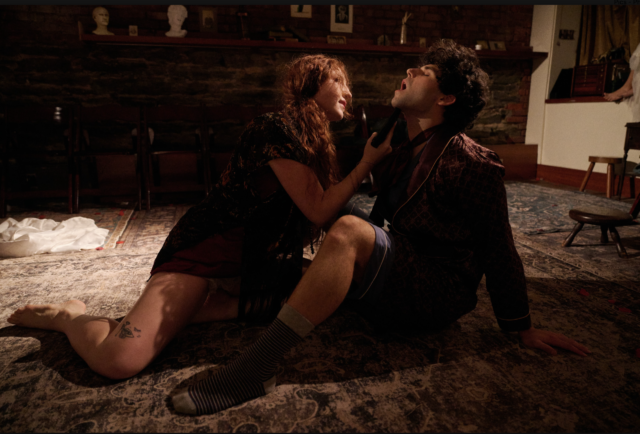
Maysie Jane Kilgore and Rutger Scott play siblings caught up in decadent games in Les Enfants Terribles(photo by Kent Meister)
Les Enfants Terribles is an exciting and exhilarating theatrical experience, harkening back to the days when companies, many based in the East Village, took risks and chances in thrilling experimental happenings that challenged norms. Gardner (The Ninja Cherry Orchard, In a Strange Room) directs with a kind of controlled chaos, allowing his talented cast to dig deep into the material, bringing it to life with an infectious energy.
Kilgore and Scott are particularly effective as the siblings who more than hint at incest as Elisabeth and Paul orchestrate the maelstrom swirling around them and tempt death again and again; the actors are no longer teenagers but they know well from where they came. The object-strewn set is haunting, a blast from the past that holds secrets all its own. Despite its tragic nature, the show is very, very funny, although it does lose some steam in the latter sections when jealousies take over.
In his novella, Cocteau, the French novelist, playwright, designer, and filmmaker, wrote, “The actual tragedies of life bear no relation to one’s preconceived ideas. In the event, one is always bewildered by their simplicity, their grandeur of design, and by that element of the bizarre which seems inherent in them.” Cocteau showed elements of understanding and empathy for his characters in Les Enfants Terribles, four youngsters who had been done wrong by their elders; we cannot blame them for the outlandish dramas they concoct.
Cocteau revealed the folly of mothers and fathers in his 1938 play, Les Parents Terribles, which he adapted into a 1948 film starring Jean Marais and Yvonne de Bray; although it is not a direct sequel to Les Enfants Terribles, the later work does not show grown-ups in the best light.
At its heart, Gardner’s adaptation is a wild and frenetic condemnation of the damage adults and society inflict on children. It is unusual, it is unpredictable, it is deeply involving, and there’s nothing else quite like it in New York theater right now.
[Mark Rifkin is a Brooklyn-born, Manhattan-based writer; you can follow him on Substack here.]