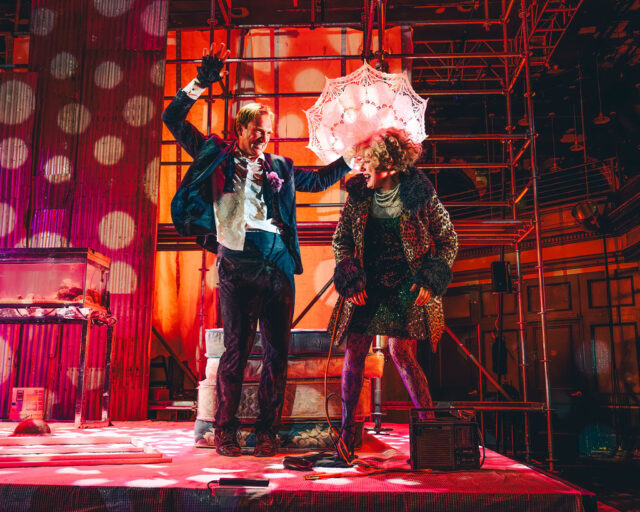
Andrey Burkovskiy and Chulpan Khamatova are delightful in Igor Golyak’s Delirium (photo by Austin Ruffer)
DELIRIUM
The Space at Irondale
85 S. Oxford St., Brooklyn
Monday – Saturday through November 7, $79-$139
deliriumnyc.com
Igor Golyak is one of the most exciting, inventive, and innovative directors working today, and he proves it yet again with the absolutely mind-blowing Delirium.
“I smashed all barriers . . . I flouted all the laws of time and space,” the protagonist Khonen says in Belarus-born S. Ansky’s 1920 play, The Dybbuk. In his unique adaptations of such important works as Anton Chekhov’s The Cherry Orchard, William Shakespeare’s The Merchant of Venice, Tadeusz Słobodzianek’s Our Class, and The Dybbuk, Golyak, whose family fled Kyiv when he was a child, has smashed theatrical barriers and flouted time and space in extraordinarily reimagined adaptations that delve deep into war, antisemitism, and human connection.
In the deliriously brilliant Delirium, based on Romanian-French playwright Eugène Ionesco’s rarely performed 1962 Frenzy for Two, or More, Golyak, the artistic director of the Massachusetts-based Arlekin company, explores the complex nature of love and the absurd ridiculousness and horrors of war, laying bare the elements of stagecraft in telling the story of an unnamed man (Andrey Burkovskiy) and woman (Chulpan Khamatova) who bicker continuously in their ramshackle apartment in an unidentified country as a fierce military battle rages on outside. Jan Pappelbaum’s set is a marvel of chaos, a center platform with a pile of old, dusty mattresses, a bucket, empty window frames and mirrors, and a large fish tank with a large live goldfish in it, all surrounded by scaffolding tenuously holding aluminum sheets of varying sizes.
During the play’s fast-paced ninety minutes, the couple argues over just about everything, starting off with their decision to be together seventeen years before, immediately establishing the current state of their relationship.
She: The life you promised me! And the life you give me! I left my husband to follow my lover. How romantic! My husband was ten times better, seducer! He didn’t contradict me stupidly!
He: I don’t contradict you on purpose. When you say things that aren’t true, I can’t just accept them. I have a passion for the truth.
She: What truth? I’m telling you there’s no difference. That’s the truth. There’s no difference. A snail and a turtle, they’re the same thing.
He: No they’re not. They’re not the same animal at all.
She: Animal yourself. Idiot.
He: You’re the idiot.
She: You’re insulting me, you imbecile, you’re disgusting, seducer.
The mollusks represent themselves, two beings whose lives move slowly, if at all, trapped within shells that may not be able to protect them from what’s outside. The man and woman may think they’re different, but they’re more similar than they’ll ever admit.
She declares, “Oh, enough! Shut up! You’d better. I can’t stand listening to you ramble anymore.” He responds, “I can’t stand listening to you either. I don’t want to hear anything.” At that instant, an explosion rattles their apartment, a moment that’s both funny and frightening. They debate whether a plaster fragment is the Venus de Milo or the Statue of Liberty, signifying the loss of love and/or freedom. He’s hot, she’s cold. He says “yes,” she says “no.” Their constant disagreements over insignificant things pale in comparison to the war, which they take seriously only when they believe they are in immediate danger, like so many people around the globe — and especially in America.
A buzzer rings, and they worry that they’re coming for them. We never find out who “they” are — the good guys, the bad guys, ICE. In this case, it doesn’t matter, as the whole world has gone to hell, and there’s no place left to hide.
“We’re caught between two fires. What made you pick this place at the border of two neighborhoods?” she complains. He snaps back, “You’re the one who wanted this place. . . . You wanted this apartment for the beautiful view.” Today, it feels like we’re all living on the border of two combative neighborhoods, perhaps sacrificing safety for the illusion of beauty.
As the war grows closer to the man and the woman, they have to think fast, and stop quarreling, if they want any kind of future.

An unnamed man (Andrey Burkovskiy) and woman (Chulpan Khamatova) seek a place to hide in deliriously entertaining Ionesco adaptation (photo by Austin Ruffer)
Golyak directs with a masterful hand, leaving no stone unturned; he takes advantage of every word, every punctuation mark, never wasting an opportunity to add to the maelstrom. He makes ingenious use of the props, from a movable door and the mattresses to a radio and the aluminum sheeting; even Sasha Ageeva’s costumes get in on the act. An early scene involving the man’s hat and the woman’s wig is like a vaudeville skit, while other scenes recall silent comedy. Jeff Adelberg’s lighting, Denis Zabiyaka’s sound, and Anna Drubich’s music take expert advantage of the space, following the man and the woman as they make their way into the audience, onto the scaffolding, and across the balcony.
Burkovskiy (Seagull: True Story, Khonen in The Dybbuk) and Khamatova (Ivanov, Shushkin’s Stories), who appeared together in the San Francisco production of Our Class, are superb as the longtime lovers, reminding me of a younger Christopher Lloyd and Carol Kane, with touches of Ricky and Lucy, Ralph and Alice, and George and Martha. They both display expert comic improv chops and occasionally relate directly to the audience, particularly as the play progresses. Burkovskiy has an electric stage presence, while Khamatova wonderfully balances innocence and petulance.
Amid all the frenzied hilarity and increasing rubble, Golyak injects some key points that may seem obvious but are being ignored by too many of us. Talking about the approaching soldiers, the man says, “Whether they’re going up or down, it’s about the same. Next time they’ll come for us.” After a missile flies past, he admits, “Yes, it’s impossible to have peace; but it’s beyond our control. It’s objectively impossible.” And a few moments later, when the bombing appears to have stopped, she says, “Probably intermission.”
In Delirium, as in real life, there is no intermission, not even for that poor fish, who just keeps swimming around his tank, oblivious, just trying to survive until tomorrow.
[Mark Rifkin is a Brooklyn-born, Manhattan-based writer; you can follow him on Substack here.]