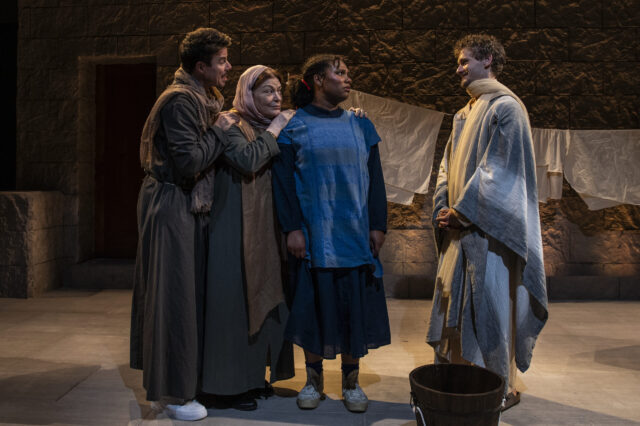
The Virgin Mary (Annalisa D’Aguilar) is not exactly thrilled when she is told she is carrying the baby Jesus (photo by Alley Babcock)
THE BODY OF MARY: A PLAY IN THREE ACTS (OF GOD)
The Gym at Judson
243 Thompson St. at Washington Square South
Thursday – Monday through October 8, $40-$129
thebodyofmary.com
www.judson.org
Katie Cappiello’s The Body of Mary: A Play in Three Acts (of God) is as funny as it is frightening.
The world premiere pulls no punches as it delves into how women’s bodies and choices have been controlled by the church, the government, and, essentially, men throughout millennia, with no end in sight. Writer-director Cappiello cleverly balances the serious heart of the show with hilarious moments that serve to the highlight the basic issues she is exploring.
In the first act, titled “The Virgin,” thirteen-year-old Mary (Annalisa D’Aguilar) can’t seem to stop throwing up into a wooden bucket while her mother, Anne (Mary Jo Mecca), offers her help. It’s not the Roman soldiers going door to door that is making her crave pickles and lose her lunch; when her father, Joachim (David Hull), arrives with the angel Gabriel (Ben Cook), she is told that God is asking if she would carry his child. She immediately declines, clearly stating, “No, thank you. My answer is no. I don’t want to do it. . . . I’m sorry, but I don’t think this whole thing works for me.”
But when Joachim blurts out that it’s too late, that she’s already pregnant and they’ve picked out a husband for her, she’s having none of it, which surprises the others, who thought she would have been thrilled at the opportunity and honor. Well, she’s not.
“God gave me this child without asking me first. That seems to be what has happened. I mean, why would He do that? Is this a trick? Father?” she asks. “Gabriel, please tell God that I’d — I’d rather not. I appreciate Him thinking of me so much and thinking me worthy of being the mother of His kid and stuff but I think instead I’m going to keep doing my regular life, if that’s OK.”
Of course, it’s not OK with the two men or her mother.
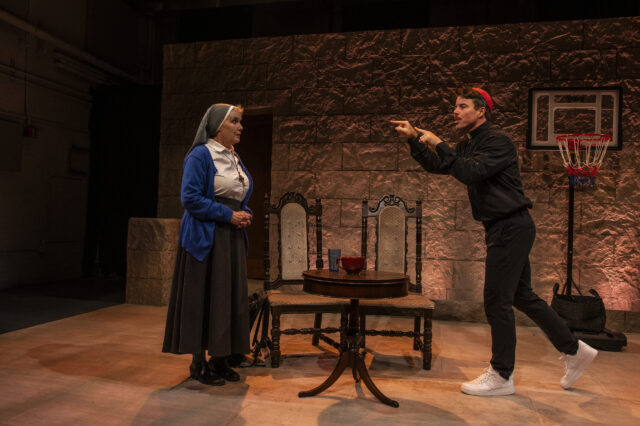
Cardinal Patrick O’Malley (David Hull) has a bizarre plan for Mother Mary Joseph (Tracy Sallows) in world premiere at the Gym at Judson (photo by Alley Babcock)
The second act, “The Mother,” takes place five years in the future in New York City, where Cardinal Patrick O’Malley (Hull) is waiting for a special delivery and has teamed up with his brother, a Massachusetts senator, on an important mission for their lord and savior. The youngest cardinal in the College of Cardinals, he is not exactly priestly; the scheming zealot quotes from Jay-Z’s “Big Pimpin’,” curses, is impatient, doesn’t listen to others, and is prepared to go to extremes to get what he and his brother want.
Cardinal O’Malley’s ever-faithful and obedient servant, Sister Genoveva (Mecca), brings in the pious, dedicated Mother Mary Joseph (Tracy Sallows), from the Immaculate Little Sisters of Self-Sacrifice and Martyrdom, which cares for migrant women escaping torture in their home countries. He insists she have a latte despite her protestation — he’s not about to listen to any woman, about anything — and complains about the current state of religion. “The world has been moving at a wild clip, I’m afraid, away from Jesus and his teachings,” he tells her. “Modernization, all this they/them stuff, anti-Christian rhetoric is everywhere, women don’t wants kids anymore, everyone’s a lesbian — yadda yadda. His Holiness will get us back on track. He’s a visionary. And somewhat of a mentor — to me.”
A concerned and curious Mother Mary Joseph responds, “I am grateful the keys of St. Peter have been placed in the hands of such a devout scholar and, and, um, bold leader. I shall pray for him — and for you, Your Eminence.”
When the cardinal advises Mother Mary Joseph of his plan — something so mind-bogglingly crazy yet terrifyingly all too believable — she reacts in a way that brings down the house. But there’s a lot more in store for her, particularly when Father Donato (Cook) joins them.
In the third act, “The Dumpster,” nineteen-year-old Mary (Gracie Conn) works in a Dairy Queen in the small town of Nazareth, Texas. She tosses two large bags of garbage into the dumpster in the parking lot as she is talking to her best friend, Nevaeh (voiced by D’Aguilar), about her period. “I worked ten hours today and I’m gushing blood at like horror movie levels,” Mary says. “Spilling my blood for the people. I’ve had to change my tampon three times in like an hour and a half. Is that bad? And the blood is chunky. Am I’m dying?”
A few minutes later, she hears a cry from the dumpster; she initially thinks it may be a rabid animal, but she eventually jumps in and finds an infant wrapped in a fleece blanket, apparently thrown away by the mother. She and Nevaeh run through the options of what they should do next, wanting to help the baby while not getting into trouble themselves. “This is low-key Handmaid’s Tale,” Mary says. Nevaeh adds, “And the baby’s mother is like Of-Whomever and she’s probably bleeding out in the woods somewhere.”
Displaying empathy and compassion, they don’t want the mother to be arrested as they try to understand what may have made her do such a thing.
“She could be us,” Mary says.
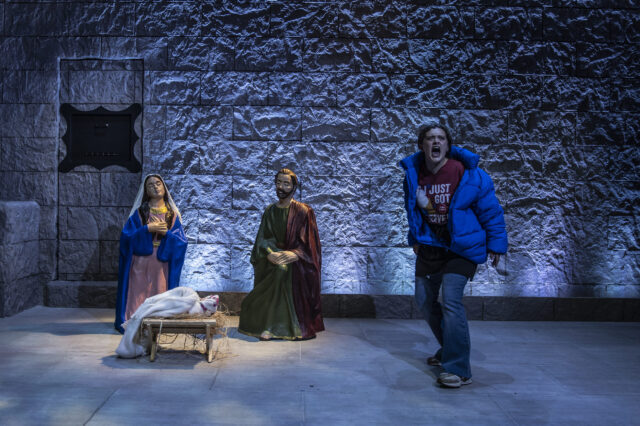
Mary (Gracie Conn) is not sure what she should do after finding a baby in a dumpster in The Body of Mary: A Play in Three Acts (of God) (photo by Alley Babcock)
The Body of Mary is intricately woven together by Cappiello (SLUT, Now That We’re Men), who was raised Catholic in Brockton, Massachusetts, and attended church regularly; she leaves no detail to chance. The venue, the Gym at Judson, is in Judson Church, which holds services on Sunday mornings and “seeks to be a just, diverse, vibrant, and worshipping spiritual community through the pursuit of social justice, creative expression, and sacred exploration of its own Protestant church roots and the wisdom of other traditions.” The narrative focuses specifically on the failings of the church when it comes to the rights of women to control their own body. It is no accident that the Texas Mary works at a Dairy Queen, which could be seen as a metaphor for women weaning their children, although it is not always so sweet, whether in biblical times or 2031. Even the image on the program is provocative, an extreme close-up of a woman’s breast and nipple, a source of life. The script makes numerous references to blood and bleeding, abortion, sacrifice, and murder; at one point, Father Donato, praising a pearl neckline on Cardinal O’Malley’s vestment, declares, “I love the choice of this red. It’s so deep. And rich. And bloody.”
Forest Entsminger’s set features a gray stone wall throughout all three acts, reminding me of the Western Wall in Jerusalem, where women were formerly forbidden to pray, although they are allowed now, albeit in a section separate from the men and with different restrictions. Changes are made for each scene, from various chairs and tables to bags of garbage and a manger. Dina El-Aziz’s costumes, ranging from the BCE era to the modern day, are bathed in sharp reds and blues that contrast earthly gray and brown palettes. Lauren Bremen’s lighting and Florian Staab’s sound fit the intimate space well.
The three Marys are outstanding, bringing tender depth to characters who are facing difficult situations that have no easy way out. Stage and television veteran Sallows (The Audience, Angels in America) portrays Mother Mary Joseph with just the right solemnity, making her outburst all the more unexpected and effective, while D’Aguilar and Conn, in their off-Broadway debuts, capture the energy, innocence, and sense of wonder that is pulled out from under them as their circumstances become more dire. Cook (Illinoise, West Side Story), Mecca (Bridgeboy, Body Language), and Hull (The Book of Mormon, How to Succeed in Business without Really Trying) excel in multiple roles, melding slapstick with a pervading sense of impending darkness. Opera singer Lu Yi Peng “Lluvia” offers a brief, poignant respite.
The ninety-minute show never sermonizes, never preaches, never veers into holier-than-thou territory; instead, it incorporates farce and physical comedy into hard-hitting dialogue that depicts how we have not come nearly as far as we might think as a society in regard to the treatment of women; The Body of Mary is likely to leave you praying that things get better fast, but it’s already been thousands of years for us to get where we are now, and, if anything, we seem to be going backward every day.
[Mark Rifkin is a Brooklyn-born, Manhattan-based writer; you can follow him on Substack here.]