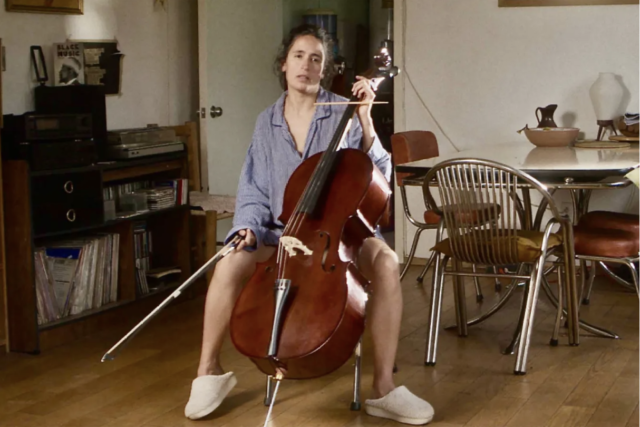
Everything Else Is Noise is one of several NYFF64 films that blend fiction and reality
NYFF64
Film at Lincoln Center
Walter Reade Theater, Alice Tully Hall, Elinor Bunin Munroe Film Center
September 25 – October 12
filmlinc.org/nyff
One of my favorite times of every year comes each September, when I play hooky and spend all day at the New York Film Festival, catching four or five press screenings. This year, I shuttled between the Walter Reade Theater and the Francesca Beale Theater to see four extraordinary gems that fit extremely well together, a quartet of exquisite works that move at the pace of life, mixing fiction and nonfiction as they explore the relationship between cinema and reality in beautiful and unique ways.
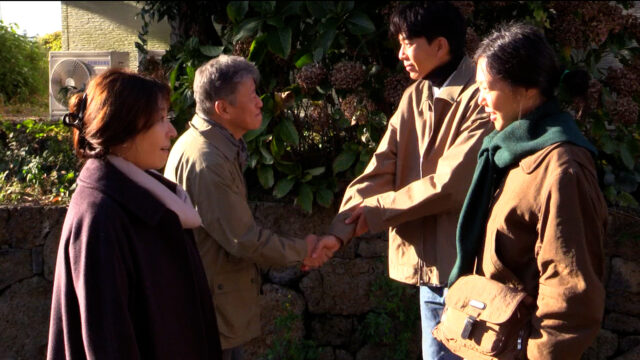
Nowhere to Lay My Eyes is another gem from Hong Sangsoo
NOWHERE TO LAY MY EYES (눈둘데가 없네) (Hong Sangsoo, 2026)
Saturday, September 26, 12:30
Wednesday, October 7, 8:45
filmlinc.org
Festival favorite Hong Sangsoo once again has two films in the schedule, both fine examples of his personal style — the South Korean auteur writes, directs, edits, produces, and photographs his films. Since 2015, they usually star his partner, Kim Min-hee, who has appeared in thirteen of his movies and doesn’t act for any other director.
In Nowhere to Lay My Eyes, Kim portrays Sanghee, an experimental filmmaker who visits her mother (Choi Myung-gil) and stepfather (Kwon Hae-hyo) for the first time in ten years; Sanghee is joined by her younger brother (Shin Seok-ho), who is caught between his sister’s and mother’s estrangement. Their mother has made a new life on Jeju Island, where she owns a successful restaurant; meanwhile, her husband is a documentary filmmaker who has been working on the same project for two decades, about chobun, or grass graves, in which bodies are not buried but decompose aboveground. They also meet their stepsister (Park Mi-so), who discusses art with Sanghee.
As in so many Hong films, the well-drawn characters eat, drink, and visit the seashore as they talk about movies, aging, responsibility, and relationships. Hong often keeps the camera still and steady; for example, when Sanghee decides to visit a nearby pond, she walks slowly down a gravel road, her back to the stationary camera, her footsteps crunching gently as she says in voiceover, “It was a pleasant day, with clean air.” It’s a simple yet deeply affecting moment, representative of Hong’s work.
However, other scenes include two of his trademark zoom bursts to remind us that we are not watching real life. “Dramas are a scam,” the stepfather says at one point, a comment not only on his documentaries but on Hong’s oeuvre.
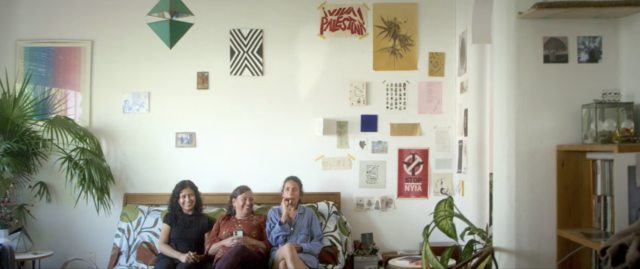
All senses are connected in Nicolás Pereda’s Everything Else Is Noise
EVERYTHING ELSE IS NOISE (LO DEMÁS ES RUIDO) (Nicolás Pereda, 2026)
Saturday, September 26, 4:30
Sunday, September 27, 9:30
Sunday, October 4, Brooklyn Academy of Music, 7:30
Monday, October 5, 1:00
filmlinc.org
Mexican filmmaker Nicolás Pereda’s Everything Else Is Noise is a wonderfully wry feminist comedy about music, family, and the art of filmmaking — as well as patience.
It begins with a long shot of crazy traffic, several minutes in which we follow one car at an intersection where vehicles are moving at a snail’s pace, if at all. This one sedan is having the most difficulty, attempting to make a left turn, but no one is letting it in. It’s both hilarious and frustrating, a terrific opening scene for a fabulously inventive film that requires patience on the part of the characters and the audience.
The story takes place in a single apartment, filled to the brim with plants. It is the home of cellist-composer Tere (Teresita Sánchez), who we first encounter when her downstairs neighbor (Andrew Rogers) comes to her door and complains that she is making too much noise. She calmly explains that she is practicing her cello and that she has already reached an agreement with another neighbor that it is fine to do so between nine and five. The man refuses to accept her explanation, repeating his demand again and again, but she insists, over and over in her soft-spoken yet sly manner, that she will continue practicing nonetheless. It’s a marvelously absurd exchange that sets the stage for the hilarious utter nonsense that is to follow.
Tere has let her friend and colleague, cellist and composer Rosa (Rosa Estela Juárez Vargas), borrow her apartment for a television interview about her career. Rosa, who does not want her husband to know about the interview, is nervous and is not the greatest with words, so Tere tries to settle her down by advising her to make up a fake story about her sense of smell. The interviewer, Lázaro (Lázaro G. Rodríguez), finally arrives with Paco (Francisco Barreiro), his cameraman and sound technician; it seems that they were in that car that was stuck in traffic, the first of a series of events that befall them as they try to conduct the interview.
It only gets more complicated when Tere’s daughter, avant-garde cellist Luisa (Luisa Pardo), shows up basically in her pajamas, eventually joined by her father, the famous composer Estevez (José Rodríguez López), who has not publicly acknowledged Luisa as his child, in order to protect his wife and their other, “legitimate” children. Things go wrong in droller and droller ways as Pereda, who wrote the script with Juan Francisco Maldonado and serves as cinematographer, has a blast with clever touches and details that sometimes fly under the radar if you don’t pay attention.
Sánchez, who has appeared in such other Pereda films as Fauna, Minotaur, and Lázaro at Night, is sensational as Tere, imbuing her with a spirited naturalism that brings a realistic quality to the narrative, melding fiction and nonfiction. (Pereda has won awards for both his documentaries and fiction features.) Pardo and Barreiro, also Pereda regulars, ramp up the absurdities to priceless levels.
Everything Else Is Noise is a small gem, making its points about gender inequality, class differences, the media, and the creative process in both subtle and overt ways that will have you shaking with laughter. As Luisa says, “In my opinion, the issue with experiencing this music live, where you can see the performer, is that the visual aspect takes over, and you stop really listening. So, for this to make sense, I’m going to ask you all to close your eyes while I play.” Paco then adjust the camera viewfinder and puts his head in his hands.
And as Tere notes, “The senses are all connected.”
Brava!
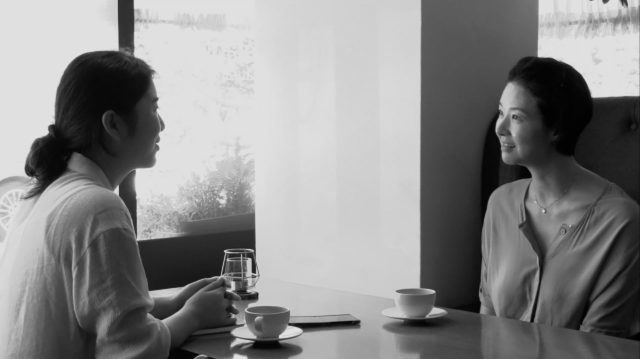
Song Sunmi stars as an actress making a comeback in The Day She Returns
THE DAY SHE RETURNS (그녀가 돌아온 날) (Hong Sangsoo, 2026)
Tuesday, October 6, 9:00
Thursday, October 8, 6:15
filmlinc.org
A kind of companion piece to his 2012 drama The Day He Arrives, Hong Sangsoo’s The Day She Returns is a meditative examination of life and art, of the choices we make amid our inherent biases and societal mores.
Song Sunmi stars as Bae Jeongsu, a famous actress returning to work after twelve years off raising her daughter. She has chosen a small indie film for her comeback, and she is promoting it through a series of one-on-one interviews with three woman journalists (Kim Seon-jin, Oh Yeon-su, and Kang So-yi) at a local German restaurant.
Instead of merely hyping the film or herself, she first asks what each of the women thought of the film, and they indeed share their thoughts while also delving into their own personal situations and agendas. Bae shows what appears to be genuine interest in them, even as their stories grow more absurd and self-centered, but she hesitates when they ask her about her recent divorce. She also wants them to have a beer with her.
Attempting to be accommodating yet not overly effusive, Bae shares such ideas as “All interpretations ultimately lead to anxiety. If you can see things as they are, then you can actually experience real peace,” “I refuse fake love in my life,” and “How can we maintain an innocent face when our souls are in tatters?” As happens at press junkets, Bae sometimes repeats herself, giving the same answer to similar questions, although the third interview is the most legitimate.
In between interviews, each of which lasts between fifteen and twenty minutes, shot with a still camera (but watch out for those strange trademark zooms), Bae goes outside with her personal assistant (Ha Seong-guk) for a smoke and wonders whether she is being too honest. Sitting on grass, seen in between two parked cars, Bae is a curious figure, provoking questions about whether she is acting for the interviewers, telling the truth, or having trouble discerning reality from fiction. That line is further blurred when she goes to her acting class and her teacher (Cho Yun-hee) gives her a challenging assignment with a fellow student (Park Mi-so).
Hong shoots The Day She Returns in a stark black-and-white that lends the film a ghostly, surreal quality, accompanied by a hypnotic score. (Hong serves as writer, director, cinematographer, editor, producer, and composer.) Sunmi, who played a film professor in The Day He Arrives, is brilliant as Bae, a former star trying to resuscitate her career in her forties but doing things her own way. She may be a well-known actress, but she could be any woman facing a transition, taking stock of where she’s been and trying to decide what comes next, but in her case displaying a vulnerability that may or may not be real, given her profession.
One of the questions asked is “What is a good film?” The answer, of course, is just about anything by Hong Sangsoo.
(The Day She Returns is screening with Kleber Mendonça Filho’s South of Tehran, in which the Brazilian director meets with Iranian auteur Jafar Panahi.)

Beatrice Gibson makes a stunning feature debut in the poetic At Night
CURRENTS: AT NIGHT (Beatrice Gibson, 2026)
Saturday, October 3, 9:00
Sunday, October 4, 5:30
filmlinc.org
“At Night is a film in the shape of a question,” experimental filmmaker and installation artist Beatrice Gibson explains in the director’s note for her feature debut, the poetic, elegiac At Night. That question mixes fiction and reality as six women examine their lives over the course of one evening in Paris, focusing on risk, love, sex, art, and motherhood.
Gibson, who has been celebrated for her short works, stars as B, a filmmaker reaching a creative crisis. Her husband (Nick Gordon) is not happy that she might miss another family event involving their son, Obie (Obie Gordon). She reaches out to an old friend and child minder, Didi (educator, mother, and activist Diocouda Diaoune), who we later see drinking tea by herself in a Chinese restaurant, by a large cerulean aquarium, watching Zheng Lu Xinyuan’s The Cloud in Her Room as she speaks on the phone with her mother (Aissata Ba). Waiting for a train, Didi meets a Metro nightworker (Habib Dembele) who, like Didi, knows Bambara, the national language of Mali.
In an extraordinary scene, B and Didi are joined for drinks by Kátia (psychoanalytic psychotherapist Kátia Belo Cardoso), Sophie (English poet and teacher Sophie Robinson), Amy (British filmmaker, photographer, and electrician Amy Gwatkin), Laida (Spanish artist and filmmaker Laida Lertxundi), Denna (producer Denna Cartamkhoob), and Pauline (visual and performance artist Pauline Curnier Jardin), who discuss their lives and careers, particularly how they try to balance sexual desire and children with their work. Other issues that are brought up in the film are race, class, and gender.
A mime (American-born English model and actress Lily McMenamy) performs a grotesque routine about women’s bodies. At a bus stop, Didi encounters a performer (London-based multimedia artist Adam Christensen) who shares a deeply personal story with her. Kátia shares the tale of Yemaya, the Yoruba ocean mother goddess.
The sounds of the night range from Elvin Brandhi’s haunting score to recited poetry, including excerpts from American poet and essayist June Jordan’s “Poem About My Rights” and Alice Notley’s “The Descent of Alette” (recorded by the American poet shortly before her death; Gibson was hoping Notley would be able to appear in the film) and a poem by Robinson she reads at a record store. (The film was inspired by the writings of Jordan, Notley, and American novelist and poet Kathy Acker.)
A compelling, deeply affecting feminist fantasia, At Night is gorgeously photographed by Ben Rivers, who captures the dark mystery of a Paris night, from bars and cafés to bland hotel rooms and empty streets. Many scenes are set at bus and train stops and in and on the Metro, as characters spend time in transition that only takes them so far. The film hovers over the melding of fiction and reality, as most of the participants — who are not professional actors — crafted their stories and dialogue with Gibson (Deux soeurs qui ne sont pas soeurs, I Hope I’m Loud When I’m Dead), based on their actual lives. Editor Liyo Gong masterfully stitches it all together, resulting in a spellbinding cinematic experience.
[Mark Rifkin is a Brooklyn-born, Manhattan-based writer; you can follow him on Substack here.]