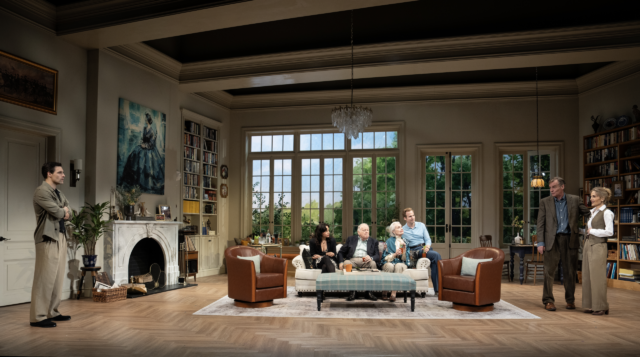
An all-star cast cannot save thirtieth-anniversary revival of Wendy Wasserstein’s An American Daughter (photo by Joan Marcus)
AN AMERICAN DAUGHTER
The Pershing Square Signature Center
The Irene Diamond Stage
480 West 42nd St. between Tenth & Eleventh Aves.
Tuesday – Sunday through September 20, $59-$149
lafemmetheatreproductions.org
With about ten minutes to go before intermission of La Femme Theatre Productions’ thirtieth-anniversary revival of Wendy Wasserstein’s An American Daughter, a group of about a half dozen people sitting behind me got up and left. I can’t say I didn’t want to join them, but it is my responsibility to stay through entire shows, which can certainly proceed to better — or worse — second acts.
At intermission, more people left and didn’t come back.
I can’t say I blamed them, as the two-and-half-hour play did not improve but instead devolved even further.
A timely topic, an excellent roster of actors, a Pulitzer Prize–winning writer, and a gorgeous set could not save the dull and lifeless narrative. The most excitement came during the second act, when a woman over my right shoulder let out a series of loud, poignant gasps that echoed throughout the Pershing Square Signature Center’s Irene Diamond Stage; much of the audience twittered, wondering what show she was watching.
An American Daughter followed Wasserstein’s The Heidi Chronicles in 1988 and The Sisters Rosensweig in 1992; the original June 1996 Seattle production starred Meryl Streep, Julianne Moore, Penny Fuller, Adam Arkin, and Liev Schreiber and moved the next year to Lincoln Center with Kate Nelligan, Elizabeth Marvel, a Tony-winning Lynne Thigpen, Hal Holbrook, and Fuller. The play was inspired by something Hillary Clinton said while campaigning for her husband, Bill, who was on the presidential trail. Defending her career — and angering housewives across the country — she stated, “I suppose I could have stayed home and baked cookies and had teas, but what I decided to do was to fulfill my profession, which I entered before my husband was in public life.”
In An American Daughter, Dr. Lyssa Dent Hughes (Jean Lichty), an avowed liberal, has been nominated for the position of surgeon general. The former president of Georgetown Hospital and a national advocate for women’s health issues, Dr. Hughes has a plan centered on education, information, and prevention to provide affordable health care to every American man, woman, and child. She is married to Georgetown sociology professor Walter Abrahmson (Robert Sean Leonard), author of the popular book Towards a Lesser Elite, who fully supports her. Her best friend since high school, Dr. Judith B. Kaufman (Montego Glover), is a Black and Jewish oncology professor at Georgetown Medical School who specializes in treating breast cancer.
Lyssa is perhaps most well known as the daughter of longtime powerful conservative Indiana senator Alan Hughes (Dakin Matthews), who is on his fourth wife, the elegant Charlotte, also known as Chubby (Mary Beth Peil). Lyssa and Alan might not agree politically but they have a strong, close relationship.
Always hovering around Walter and Lyssa’s lovely home is their good friend Morrow McCarthy (Ryan Spahn), a controversial, acerbic Washington Post columnist who is both gay and antichoice.
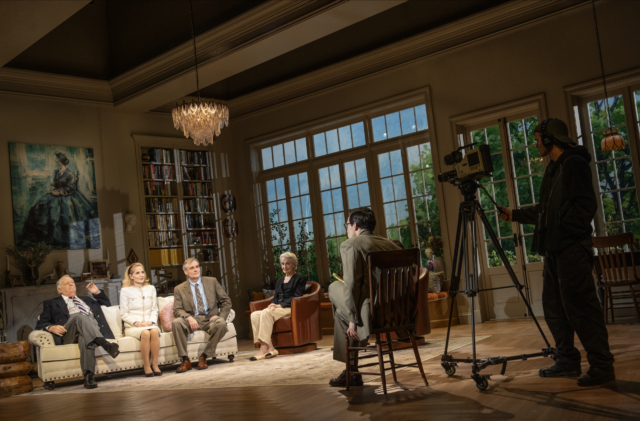
The media plays a key role in the attacks on a woman surgeon general nominee in An American Daughter (photo by Joan Marcus)
One of Walter’s prized former students, Quincy Quince (Carmen Zilles), drops by unannounced one afternoon; Quincy has become a celebrity since the publication of her book The Prisoner of Gender and is drawn to the limelight, especially when popular broadcaster Timber Tucker (Chris Ghaffari) and his cameraman kick off a series of interviews with Lyssa.
Lyssa’s nomination is immediately in jeopardy when Morrow lets it slip that Lyssa apparently ignored a jury duty notice and she remarks to Timber about her mother, “She was the kind of ordinary Indiana housewife who took pride in her icebox cakes and cheese pimento canapés.”
All hell breaks loose as people jockey for position, seek to protect or attack Lyssa, flirt with one another, and argue over a woman’s place in society. It all feels like much ado about nothing, whether it’s 1997 or 2026. Even if that’s part of the point — that it doesn’t take a lot to bring down brilliant women about to acquire some kind of power — the controversies inherent in the play ring false and are overly manufactured and manipulated.
The problems extend to the forced musical choices; the play begins with the hit song “You’re Sixteen,” a creepy tune about a man in love with a sixteen-year-old girl, while Walter is a big Beach Boys fan, which disappoints Quincy, who explains, “All that California crap is so limited in positive body imagery for women.” This play does not rely on subtlety in any way.
The revival was cobbled together from an unpublished second act and eight versions of the script, including from the 2000 Lifetime television movie featuring Christine Lahti, Tom Skerritt, Jay Thomas, Mark Feuerstein, and Thigpen. The result is an uneven pace and choppy transitions that director Sarna Lapine (Call Me Izzy, Little Women) is unable to smooth out. The impressive collection of award-winning pros seems lost, starting with Lichty, La Femme’s founding executive director, who is seriously miscast; nearly every performer is noticeably either too young or too old for their role. They wander aimlessly around Mikiko Suzuki MacAdams’s pristine Georgetown living room, the former home of general and president Ulysses S. Grant, as if it’s representative of the United States itself; in fact, Lyssa is named after her great-great-grandfather, and the family owns a treasured letter Grant sent to his wife, Julia, from Vicksburg, which is teased throughout the play.
At one point, discussing Grant’s failures and achievements, the senator says to Tucker, “We’re human, Timber, that’s what’s so timeless about Grant: His foibles are our foibles. He was a great American hero, imperfect like all of us.”
In 2015, I called Pam McKinnon’s Broadway revival of The Heidi Chronicles “a kind of tepid time-capsule experience that lacks energy and fervor.” Unfortunately, An American Daughter is much of the same, not timeless but certainly imperfect, overstuffed with foibles that feel dated and irrelevant today.
[Mark Rifkin is a Brooklyn-born, Manhattan-based writer; you can follow him on Substack here.]