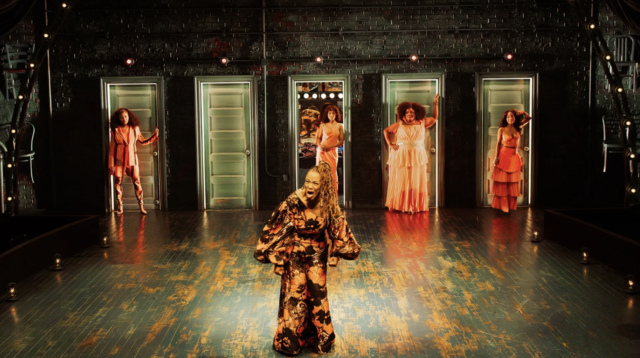
Five unique characters share their stories in The Whoopi Monologues at Lincoln Center (photo by Angela Marie Orellana)
THE WHOOPI MONOLOGUES
Lincoln Center Theater at the Mitzi E. Newhouse
150 West 65th St. between Broadway & Amsterdam Ave.
Tuesday – Sunday through August 30, $102.50 – $202.50
212-362-7600
www.lct.org/shows
In 1983, a little-known actress and comedian with the unlikely name Whoopi Goldberg, born Caryn Elaine Johnson in a Chelsea housing project, caused a sensation with The Spook Show, a solo performance at Dance Theatre Workshop in which she portrayed a collection of Black characters commenting on everyday life in America. Mike Nichols saw it, retitled it Whoopi Goldberg, and brought it to the Lyceum on Broadway in 1984; in 1985, it was adapted into an HBO special. I still remember how the HBO show blew me away; like so many other people, I had never seen anything like it.
It has now been reimagined by director Whitney White as The Whoopi Monologues, continuing at Lincoln Center’s Mitzi E. Newhouse Theater through August 30. Instead of having one actor portray all five characters — four from the original Broadway production and one introduced in the twentieth-anniversary revival — the outstanding cast features five actors taking on one role apiece.
The play begins as the ensemble gets ready in individual dressing rooms at the back of the stage, referencing the HBO show, which started with Goldberg walking into the Lyceum and knocking on dressing-room doors, saying hello to Fontaine, Blonde Girl, Surfer Girl, Jamaican Lady, and the Cripple through cinematic magic. It was a clever way of immediately giving the characters their individuality; Goldberg portrayed them in the same black-and-white costume, with only minor changes to help define each person.
But at the Newhouse, the actors appear in different costumes, designed by Tony winner Qween Jean, and distinctive hairstyles, by Nikiya Mathis, that further emphasize their uniqueness. In between scenes, they intermingle and go in and out of the dressing rooms as if deciding whose turn is next, adding a fun element to the proceedings.
Theater superstar and two-time Tony winner Kara Young (Purlie Victorious, Gruesome Playground Injuries) kicks things off as Fontaine, a gender-neutral street philosopher and junkie with a PhD who quickly sets the tone by wanting to kiss the hand of an audience member. “No, the one with the diamonds on it,” Fontaine says, adding after the smooch, “I’m glad you was cool enough to play. I noticed you didn’t clutch your pocketbook.” Fontaine explains, “I’m a thief. It’s the old American traditional gig. People always got stuff, people always want stuff. I provide a service.” Fontaine travels on a plane for the first time — the trip is hilarious — and heads to Amsterdam to visit the Anne Frank House, finding a kindred spirit in the young girl who had to hide from the Nazis, understanding the Jewish plight and comparing it to the civil rights movement.
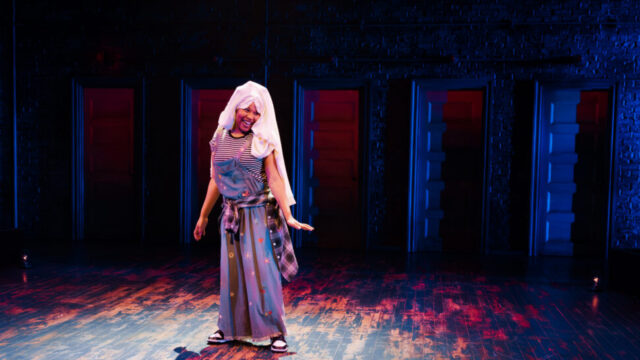
Dominique Fishback nearly steals the show as Blonde Girl in The Whoopi Monologues (photo by Angela Marie Orellana)
Emmy nominee Dominique Fishback (Swarm, The Deuce) is sensational as Blonde Girl, a seven-year-old who dreams of being white. She wears a white shirt over her head, dangling like blonde locks, and tells us she’s going to get blue eyes. “And then I’m gonna have a dream house and a dream car and dream candy and a dream horse and me and Barbie gonna live together with Ken and Skipper and Malibu Barbie. We are!” she declares. Like Fontaine, she interacts with the audience, asking a man or woman if she can touch their hair. It’s a particularly tense moment for the white people in the audience, who have been told again and again to respect and celebrate Black people’s hair without touching it.
The night I went, I saw Denise Manning (What to Send Up When It Goes Down, Amani), the understudy for Danielle Pinnock (Ghosts), as Jamaican Lady, who is hired by a wealthy elderly white man to leave her home in Kingston and come take care of him in America. A jaunty storyteller, she says, “I don’t know if you can tell that I’m Jamaican because I lost my accent,” which elicits laughter because she could not sound much more Jamaican. She refers to her new employer as the Old Raisin, a shriveled man. She asks the audience to join her in singing the well-known song from a Jamaica travel commercial, she talks about dentistry, but things take a turn when he wants her to do more than just cook and do the laundry.
Emmy winner Kerry Washington (Race, American Son) is next as Surfer Girl, a young teen who, despite her accent and subject matter, claims not to be a Valley girl, pointing out, “No, I’m a surfer because before there was the mall, there was the ocean, okay.” After a dalliance with a “total hunk” on the beach, she is pregnant, trying to figure out what to do. At confession, she tells the priest, “I’m totally with child, like Mary was with Jesus, except like I do know who the father was.” The adults around her are unhelpful, and she doesn’t understand the severity of her situation; she soon contemplates getting rid of the baby herself. [Note: Emmy nominee Jurnee Smollett (Lovecraft Country) has since taken over the role.]
The hundred-minute play concludes with Tony winner Kecia Lewis (Hell’s Kitchen, Dreamgirls) as Lurleen, who was added to the repertoire in 2004, replacing the Cripple. Lurleen is a delightfully open and honest woman freely sharing the details of going through menopause and what her life used to be like, delving into the future of her pudenda, the horror of hot flashes, sanitary napkins, girdles, the pill, erectile dysfunction, Sex and the City, waxing, and plastic surgery. Amid all the comedy are some serious explorations of race, misogyny, discrimination, and fear, especially when her son asks her, “Am I going to die on the way to school?” She also gets the audience to join in on the Hustle (humorously crediting it to jazz legend McCoy Tyner instead of Van McCoy).
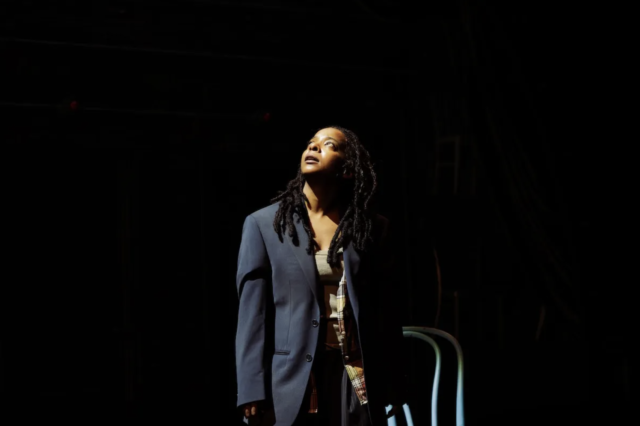
Fontaine (Kara Young) takes a life-changing trip to Amsterdam in Whoopi Goldberg revival (photo by Angela Marie Orellana)
In the fall of 2021, director Taibi Magar reimagined Anna Deavere Smith’s solo show, Twilight: Los Angeles, 1992, for five actors taking on some forty roles, which breathed new life into the play, ensuring it felt as vital as ever despite covering a tragic event that happened nearly thirty years before.
White (Jaja’s African Hair Braiding, On Sugarland) directs The Whoopi Monologues with a swift, infectious enthusiasm, giving plenty of room for the five extraordinary actors to embody their characters in their own way, rather than attempting to mimic Goldberg, although it’s difficult not to think of the originator of the material as the show progresses. Having them all together onstage, at the beginning, in between scenes, and at the end, makes it feel like they’re representing all women, everywhere.
However, some of the material is dated, as various references and other parts are old, the Jamaican Lady’s story is funny but obvious, Lurleen’s tale is too long, and the characters no longer shock like they did in the 1980s. But more than enough hits home in 2026, especially the elements relating to control of (Black) women’s bodies, inherent racism, and class conflict, to make this a necessary and vibrant reboot. Who would have thought in 1984 that the Civil Rights Act and Roe v. Wade would be gutted two generations later?
Speaking of her younger years, Lureen says, “We were being told that we could talk to anybody, anywhere, something new. We were told that we had peace in our hands. That we had the ability to change the world.”
Although a lot of progress has been made, it’s frightening to think that these struggles continue. Who knows how The Whoopi Monologues will be experienced in ten, twenty, or forty years.
[Mark Rifkin is a Brooklyn-born, Manhattan-based writer; you can follow him on Substack here.]