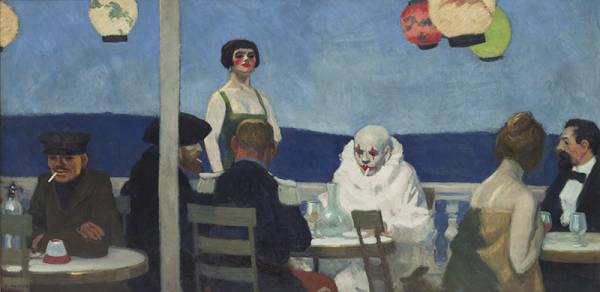
Edward Hopper, “Soir Bleu,” oil on canvas, 1914 (© Heirs of Josephine N. Hopper, photograph by Sheldan C. Collins)
Whitney Museum of American Art
945 Madison Ave. at 75th St.
Wednesday – Sunday through April 10
Admission: $12-$18 (pay-what-you-wish Fridays from 6:00 to 9:00)
212-570-3600
www.whitney.org
Throughout his long life, Edward Hopper (1882-1967) captured the lonely side of American life in his paintings, filling canvases with desolate streets that have not woken up yet (“Early Sunday Morning”) and solitary figures looking out windows and doorways (“South Carolina Morning,” “A Woman in the Sun”) as if there is something else, something more, out there. Even in works that feature more than one person, a single character stands out, like the smoking clown in “Soir Bleu.” And while several painting cliques tried to claim him as one of their own, including the Social Realists, the Precisionists, and the Ashcan School, Hopper never saw himself as part of those groups. There won’t be nearly as much loneliness as the Whitney’s “Modern Life: Edward Hopper and His Time” comes to a close this weekend. Visitors have been packing the gallery in its last days, getting lost in Hopper’s intriguing world view, alongside paintings, photographs, sculpture, and film by such Hopper contemporaries as Charles Burchfield, Reginald Marsh, Alfred Stieglitz, George Bellows, Charles Sheeler, and Ralston Crawford. Although the Whitney boasts a collection of some 2500 Hoppers, the works by others outnumber those by Hopper by nearly two to one here, and many of the Hopper canvases on view are familiar Whitney presences, but be on the lookout for several terrific etchings, prints, and drawings, including “Night Shadows” and “Untitled (Rooftops),” and the lesser-seen large-scale painting “Barber Shop.” You should also make your way to the small hallway leading to the bathroom to see photos of Hopper, his wife and model, Jo, and many of his colleagues. Although not a revelatory exhibit, “Modern Life” places one of America’s most important painters in historical and artistic context, especially his captivating use of color and light. The Whitney is also currently showing “Glenn Ligon: AMERICA,” “Legacy: The Emily Fisher Landau Collection,” “Singular Visions,” “Slater Bradley and Ed Lachman: Shadow,” and, beginning Friday, “Dianna Molzan: Bologna Meissen.”