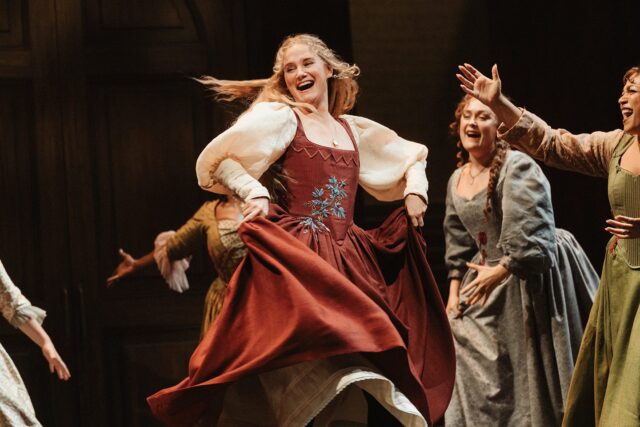
Jennifer Nettles wrote the book, music and lyrics for Giulia: The Poison Queen of Palermo and stars as the title character (photo by Andy Henderson)
GIULIA: THE POISON QUEEN OF PALERMO
Perelman Performing Arts Center (PAC NYC)
251 Fulton St.
Tuesday – Sunday through August 2, $88-$226
pacnyc.org
Jennifer Nettles’s Giulia: The Poison Queen of Palermo is a cleverly staged, rousing feminist fantasia about shame and sin, hypocrisy and justice, faith and grrl power. It’s a tasty concoction filled with fantastic period costumes and a beguiling set, playful choreography and soaring orchestrations, and far too many clichés and anachronisms; it will need significant work before achieving its Broadway aspirations, but in the meantime it is thrilling audiences at PAC NYC through August 2.
Nettles, a multiple Grammy and Country Music Association award winner, is a singer-songwriter, actress, and producer who has released such solo records as That Girl and a half-dozen albums as part of the duo Sugarland, starred on Broadway in Waitress and Chicago, and has appeared in such streaming series as The Righteous Gemstones and The Bondsman in addition to two Dolly Parton television biopics. Inspired by the story of seventeenth-century Italian apothecary and cosmetician Giulia Tofana, Nettles wrote the book, music, and lyrics for the show and takes on the title role. Not many details are known about the real-life Giulia, who might have been the world’s first female serial killer; regardless, she’s the center of a legitimate crowd pleaser.
It’s 1653, and Giulia runs an apothecary with her young daughter, Vitoria (Naomi Serrano), now that her former employee, Renata (Aubrey Matalon), is engaged to one of the Gambino twins. Giulia’s second husband, the wayward, unemployed drunkard Carlo (Matthew Amira), is incensed that Vitoria is now working and decides he has other plans for her, which sets Giulia in motion, prepared to do anything she can to protect her daughter.
Giulia caters to a wide range of women, including the pregnant Maria (Emily Fink), the Duchessa (Didi Romero), who always gets what she wants, and others who are experiencing various man troubles and marital oppression. They come to Giulia and beg, “Help me, sister.” With a potion brought to her by the mysterious conjurer La Capitana (Bre Jackson), Giulia knows how to cure what ails her customers, and herself.
“There’s a poor parade of women coming in my door / I can tell you what each of them is here for / Sophia comes on Tuesdays / She doesn’t have much time to waste / And it’s the first time Isabell’s been hit / I can tell by the sad look on her face / Angelina knows the hurting on both sides of birthing / And Theresa is so desperate for a baby / She’s just starting a journey,” Giulia sings. “They will come to heal their wounds / They will come to hear the stars / They will come to fill or empty their wombs / Cover their bruises / Mend their broken hearts / All of them come in an hour of need / Looking for a glimmer of hope / And I try but I know / It’s never enough.”
Meanwhile, there is a power struggle going on between the Cardinale (Quentin Earl Darrington), who follows the precepts of the church, and the slimy new Governatore (Christopher M. Ramirez), who is instantly attracted to Vitoria.
As the body count rises, so do Giulia’s chances of getting caught.
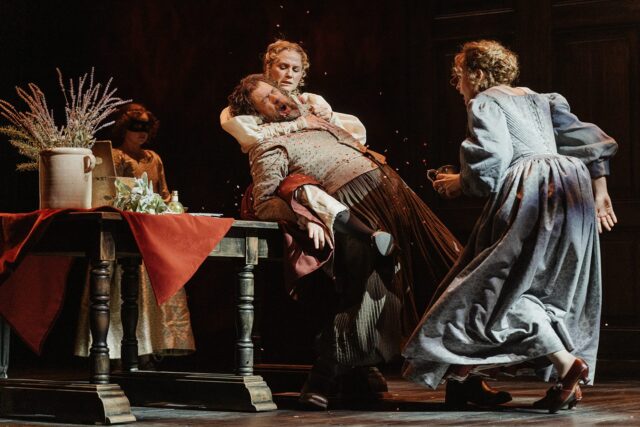
Men better watch out in world premiere musical inspired by a somewhat true story (photo by Andy Henderson)
Evoking such films as Kill Bill, Thelma & Louise, Perfume: The Story of a Murderer, and Black Widow, Giulia: The Poison Queen of Palermo feels fresh and relevant to what is happening today, particularly in the neverending saga of the Epstein Files. Giulia is a heroic figure, albeit one who wrestles with her conscience.
Daniel Ostling’s gorgeous set features a large staircase stage left and a wall of doors and windows stage right that open up to reveal changing scenery behind them, from the apothecary to a church to a nunnery. Ana Kuzmanić’s end-of-the-Renaissance costumes are a delight, swirling amid Austin McCormick’s appropriately unextravagant choreography. The unseen eight-piece band is conducted by arranger, music director, and keyboardist Adam Rothenberg.
Nettles is magnetic as Giulia; you just can’t get enough of her, even with a probably unnecessary encore number during the curtain call. She practically glows throughout the show, her eyes shining at the audience like she’s wrapping her arms around us. The entire cast is terrific, with a special nod to Sam Simahk as Father Paolo, the only male character with any sense of decency and fairness, up to a point.
Songs such as “What Happens Next?,” “Next Time,” and “Fly Away” are too general; they could fit into many musicals without making any tweaks to the lyrics. “Happily Ever After” veers too close to Fiddler’s “Matchmaker.” Ramirez scores with “Bones,” Darrington’s baritone rattles the theater in “Original Sin,” and the women come together for a sparkling “Power.”
Water streams through the show as a metaphor for life, purification, resilience, and hope in a changing world. “You are the river / You are unstoppable / You’ll flow around every obstruction and break through / Every obstacle / You are as soft and humble as a single drop of rain / Or you can make canyons out of cliffs / With just the power of your rage / They don’t know you / Or the power that flows through. . . . Because water is the only / thing they cannot break,” Giulia sings in “The River,” a song that encapsulates what is both right and wrong about the lively and spirited production as a whole.
[Mark Rifkin is a Brooklyn-born, Manhattan-based writer and editor; you can follow him on Substack here.]