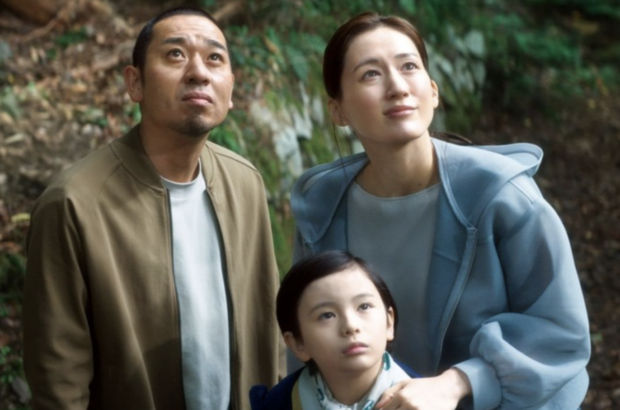
Hirokazu Koreeda’s Sheep in the Box closes the 2026 Japan Cuts festival
JAPAN CUTS: FESTIVAL OF NEW JAPANESE FILM
Japan Society
333 East 47th St. at First Ave.
July 8–19, $16-$20
www.japansociety.org
“The world is full of strange things,” a narrator says in one of the films that make up this year’s “Japan Cuts: Festival of New Japanese Film,” running July 8–19 at Japan Society. As always, the nineteenth edition of the hotly anticipated series is chock full of strange things, as well as things of beauty — and often both at the same time.
Japanese films may come in all genres, but the best of the best tend to veer off track into their own indefinable categories, and the 2026 iteration is no different, with more than its share of exciting, unusual, frightening, romantic, bloodthirsty, chilling, touching, and gorgeous works. There are twenty-seven programs divided into five sections: “Feature Slate,” “Next Generation,” “Classics,” “Documentaries,” and “New Directions in Japanese Cinema.”
The festival opens July 8 with Yoji Yamada’s ninety-first full-length film, Tokyo Taxi, followed by a reception with Twisty BonBon. The centerpiece selection is Kei Ishikawa’s A Pale View of Hills, followed by a Q&A and reception with star Suzu Hirose, winner of the Cut Above award. The closing-night film is Hirokazu Koreeda’s Sheep in the Box, followed by a Q&A and reception with the director.
Below is a look at some of the other highlights, with more strangeness to come.
SHUFFLE (『シャッフル』) (Gakuryu Ishii, 1981)
THE MASTER OF SHIATSU (『指圧王者』; SHIATSU OJA) (Gakuryu Ishii as Sogo Ishii, 1989)
Saturday, July 11, 5:30
japansociety.org
One of the myriad reasons to check out Japan Cuts is for double features such as this wild one, the world premieres of 4K restorations of Gakuryu Ishii’s 1981 thirty-seven-minute Shuffle and 1989 thirteen-minute The Master of Shiatsu.
The Master of Shiatsu begins with a close-up of a woman’s left hand stroking a man’s right hand in what appears to be an elegant bar. Bright lights glow from the contact, a crazy laugh is heard, and the opening credits roll, the title in a wacky design reminiscent of 1970s wuxia films. Ishii then cuts to a feather floating into a candle and a woman (Anna Hole) getting a deep, erotic massage from an older man (Tokujiro Namikoshi, the real-life Father of Shiatsu). Wonderfully cheesy special effects take them both to another dimension, leading to a very strange but optimistic finale.
Inspired by Katsuhiro Otomo’s manga Run, the mostly black-and-white Shuffle begins with a close-up of a young punk, Hiroshi Kobayashi (Yosuke Nakajima), cutting off his hair when a small earthquake hits, knocking down some of the bullets next to a handgun. He peers out his window at two men in suits surveilling the area, then heads outside, where he is spotted by one of the detectives (Tatsuya Mori). What ensues is one of the wildest foot chases you’ve ever seen, a brilliantly filmed frenetic pursuit, set to Hikashu’s propulsive score, in which neither man is willing to give up. The action cuts away a few times to reveal a back story involving a femme fatale, Naomi (Shigeru Muroi), and a gangster, Kimura (Genjirō Arato), but keeps returning to the seemingly endless hunt, with Kobayashi hallucinating, in color, moments from his past.
Both films create fantastical realities with characters immersed in activities that release endorphins and dopamine that the audience tunes in to, The Master of Shiatsu slowly paced and intimate, Shuffle a marathon sprint Ishii called “a portrait of my generation.” I dare you to not think about these films the next time you get a massage or go running, for whatever reason.
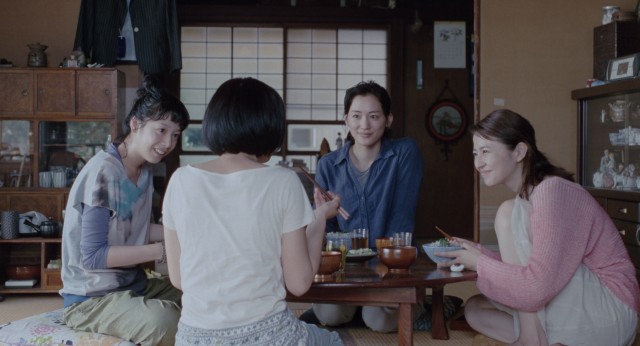
Four sisters come together after their father’s death in another masterpiece from Hirokazu Koreeda
OUR LITTLE SISTER (Hirokazu Koreeda, 2015)
Sunday, July 12, 8:00
japansociety.org
sonyclassics.com
In such films as Still Walking, Nobody Knows, and Like Father, Like Son, Japanese writer-director-editor Hirokazu Koreeda has crafted beautifully told tales of parents and children, of estrangement and divorce, of death and ritual and the unbreakable bonds between siblings. In yet another minimalist masterpiece, Our Little Sister, he focuses on the women of the happily dysfunctional Kōda family in the scenic city of Kamakura. Sachi (Haruka Ayase), Yoshino (Masami Nagasawa), and Chika (Kaho) live together in a large house, where they go about their days with the normal trials and tribulations of twentysomething women. Sachi, the oldest, is a nurse who acts as a surrogate mother to her younger sisters, since their real mother plays almost no role in their lives. Yoshino, the middle sister, works in a bank and likes to stay out late drinking and partying. And Chika, the baby of the trio, is sweet and goofy, but not as goofy as her mountain-climbing boyfriend. When their long-estranged father dies, they decide to attend the funeral, where they meet their dad’s thirteen-year-old daughter from his second of three marriages, Suzu Asano (Suzu Hirose), a solid, smart girl who seems a bit lost now that both of her parents are dead. So the three older sisters invite her to move in with them in Kamakura and extend their family. The four immediately grow close as they live their daily lives, going to work or school, eating together, interacting with the opposite sex, and honoring their deceased ancestors. Suzu also regales them with tales of their father, some of which surprise them. Not a whole lot happens except a series of heartfelt, realistic scenes that audiences of all kinds can relate to.
Freely adapted from Akimi Yoshida’s josei manga Umimachi Diary, Our Little Sister simmers with the beauty and energy of real life, as Koreeda offers viewers a fly-on-the-wall look at four exquisite women living day by day. Koreeda once again blends documentary techniques with the intimate style of Yasujirō Ozu to fully develop his delightful characters, from the four sisters to their great-aunt to a student smitten with Suzu to local diner owner Sachiko Ninomiya (Jun Fubuki), who serves as a kind of tenderhearted matriarchal figure to the community. Yoko Kanno’s sweet music and Mikiya Takimoto’s lovely cinematography make it all a visual and aural pleasure, along with a fabulous cast that acts with an infectious naturalism. No one makes family dramas like Koreeda, who skillfully avoids treacly plot twists in favor of simplicity, making it all seem easy. If you’ve never seen a Koreeda film, Our Little Sister is a great place to start, and if you have experienced any of his previous work, this one is another gentle, graceful, and immensely engaging tour de force from one of the world’s most talented and original filmmakers. His latest, Sheep in the Box, closes “Japan Cuts” on July 19.
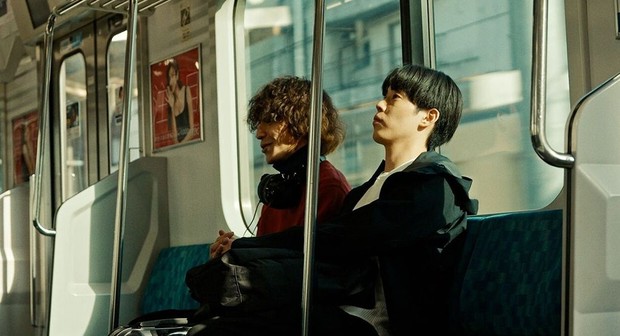
Kura (Kei Nakafuji) and Kishida (Kai Fujita) are reunited high school friends in Gingerboy
GINGERBOY (『ジンジャーボーイ』; JINJABOI; SEPARATED) (Miki Tanaka, 2024)
NAOMI OUT OF SYNC (『空回りする直美』; KARAMAWARI SURU NAOMI) (Fuku Nakazato, 2025)
Tuesday, July 14, 9:00
japansociety.org
The North American premiere of Miki Tanaka’s forty-eight-minute Gingerboy and the international premiere of Fuku Nakazato’s forty-four-minute Naomi Out of Sync make for a strangely compelling double feature. Part of “Next Generation,” in which one filmmaker will take home a three-thousand-dollar stipend, the movies both explore offbeat relationships, obsession, and physiological and neurodevelopmental conditions.
Winner of a joint third prize La Cinéf Selection award at Cannes, Gingerboy reunites high school friends Kishida (Kai Fujita) and Kura (Kei Nakafuji), whose lives have gone in opposite directions. The former is a regional banker who has been transferred to Tokyo, while the latter is an aspiring ne’er-do-well filmmaker. Kishida puts on a suit for work and has a girlfriend back home; he is quiet and unassuming, serious about his career. “I’m not nice,” he admits to a coworker. “It’s just a hassle to say no.” Kura is unpredictable and unkempt, wasting away the days and partying at night with booze and women. At first Kishida goes out with Kura, but he soon makes some discoveries about his roommate that complicate their friendship, even as Kura grows more dependent on him. Nakazato creates unique characters in knotty situations in a tense narrative that builds to a moving conclusion that provides no easy answers.
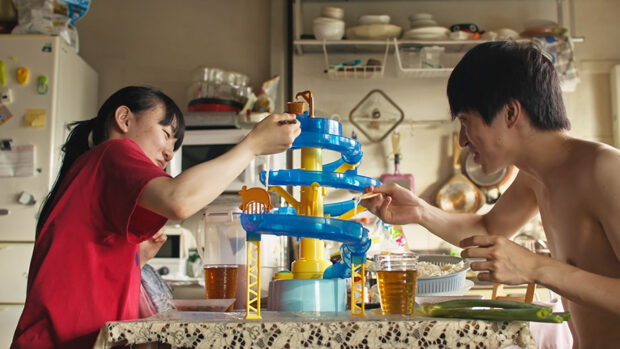
Naomi (Kono Adachi) and Shingo (Masafumi Shinohara) try the best they can in Naomi Out of Sync
In Naomi Out of Sync, Kono Adachi is delightful in the title role, an eighteen-year-old part-time employee caring for her her older brother, Shingo (Masafumi Shinohara), who has debilitating Tourette’s, while her father (Wataru Ohshige) is away. Naomi works at a supermarket but has trouble focusing on her job; when she gets disciplined, it looks like she’s not taking it seriously, but that’s just the way she approaches life. “What goes on in her head? And she always smiles when I scold her. What is she grinning about?” her boss asks another manager. When Shingo sells her clothes so he can buy a plastic toy, instead of getting mad, Naomi slurps down noodles she and Shingo slide through the toy. Naomi’s main responsibility is to make sure Shingo takes his medication, but when that goes awry, serious problems arise. But as her T-shirt says: “Fully honest: Believe in yourself.”
Winner of the Grand Prize at the PIA Film Festival, Naomi Out of Sync is an affecting drama about a dysfunctional family in which the two kids are trying to do the best they can, not unlike Kishida and Kura in Gingerboy. Kono is mesmerizing as Naomi; even when Naomi makes questionable decisions, you can’t help but be charmed by her, rooting her on as she stands by her choices. And oh, that surprise ending, one that is deeper than you might first imagine.
[Mark Rifkin is a Brooklyn-born, Manhattan-based writer; you can follow him on Substack here.]