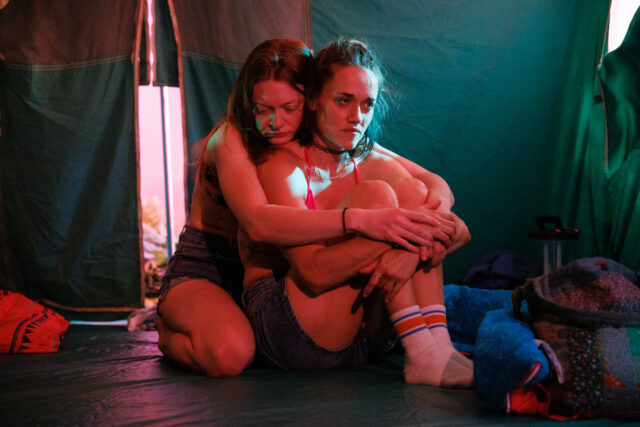
Ari (Colby Minifie) and Brit (Alice Kremelberg) hold on to each other for dear life in Victoria Lynne Barclay’s Camping (photo by Maria Baranova)
CAMPING
HERE Arts Center
Dorothy B. Williams Theatre
145 Sixth Ave.
Tuesday – Sunday through July 11, $10.50-$126 (GA $31.50)
here.org
coltcoeur.org
My decades of camping with grade school and junior high besties — all guys — were never quite like this.
Victoria Lynne Barclay’s Camping is an intense, exhilarating, frustrating, and moving story of female friendship that unfolds in the same green tent over the course of many years as two women who’ve known each other since infancy share their hopes and dreams, choosing different paths as time progresses and their lives change — or don’t.
The two-character play begins when Ari (Colby Minifie) and Brit (Alice Kremelberg) are fifteen years old, in ninth grade, waiting for two boys to show up to relieve them of their virginity. Ari has brought a ham sandwich, condoms, and a towel for the blood.
“I just want it to be over. I want it to be like two hours from now right now,” Brit says. The girls wrestle, crack jokes, and betray their innocence — Brit admits she has never been kissed — as they contemplate what is about to happen, something that they feel destined to experience together. After it’s over, their conversation is both very funny and unsurprising — they don’t fully understand what just occurred and how they’re supposed to feel. “We should have rescheduled,” Ari says. Brit replies, “‘Hello thank you for coming-or-probably-not-coming-we’re-not-sure-we’re-going-to-check-the-condom-outside but we’re afraid we will need to reschedule.’”
They were expecting fireworks, but instead they are left wondering if sex of any kind will ever be pleasurable.
“I guess I just thought I was supposed to like find something out? Something that wasn’t sore?” Ari explains. “I thought I was supposed to, like, not learn something, just like find this, like . . . unfound part of myself.”
Three years later, they are Girl Scout troop leaders dealing with a thirteen-year-old who demands a party for getting her period, and in anger she threw her bloody towel at Brit, echoing the towel Brit had when first having sex. Not recognizing the similarities between them and the younger girls, Brit asks not so rhetorically, “Can we just leave them here in the woods?” Brit answers, “They’ll kill each other within hours. . . . Tell them it’s how they get their like, their, Wilderness Survival badge. Hunt for your food with the towel. Kill each other in cold blood and clean it up with the towel. Survive, but be forever irreversibly changed because of the towel. Then you get a cute badge.” It’s a none-too-subtle truth about women and original sin.
But soon their relationship takes a major turn when Ari casually mentions that she will be leaving the following month to go to Ohio University, which devastates Brit, who believed their plan was to stay in town and attend Shawnee State together. “Do you hate it here that much?” Brit asks. “You hate it here,” Ari counters, to which Brit argues, “We hate it here. That’s the fucking point. When you leave and I stay I’m just a miserable loser who hates her hometown. I can’t believe you didn’t tell me.”
As time goes on, Ari and Brit return to the tent at significant moments of their lives, examining the choices they’ve made — or were made for them — rehashing old wounds, and trying to find out why and where it all went astray. One choice in particular looms over them like a curse.
“Why didn’t you give your brother his tent back?” Ari asks when they are thirty. “It’s the only place in my life where anything exciting has ever happened,” Brit replies.
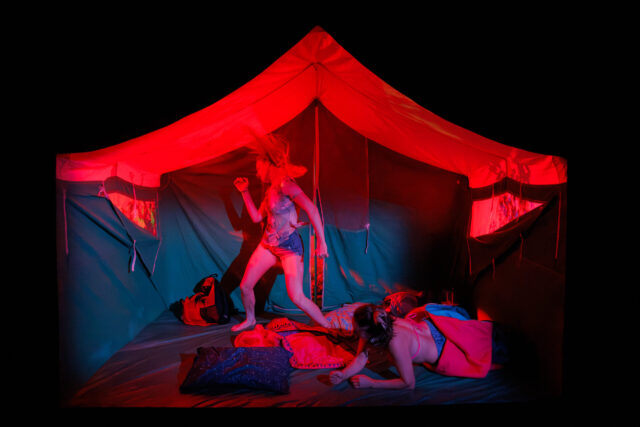
Ari (Colby Minifie) and Brit (Alice Kremelberg) share their hopes and dreams, along with their failures and disappointments, in Camping at HERE Arts Center (photo by Maria Baranova)
The Colt Coeur production is beautifully directed by Adrienne Campbell-Holt (Still, Eureka Day, Downstairs) in the confined, claustrophobic space of the tent, which is at the center-middle of the stage, darkness on either side, like a window the audience is peering into as if voyeurs. (The set is by Krit Robinson, with clever costumes by Sarita P. Fellows and props by Thomas Jenkeleit.) At ninety minutes, it could use some trimming, although being in the presence of these two young women is continually exciting.
Ari and Brit were born and raised in a trailer park community; the tent serves as an oasis, a hideaway from a bleak, limiting life. Vittoria Orlando’s lighting and Salvador Zamora’s sound regularly remind us, and them, that there is an outside world that the two friends are escaping from, at least temporarily, a place where they can be themselves, talk about sex, drugs, and music, about love, loss, and longing, to hold each other closely.
Kremelberg (Dry Land, & All Our Yesterdays) and Minifie (Long Day’s Journey into Night, Epiphany) have an alluring, fiery chemistry that builds as the years fly by; the time shifts are a bit awkward at first, but the two actors help smooth out the narrative bumps with small tweaks to their characters. When Ari and Brit argue over the former’s leaving, Minifie stands tall, barely fitting into the tent, as if she’ll burst through it. Later, when the latter is lamenting her situation, she practically crawls into a fetal position, almost disappearing.
In a program note, Barclay refers to the show as “a love story. It’s hands that smell of Dolce and Gabbana Light Blue after days spent clutching fistfuls of her hair. It’s the rain hitting the earth in a way that reminds you of blood, that makes you think the world’s holding a knife to your underwear. It’s the spins. It’s running out of air because you gulped too much of it while you were sobbing. It’s waking up hot and sticky. It’s desperately falling in love with your best friend inside a camping tent while everything outside rages.” She adds that she spent a lot of time in tents when she was a young bairn in Scotland, growing up and learning about life, and that’s what happens with Ari and Brit.
Camping might not be like the camping my buddies and I used to do, but it’s a trip well worth taking, one that will have you thinking about the paths you took, and those you didn’t.
[There will be talkbacks with Trans Literacy Project founder Maybe Burke following the June 27 performance and with Colt Ceur founding artistic director Campbell-Holt, Kremelberg, and Minifie after the June 30 show. Mark Rifkin is a Brooklyn-born, Manhattan-based writer; you can follow him on Substack here.]