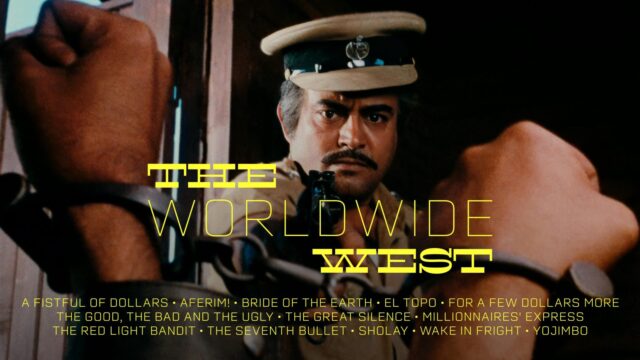
THE WORLDWIDE WEST
Metrograph
7 Ludlow St. between Canal & Hester Sts.
July 3 – August 2
metrograph.com
Film doesn’t get much more American than the Western, and Metrograph is paying tribute to the art form with “The Worldwide West,” a celebration of international movies that reimagine the US frontier for their countries. In honor of the 250th birthday of the United States, Metrograph is screening works by Yılmaz Güney (Kurdish), Sammo Kam-Bo Hung (Hong Kong), Alejandro Jodorowsky (Chile and France), Radu Jude (Romania), Ted Kotcheff (Canada), Akira Kurosawa (Japan), Sergio Leone (Italy), Ramesh Sippy (India), Ali Khamraev (Uzbekistan), and Rogério Sganzerla (Brazil).
The thirteen films will be shown July 3 to August 2; below is a look at some of the highlights. For cool avant-garde Westerns, check out the concurrent Anthology series “Experimental Westerns, Part 1: Avant-Garde Westerns” here.
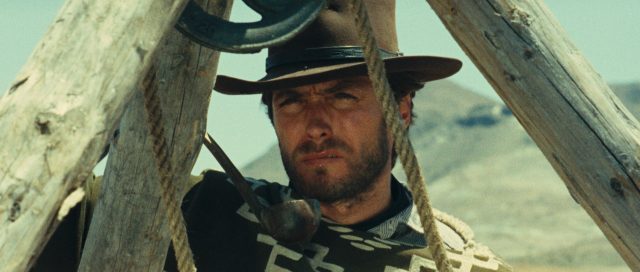
Clint Eastwood introduces the Man with No Name in Sergio Leone’s A Fistful of Dollars (photo courtesy MGM / Cineteca di Bologna / Park Circus)
A FISTFUL OF DOLLARS (PER UN PUGNO DI DOLLARI) (Sergio Leone, 1964)
Friday, July 3, 3:35
Sunday, July 5, 2:00
Wednesday, July 8, 4:00
metrograph.com
Clint Eastwood made a name for himself on the big screen playing the Man with No Name in Sergio Leone’s 1964 spaghetti Western, A Fistful of Dollars. In his first lead movie role, Eastwood, the costar of the television series Rawhide, is a gunslinger draped in a poncho and smoking a small cigar who rides on a mule into San Miguel, a tiny town in the middle of nowhere, home to an ongoing feud between the gun-running Baxters and the liquor-dealing Rojos. The stranger decides to play both sides against the middle, caring only that he earns lots of cash. “Never saw a town as dead as this one,” the stranger tells saloon owner Silvanito (Jose Calvo), who explains, “The place is only widows. Here you can only get respect by killing other men, so nobody works anymore.” The stranger hears the sound of banging outside and says, “Somebody doesn’t share your opinion.” Silvanito opens the window to reveal old man Piripero (Joe Edger) making coffins. “You’ll be a customer,” Silvanito tells the stranger with assurance. The stranger goes back and forth between the Baxters, led by the sheriff (W. Lukschy), and the Rojos, who follow the dangerous, unpredictable Ramón (Gian Maria Volontè). Also caught up in the Hatfield-McCoy battle are the sheriff’s wife, Consuelo (Margherita Lozano), and brother, Antonio (Bruno Carotenuto), along with Rojo brothers Benito (Antonio Prieto) and Esteban (S. Rupp) and their enforcer, Chico (Richard Stuyvesant). Ramón, meanwhile, has his eyes set on Marisol (Marianne Koch), who is married to Julio (Daniel Martín), who does not want to get involved in any fighting. Carefully watching it all is Juan de Díos (Raf Baldassarre), who rings the church bell at every death.
The Italian-German-Spanish production is a remake of Akira Kurosawa’s Yojimbo, which led to legal entanglements when the Japanese auteur demanded, well, a fistful of dollars in financial compensation. According to Christopher Frayling’s Sergio Leone — Something to Do with Death, Leone received a note from Kurosawa that read, “Signor Leone — I have just had the chance to see your film. It is a very fine film, but it is my film. Since Japan is a signatory of the Berne Convention on international copyright, you must pay me.” Frayling also suggests that Leone was influenced by Dashiell Hammett’s Red Harvest and Carlo Goldoni’s Servant of Two Masters and did not feel he was stealing only from Kurosawa. In The BFI Companion to the Western, Frayling quotes Leone as saying, “Kurosawa’s Yojimbo was inspired by an American novel of the serie-noire so I was really taking the story back home again.” (For a montage of similarities between the two films, check out this video.). Regardless, A Fistful of Dollars, made for about two hundred grand, set the standard for the new genre, and Eastwood was its antihero. He and Leone would team up again on the sequel, For a Few Dollars More, which is not a direct remake of Kurosawa’s Yojimbo follow-up, Sanjuro, as well as The Good, the Bad, and the Ugly, the best of the Dollars Trilogy.
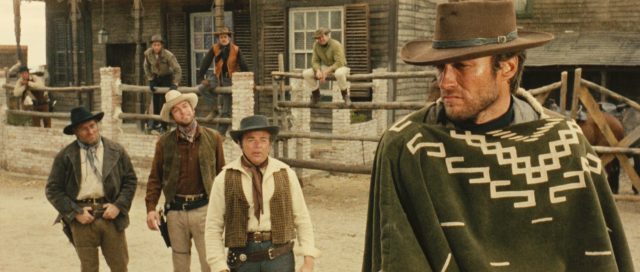
Clint Eastwood watches his back in first of the Dollars Trilogy (photo courtesy MGM / Cineteca di Bologna / Park Circus)
Fistful is steeped in violence and death, from Iginio Lardani’s rad title sequence of silhouettes in black, white, and blood red to an early shot of the stranger riding under a noose and giving it a long look. Whereas Toshirô Mifune played the bodyguard in Yojimbo with a devilish glee, Eastwood — in a role that had been previously offered to Henry Fonda, Charles Bronson, James Coburn, and others — is much more serious as the Man with No Name, who would become more sympathetic in future outings. The extremely poor dubbing only adds to the film’s magnificence. To enhance its foreign appeal to American audiences, several members of the cast and crew appear under pseudonyms in the credits, including Leone (Bob Robertson), cinematographer Massimo Dallamano (Jack Dalmas), actor Gian Maria Volontè (John Wells), and composer Ennio Morricone (Leo Nichols or Dan Savio). There is no mention of Kurosawa or Yojimbo anywhere.
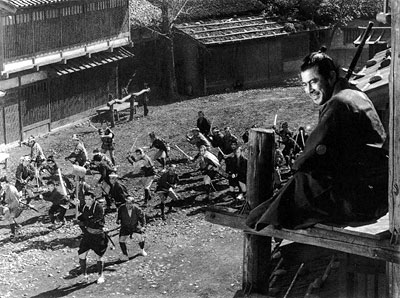
Toshirō Mifune can’t believe what he sees in Akira Kurosawa’s Yojimbo
YOJIMBO (Akira Kurosawa, 1961)
Friday, July 3, 1:15
Sunday, July 5, 11:30 am
Saturday, July 11, 11:30 am
metrograph.com
Kuwabatake Sanjuro (Toshirō Mifune) is a lone samurai on the road following the end of the Tokugawa dynasty in yet another of Akira Kurosawa’s unforgettable masterpieces, which was inspired by Dashiell Hammett’s Red Harvest. Sanjuro comes to a town with two warring factions and plays each one off the other as a hired hand. Neo’s battles with myriad Agent Smiths are nothing compared to Yojimbo’s magnificent swordfights against growing bands of warriors that include the evil Unosuke (Tatsuya Nakadai), who is in possession of a new weapon that shoots bullets. Try watching this film and not think of several Clint Eastwood Westerns (including Sergio Leone’s pasta remake, A Fistful of Dollars) as well as High Noon.
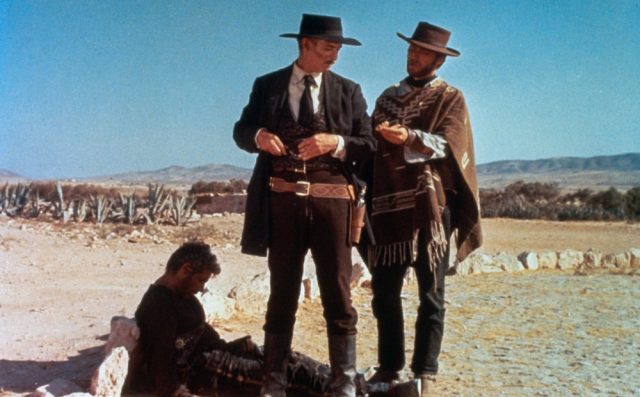
Rival bounty killers colonel Douglas Mortimer (Lee Van Cleef) and Manco (Clint Eastwood) join forces in Sergio Leone’s For a Few Dollars More
FOR A FEW DOLLARS MORE (PER QUALCHE DOLLARO IN PIÙ) (Sergio Leone, 1965)
Saturday, July 4, 1:10
Sunday, July 5, 4:15
Sunday, July 12, 11:15 am
metrograph.com
Determined to capitalize on the immediate success of A Fistful of Dollars, director and cowriter Sergio Leone and stars Clint Eastwood and Gian Maria Volonté quickly got back in the saddle to make the initially underrated, now celebrated follow-up, For a Few Dollars More. In the 1965 spaghetti Western, filmed in Almería, Spain, and at Rome’s Cinecittà Studios — and featuring a town doubling as El Paso built by production designer Carlo Simi that still stands today, part of the MiniHollywood theme park in Tabernas — Eastwood is a bounty killer that some call Manco, but he is essentially the Man with No Name again. He travels from wretched place to wretched place with his horse, poncho, cigar, squinty eyes, and guns, shooting criminals and collecting rewards. When he encounters a rival, former Confederate colonel Douglas Mortimer (Lee Van Cleef), they are initially at odds, going after the same trophies, but they ultimately decide to join forces to capture and kill El Indio (Volonté), a murderous psychopath who likes to use a pocket watch that plays a gentle tune when opened when he is getting ready to shoot someone, an element from his past (involving a mystery woman played by Rosemary Dexter) that haunts him. Manco embeds himself with Indio’s mangy gang, which includes Groggy (Luigi Pistilli), Niño (Mario Brega), Cuchillo (Aldo Sambrell), Tomaso (Lorenzo Robledo), Sancho Perez (Panos Papadopulos), Slim (Werner Abrolat), Blackie (Frank Braña), Chico (José Canalejas), Frisco (Antonio Molino Rojo), Hughie (Benito Stefanelli, who was in all three Dollars films), and Wild (the one and only Klaus Kinski). As Indio prepares to rob a bank in El Paso, a series of double crosses and personal vengeance lead to a memorable ending.
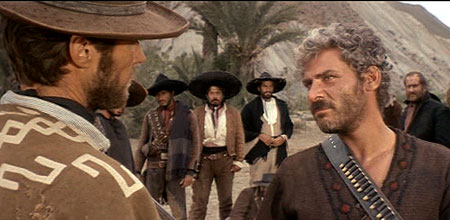
Manco (Clint Eastwood) becomes part of Indio’s (Gian Maria Volonté) gang in For a Few Dollars More
Written by Leone and Luciano Vincenzoni with added dialogue by Sergio Donati, For a Few Dollars More fits right in between A Fistful of Dollars and The Good, the Bad, and the Ugly, from its overall look and mood to Ennio Morricone’s stupendous score and Massimo Dallamano’s beautiful cinematography, both veterans of Fistful. Eastwood further established his ability to carry a film as a compelling antihero, Van Cleef (How the West Was Won, Escape from New York) earned one of the three title roles in Ugly, and Volonté, who would go on to make such classics as A Bullet for the General, Investigation of a Citizen Above Suspicion, and Christ Stopped at Eboli, is superbly grimy as a brutal villain hiding a soft spot. Genre tropes abound, highlighted by Leone’s love of close-ups of his characters’ eyes, shifting from one side to the other as they face their destinies.
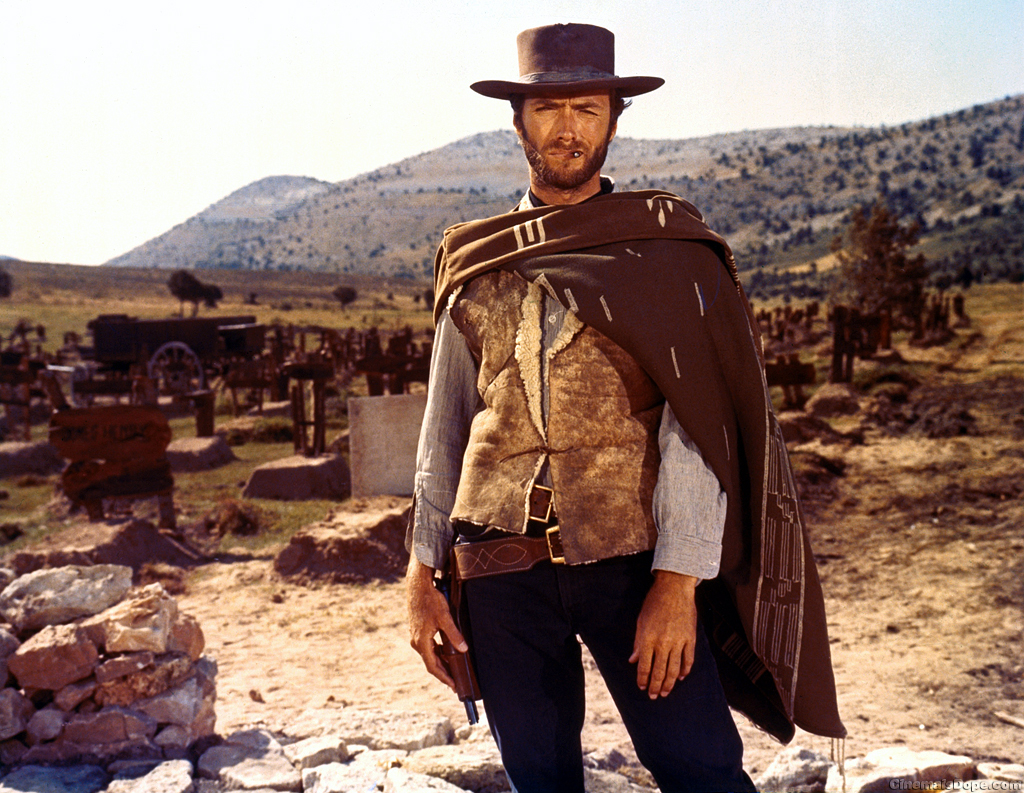
Clint Eastwood is the Good in classic Sergio Leone operatic oater
THE GOOD, THE BAD AND THE UGLY (Sergio Leone, 1966)
Friday, July 10, 2:30
Sunday, July 12, 2:00
metrograph.com
One of the all-time-great spaghetti Westerns, Sergio Leone’s dusty three-hour operatic oater stars Clint Eastwood as the Good (Blondie), Lee Van Cleef as the Bad (Angel Eyes), and Eli Wallach as the Ugly (Tuco Benedicto Pacifico Juan Maria Ramirez, whose list of criminal offenses is a riot), three unique individuals after $200,000 in Confederate gold buried in a cemetery in the middle of nowhere. Nearly twenty minutes of never-before-seen footage was added to the film several years ago, with Wallach and Eastwood overdubbing brand-new dialogue, so if you haven’t seen it in a while, it might just be time to catch it again. Ennio Morricone’s unforgettable score and Torino delli Colli’s gorgeous widescreen cinematography were also marvelously enhanced; their work in the scene when Tuco first comes upon the graveyard will make you dizzy with delight. And then comes one of the greatest finales in cinema history.
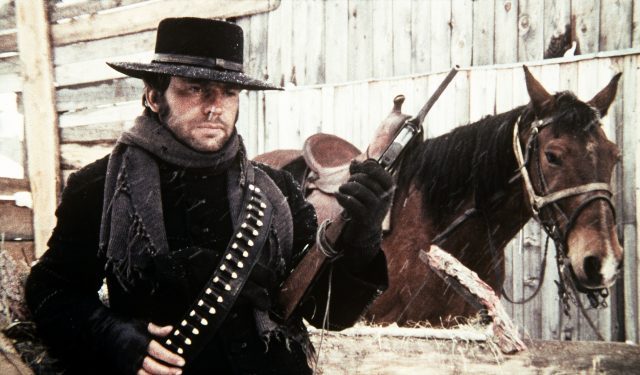
Jean-Louis Trintignant stars as a mute antihero in Sergio Corbucci’s The Great Silence
THE GREAT SILENCE (IL GRANDE SILENZIO) (Sergio Corbucci, 1968)
Friday, July 17, 1:50
Saturday, July 18, 3:35
After half a century, Sergio Corbucci’s underseen masterpiece, The Great Silence, was finally released in the United States in 2018, in a gorgeous fiftieth anniversary restoration. Corbucci’s revisionist spaghetti Western was shot by Silvano Ippoliti in the Dolomites in northeastern Italy, where luxurious white snow (actually shaving cream) goes on forever until it is stained with so much blood. French star Jean-Louis Trintignant plays a variation of the quiet hero who lets his guns do his talking; Trintignant, who did not speak English, is Silence, who, as a young boy, witnessed the merciless murder of his parents by bounty killers and is rendered mute with a knife to prevent his testimony. Years later, now an adult, Silence, with his unusual Mauser C96, roams the land in search of bounty killers, getting them to draw first so he can then fire back in self-defense, shooting off their thumbs so they can never use a gun again. It’s 1898, and hard times have come to Snow Hill, leading many average citizens to break laws just to put food on the table. Greedy banker Henry Pollicut (Luigi Pistilli) puts a price on their heads, wanted dead or alive, attracting various bounty killers, including the notorious Loco (German star Klaus Kinski), aka Tigrero, who never brings his targets in breathing, no matter how minor their crimes. Relatively hapless sheriff Gideon Burnett (Frank Wolff) is caught somewhere in the middle, as it’s Loco who is on the right side of the law and Silence who is walking a fine line about what’s legal. After Loco kills James Middleton, his widow, Pauline (Vonetta McGee), hires Silence to gain revenge, setting the stage for one of the most brutal endings in the history of cinema.
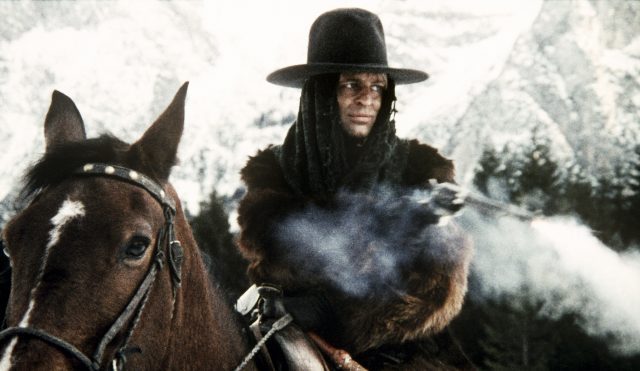
Klaus Kinski is a vicious bounty killer on the right side of the law in Corbucci masterpiece
The pairing of Trintignant, who had gained international fame in Claude Lelouch’s A Man and a Woman, and Kinski, who had made such previous Westerns as Damiano Damiani’s A Bullet for the General and Sergio Leone’s For a Few Dollars More, has a dark magic, particularly since their characters are not clear representations of good vs. evil. Each one uses their eyes to intense dramatic effect, with Trintignant particularly effective since he doesn’t speak a word — just wait till you see him scream. In her film debut, McGee (Blacula, Repo Man) brings a stark sensitivity to Pauline; her interracial love scene was shocking for the genre, especially with Corbucci (Django, Navajo Joe) handling it in such a gentle way. Meanwhile, composer Ennio Morricone (Once Upon a Time in the West; The Good, the Bad, and the Ugly) delivers one of his most emotional and wide-ranging scores. Fifty years on, The Great Silence can still be read as a parable attacking rampant injustice in society while also subverting the Western genre itself, a dark and bleak tale about the hopelessness of life. (If the ending is too much for you, you can watch the absurdly ridiculous alternate happy ending made for some foreign markets here.)
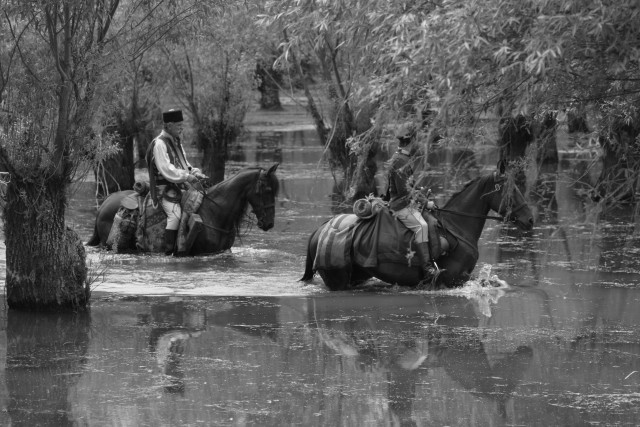
Father (Teodor Corban) and son (Mihai Comānoiu) hunt for a runaway slave in wickedly funny Aferim!
AFERIM! (Radu Jude, 2015)
Friday, July 17, 8:40
Sunday, July 19, 5:35
bigworldpictures.org
metrograph.com
Romanian director Radu Jude won the Silver Bear as Best Director at the 2015 Berlin International Film Festival for Aferim!, his savagely funny blacker-than-black comic Western about bigotry, infidelity, and frontier justice in 1835 Wallachia. Lawkeeper Costandin (Teodor Corban) and his son, Ionitā (Mihai Comānoiu), are galloping through the local countryside, searching for runaway Gypsy slave Carfin (Cuzin Toma), who Boyar Iordache Cindescu (Alexandru Dabija) has accused of having an affair with his wife, Sultana (Mihaela Sîrbu). The surly Costandin leads the hunt, verbally cutting down everyone he meets, from random old women to abbots to fellow lawmen, with wicked barbs, calling them filthy whores, crows, and other foul names while spouting ridiculous theories about honor and religion; he even batters his son, saying he’s “a waste of bread” and that “if you slap him, he’ll die of grief.” It’s a cruel, cholera-filled time in which even the monks beat the poor, where Costandin regales a priest with the telling riddle, “Lifeless out of life, life out of lifeless,” which the priest thinks refers to the coming doomsday.
Cowritten by Jude (The Happiest Girl in the World, Everybody in Our Family) and novelist Florin Lăzărescu (Our Special Envoy, Numbness), who previously collaborated on the short film The Tube with a Hat, and shot in gloriously stark black-and-white by Marius Panduru (12:08 East of Bucharest; Police, Adjective), the Romanian / Bulgarian / Czech coproduction is an absurdist combination of Monty Python and the Holy Grail, Andrei Tarkovsky’s Andrei Rublev, Hal Ashby’s The Last Detail, and John Ford’s The Searchers, skewering everything in its path, either overtly or under its wide-reaching breath. Even Dana Pāpāruz’s costumes are a genuine riot, especially the boyar’s majestically ridiculous hat. But Aferim! is more than just a clever parody of period films and nineteenth-century Eastern European culture and social mores; it is also a brilliant exploration of the nature of racism, discrimination, misogyny, and the aristocracy that directly relates to what’s going on around the world today as well as how Romania has dealt with its own sorry past of enslaving the Romani people. Jude was inspired by real events and historical documents, setting the film immediately after the 1834 Russian occupation, which adds to its razor-sharp observations. “Aferim! is an attempt to gaze into the past, to take a journey inside the mentalities of the beginning of the nineteenth century — all epistemological imperfections inherent to such an enterprise included,” Jude says in his director’s statement. “It is obvious that such an effort would be pointless should we not believe that this hazy past holds the explanation for certain present issues.” Don’t miss this absolute gem of a film, Romania’s submission for the Academy Awards.
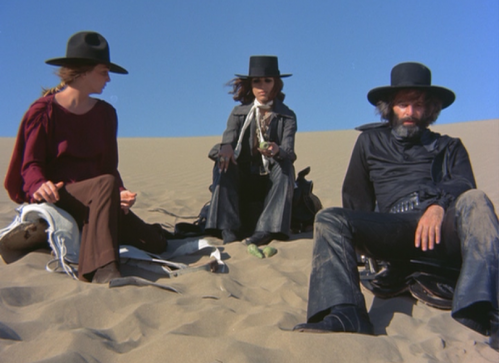
Alejandro Jodorowsky takes viewers on quite an acid trip in surreal Western El Topo
EL TOPO (Alejandro Jodorowsky, 1970)
Friday, July 24, 10:40
Sunday, July 26, 1:00
metrograph.com
Chilean-born French filmmaker Alejandro Jodorowsky’s El Topo is a psychedelic head trip, an acid Western that will blow your mind. Jodorowsky stars as the title character, a gunslinger traveling through a deserted landscape accompanied by his naked young son, who already knows his way around a firearm. After coming upon a town that has been decimated by a nasty group of marauders working for the Colonel, El Topo seeks violent revenge, eventually taking off with a woman and leaving his boy behind as he meets four masters on his path to proving he is the best there is. But soon El Topo is praying for redemption with a community of inbred cripples trapped in a cave.
El Topo is a wild and bizarre journey through religious imagery, romance, and vengeance, a surreal spaghetti Western strained through the mad mind of Jodorowsky, widely hailed as the creator of the midnight movie. The film melds Bergman with Leone, Tod Browning’s Freaks with Hiroshi Inagaki’s Samurai Trilogy, filtered through Kazuo Koike and Goseki Kojima’s Lone Wolf and Cub. It’s like nothing you’ve ever seen before and, despite your better instincts, will lure you into the cult of Jodorowsky.
[Mark Rifkin is a Brooklyn-born, Manhattan-based writer; you can follow him on Substack here.]