Mehrnoush Alia’s 1001 Frames makes its NYC premiere at the Brooklyn Film Festival
1001 FRAMES (Mehrnoush Alia, 2025)
Brooklyn Film Festival
Sunday, May 31, Wythe Hotel, 80 Wythe Ave., Williamsburg, $25, 4:00
Monday, June 1, BRIC, 647 Fulton St., $28.37, 4:00
Festival runs May 29 – June 7
www.brooklynfilmfestival.org
www.loco-films.com
In the Middle Eastern fairy-tale collection One Thousand and One Nights, also known as The Arabian Nights, a woman named Scheherazade marries an evil king and tells him a different bedtime story every evening in order to stay alive. Brooklyn-based Iranian-American filmmaker Mehrnoush Alia uses that as her jumping-off point in her chilling feature debut, 1001 Frames, making its New York premiere at the Brooklyn Film Festival on May 31 and June 1.
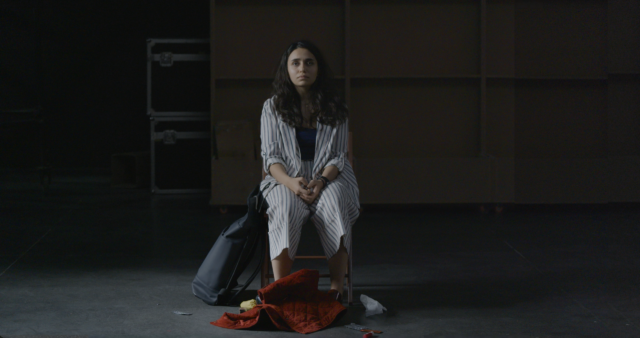
Expanded from her 2015 short Scheherazade, the intense 1001 Frames brilliantly blurs the lines between fiction and reality, photographed by Hamed Hosseini Sangari in a cinéma vérité style. The film is set in a vast, empty warehouse studio where a famous Iranian director (Mohammad Aghebati) is holding auditions for the role of Scheherazade in his new horror film. Over the course of one day, he meets with more than a dozen women, ostensibly to audition them, but it becomes clear early on that something else is going on.
In the first shot, a woman is on the floor on all fours, grunting like an animal until she rolls over and lays still. Writer, director, editor, and producer Alia then cuts to a series of interviews as the unseen director asks the women ever-more-invasive questions. The actresses sit in a plain wooden folding chair, trying to balance confidence with their growing sense of discomfort as the director asserts his power and control over them in both subtle and overt ways, mirroring the treatment of women not only in the film industry but in the world as a whole.
“Tell me. It stays right here between us. It’s only you and the camera here,” he says to one auditioner, as if his presence is not central to their relationship.
Alia switches between a stationary camera focused on the woman in full and in closeup and a handheld camera as the director physically approaches them, often in a threatening manner. The effect forces the viewer to be the perpetrator, to be the one with the male gaze, a phrase coined by Laura Mulvey, who wrote in Visual and Other Pleasures, “Woman, then, stands in patriarchal culture as a signifier for the male other, bound by a symbolic order in which man can live out his fantasies and obsessions through linguistic command by imposing them on the silent image of a woman still tied to her place as the bearer of meaning, not maker of meaning.”
As the interactions become more personal and intimate, some of the women squirm, some consider leaving, while others start challenging the director.
“You think you can edit everything, even your life!” his ex-wife, Firoozeh (Iranian multidisciplinary artist Mahin Sadri), boldly argues. A model states, “I’m not supposed to do whatever I’m told.” Another actress, looking frightened, says, “I’m afraid of that moment that you cross a line that things become ok that shouldn’t be.”
Meanwhile, the director refuses to back down, asking one auditioner about the role, “What are you willing to do to get it?” He scolds another, “This is my workplace. You can’t show up and say whatever you want.”
The dynamic of men’s insistent domination over women, in all areas of life, turns 1001 Frames into its own horror film, going beyond the mere psychological as the ending approaches.
“Are you scared of me?” the director asks one actress, who answers, “Do you want me to be scared?”
Previously known as Mehrnoush Aliaghaei, Alia based many of the incidents in 1001 Frames on real stories; she also worked closely with the actresses in developing their characters, allowing improvisation and giving the full script to only some of the women, depending on their preference. The result is a terrifying finale that morphs into a spectacularly effective coda.
The ensemble cast is remarkable, representing a wide range of ages and experience, each worthy of note: Sadri, Leili Rashidi, Mahsa Rezaei, Behafarid Ghaffarian, Fereshteh Aliyari, Maryam Arabzadeh, Aisan Ghanbari, Parastoo Ghorbani, Mahdieh Mohammadi, Dorsa Panjehband, Shayesteh Sajadi, Fatemeh Salehian, Helia Shadifar, and Avin Taffakori. They spend most of the film sitting in the chair, the camera zooming in on their face, capturing their changing, conflicted emotions as they reach difficult realizations and have impossible decisions to make. Aghebati, who is also the casting director and one of the film’s producers, is menacing as the director, his face never seen, as if he could be any man; he is a persuasive and controlling figure who completely understands his power and flaunts it, and perhaps not only to find the right actress for the part.
The most potent film about auditions since Takashi Miike’s 1999 ultraviolent cult classic Ôdishon, in which two men hold a fake audition in order to find a romantic partner for one of them, a tryout that doesn’t go particularly well, 1001 Nights is a haunting tale of all-too-real psychological horror, a beautifully rendered parable about misogyny with an unforgettable conclusion.
The eighteenth-century version of One Thousand and One Nights consists of such beloved, familiar tales as “Aladdin and the Wonderful Lamp,” “Ali Baba and the Forty Thieves,” and “The Seven Voyages of Sinbad the Sailor.” 1001 Frames is never so benign but all too familiar and scary, a story that Scheherazade has to keep on telling, over and over again, one frame at a time.
The May 31 and June 1 screenings will be followed by a Q&A with Alia and Aghebati. The Brooklyn Film Festival runs May 29 to June 7 at multiple venues and online; among the other films to watch out for are Walter Thompson-Hernández’s If I Go Will They Miss Me, Carlye Rubin, Katie Green, and Tina Grapenthin’s Blood & Guts, and Thales Banzai’s Tony Odyssey.
[ Mark Rifkin is a Brooklyn-born, Manhattan-based writer; you can follow him on Substack here.]