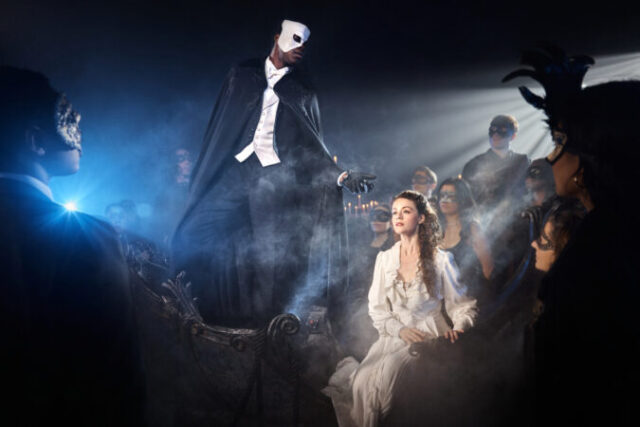
Phantom has been resurrected in Midtown in dazzling production (photo by Matthew Murphy and Evan Zimmerman)
MASQUERADE
218 West Fifty-Seventh St.
Tuesday – Sunday through January 31, $1795-$395
masqueradenyc.com
You can’t keep Sir Andrew Lloyd Webber down.
Cats, the British composer’s beloved but much-maligned adaptation of T. S. Eliot’s Old Possum’s Book of Practical Cats, ran on Broadway from 1982 to 2000, followed by a 2006–17 revival and a disastrous 2019 all-star-laden film. It was then reinvented in 2024 as Cats: The Jellicle Ball at PAC NYC, brilliantly setting it in the world of queer ballroom culture, breathing new life into the old kitty. The Broadway transfer lacked some of the key elements but closed early, on August 8, despite winning three Tonys.
Lloyd Webber’s 1993 musical, Sunset Blvd., was revived on Broadway in 2016 and 2024–25, while 1976’s Evita is returning next spring.
Which brings us to The Phantom of the Opera. Based on the 1910 novel by Gaston Leroux, the show features music by Lloyd Webber, a book by Lloyd Webber and Richard Stilgoe, and lyrics by Charles Hart (with additional lyrics by Stilgoe.) The original production, which earned seven Tonys, ran at the Majestic from 1988 to 2023 for an astonishing 13,981 performances. But just as Cats was resurrected and reinvented, so has Phantom, as the shrewdly clever, thoroughly entertaining, and fully immersive Masquerade.
Tony-winning director Diane Paulus (Pippin, Porgy and Bess) has transformed Phantom into a thrilling interactive production that moves audiences up, down, and across six floors of the old Lee’s Art Shop on West Fifty-Seventh St., by Carnegie Hall, performed by six casts. The audience is asked to dress in black, white, or silver and wear a mask; a black one will be provided if you don’t have one. Heels are verboten, all bags must be checked, and stickers reading “Let the spectacle astound you” will be placed over your phone’s camera.
For those unfamiliar with the Gothic horror romance, Phantom is about a strange figure (Kyle Scatliffe) living under the Paris Opera House who is determined to have little-known soprano Christine Daaé (Eryn LeCroy) sing the role of Marguerite in Charles Gounod’s Faust instead of the company’s star, Carlotta Guidicelli (Stephanie Jae Park). The Phantom is jealous of Christine’s childhood friend and suitor, the Vicomte Raoul de Chagny (Gregory Lee Rodriguez), and is critical of the opera house’s new owners, Firmin (Alex Ross) and André (Schyler Vargas). Meanwhile, the Phantom attempts to get opera employees Madame Giry (Marce Johnson) and her daughter, Meg (Haile Ferrier), on his side, although stagehand Buquet (Jacob Lacopo) has other ideas. Caught in the middle is egotistical tenor Piangi (Sean Seamus Thompson).
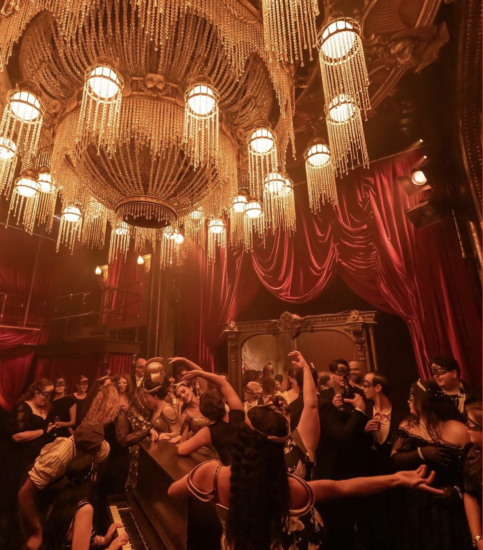
Audience and cast become one in fully immersive Masquerade (photo by Matthew Murphy and Evan Zimmerman)
Aside from a violinist who pops up occasionally (Nikita Yermak), the music for Masquerade is prerecorded and loud, but all the singing is live. While the songs and basic melodies are from the Broadway version, they have more oomph in these surroundings, in part because the actors are right there with you every step of the way. At one moment, I was tapped on the shoulder and turned around to see the Phantom seeking to get past me as he was singing in his resonant baritone. At another, I was handed a rose to toss at Christine, the Phantom’s object of desire. And later I was nearly hanged by the Ropes of Judgement.
Each room is spectacularly decorated, with lovely and frightening detail, from candles and mirrors to luxurious draping and hidden clues. There is limited seating in each space, so be prepared to do a lot of standing. Don’t worry; the classic Phantom elements have been accounted for, with new takes on the boat and chandelier, and the sideshow scene boasts a real blockhead (Anna Monoxide) and master of pyromancy (Joseph Kerr) in addition to a barker (Matthew Curiano), carny (Judah Frank), boy in a cage (Joshua Ike).
The creative team deserves a bevy of accolades, from production designer James Fluhr, art director Jessie Flynn, props designer Kathy Fabian, and hair, wig, and makeup designer J. J. Janas to costume designer Emilio Sosa, lighting designer Ben Stanton, sound designer Brett Jarvis, and magic and visual effects designer Skylar Fox. The intricate choreography, making sure the performers don’t get cornered by the audience, is by Sidi Larbi Cherkaoui, and Shai Baitel is in charge of the fine art, which is highlighted by specially commissioned ironwork gates by Bob Dylan. Among the other art collaborators are Marina Abramović, Barry X Ball, Z Behl, Paul Cummins MBE, Yigal Ozeri, and Kenny Scharf.
The narrative has been tinkered with, so some songs are out and others have been moved around, and there is more back story, delving into the mind of the Phantom as a child, who is told by his mother in a letter, “From now on, the carnival will be your home. You are a child of the devil. Among freaks and monsters you will find your kind. Forget you ever had a mother.” There are elements from various stage productions as well as the 2004 Joel Schumacher film, which starred Gerard Butler as the Phantom, Emmy Rossum as Christine, Patrick Wilson as Raoul, Miranda Richardson as Madame Giry, and Minnie Driver as Carlotta.
As with all immersive shows, you more you put into it, the more you will get out of it; to heighten that involvement, there are lots of mirrors where you can see yourself amid the action. In addition, after the grand finale, the audience is invited into a dark bar where you can sip cocktails and pose with some of the major props.
It’s a great deal of fun in which the score is only part of the enchantment, making it a must for Phantom fans, Phantom detractors, and everyone in between.
[Mark Rifkin is a Brooklyn-born, Manhattan-based writer; you can follow him on Substack here.]