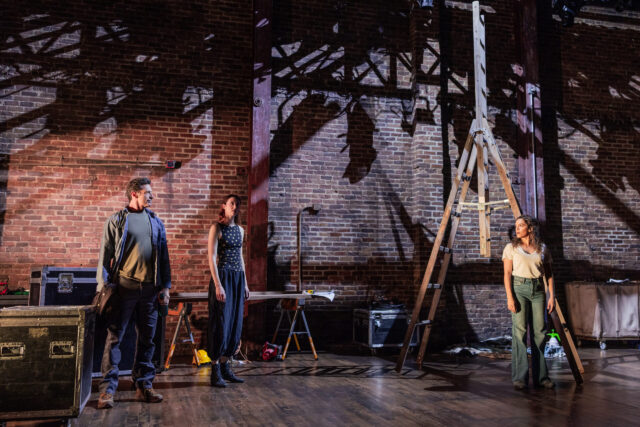
Hugh Jackman, Marianna Gailus, and Sepideh Moafi star in Ella Hickson’s New Born (photo by Evan Zimmerman for MurphyMade)
NEW BORN
Audible’s Minetta Lane Theatre
18 Minetta Lane between Sixth Ave. and MacDougal St.
Through June 8, $25-$286.50
www.audible.com
There’s an important reason why the title of Ella Hickson’s new play, New Born, is two words; although children figure prominently in each of the three monologues that comprise the nearly two-hour show, it is not about pregnancy or infants. Instead, it deals with three people whose lives are changed forever by someone who unexpectedly enters their sphere of existence, as if they are born anew. Although their stories do not intersect, all three actors — Sepideh Moafi, Marianna Gailus, and Hugh Jackman — are onstage together at the beginning and end of each segment, as if part of an unrelated trio that intrinsically understands one another.
The play opens with “Light,” in which Moafi beautifully portrays a married mother of a young boy. She has a classics degree and an MFA from RISD, is obsessed with celebrity culture, has a job as an illustrator, and believes she is satisfied with her situation.
“I don’t complain, obviously. Never! Me? No. I’m very easy to live with,” she explains. “I can hear my husband cleaning the kitchen, while I’m on the floor, in the dark, holding our kid’s hand, trying to get him to sleep. . . . I can hear my breathing and our child’s breathing, and the soft clanking of my husband cleaning the sink . . . and I do know I’m lucky . . . the luckiest of all.”
But then one Saturday night she has to meet her brother-in-law at a club in order to give him the keys to their summer place and is swept off her feet by an international pop superstar. One dance could potentially lead to more as she takes stock of who she is and what she wants amid a flurry of text messages.
“Hearing from the singer feels like light. Like someone has opened up the top of my skull and poured a load of light inside,” she shares. She is so excited that she forgets to contemplate her own death, something that has plagued her since the day her son was born.
As the two women grow closer, the narrator is faced with yet more choices, none of them easy.
Wearing jeans and a white top, Moafi (The Pitt, Corruption) is warm and engaging as she wanders around Brett J. Banakis and Christine Jones’s spare, seemingly unfinished set, which features black-and-silver utility trunks, scattered chairs and tables, and a ladder in the center, as if it is still a work-in-progress at the Minetta Lane. She is so calmly appealing that I was disappointed when her monologue ended, with a shock.
“Light” is followed by “Rattle,” a blistering if uneven story told by Martha (Gailus), a bartender in her early twenties at an inn in the small town of Sheridan, Wyoming, about a hundred years ago. Raised by a single mother, Martha lives a simple life, one where, she says, “my feet ain’t never left this red sand ground.”
She works with her mama and Little Jimmy, a ten-year-old Black child. She appears to be unsocial yet content. “At nights, I hear the train horn sound right out across the plains, miles and miles of nothing in its way, and it gives me a feeling so lonely — like some kind of poverty,” she says. “I try to focus on something else — even mama’s snoring, or late summer, the sound of them poor cows when the ranchers take their calves away.”
But then one day three cowboys enter the bar: John, who she remembers from school, his friend Wyatt, and a third man. While serving them, the rag she is using for her menstrual flow falls onto the floor, and she notices at the same time the three men do. Seized with a sort of defiance, she doesn’t immediately pick it up, and Wyatt gives her a hard time and eventually punches her in the face.
Soon Martha is getting cozy with John, Wyatt might be hanging around with the Ku Klux Klan, and Little Jimmy goes missing.
Wearing a contemporary outfit, Gailus (Patriots, Sylvia, Sylvia, Sylvia) is deeply affecting as Martha, a jittery young woman who is surrounded by trouble but won’t let that bring her down. She appears to make questionable choices, even when aware of the possible consequences. She is a living dichotomy, just like Wyoming, the first state to grant women the right to vote, in 1890, while also becoming home to a wave of KKK activity in the 1920s.
“Rattle” is a bumpy tale with cinematic language, but it loses track of itself as it meanders to a surprising ending.
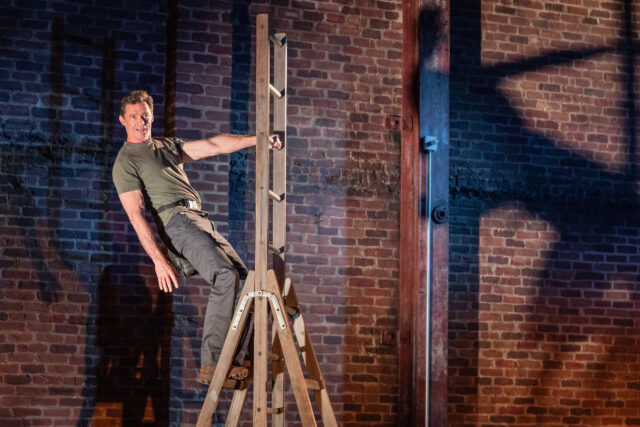
Hugh Jackman plays a hunky tree surgeon in “Deadwood” (photo by Evan Zimmerman for MurphyMade)
The show concludes with “Deadwood,” which lives up to its name. Jackman stars as a hunky tree surgeon who falls for one of his customers, a single woman named Katie. He is of course well aware that he is rather handsome and desirable, and he knows how to use that to his advantage.
“In my job, I meet a lot of women. I don’t know why, but it’s usually women who book the tree surgeon, or they’re the ones who are around when I show up — and, if they’re women of a certain age, like — you know, a decade either side of me — I do, just in a normal way — think . . . ‘Would I?’” he admits after she compliments him. “But on this occasion — and I know this sounds, I mean — but I think, I hadn’t considered sleeping with her because I was distracted by her — beauty. Not that I didn’t find her sexually attractive, because now she’s mentioned it, I really do — and I must have taken a while to respond, because she’s kind of laughing, in a nice way, waiting for me to say something.”
As their relationship evolves, he shares numerous metaphors involving trees, dead wood, wood chips, bark, and potentially dangerous boughs, but it all feels like a Hallmark romance movie for people of a certain age. It’s overgrown with genre clichés, standard plot twists, and somewhat boring explication, all delivered in the same straightforward manner by Emmy, Grammy, and Tony winner and Oscar nominee Jackman (The River, The Music Man). Even when tragedy strikes, he maintains his cool demeanor, which is admirable if not realistic. It fails to connect the way the first two monologues did, especially “Light.”
New Born is smoothly directed by Ian Rickson (Jerusalem, The Weir), who has helmed all four plays that have been presented at Audible’s Minetta Lane Theatre by Jackman and Sonia Friedman’s company, Together, which is “dedicated to live theater that is intimate and accessible . . . driven by a commitment to offering audiences a chance to experience theater in a fresh and engaging way.” Last year they staged Hannah Moscovitch’s Sexual Misconduct of the Middle Classes and August Strindberg’s Creditors in repertory with all-star casts, to well-deserved acclaim; this spring they brought back Sexual Misconduct for an encore, along with New Born and a wonderful revival of Tom Noonan’s What Happened Was . . .
A terrific idea that is off to a fine start, Together, still in its infancy, is an ambitious project that I hope continues long into the future.
[ Mark Rifkin is a Brooklyn-born, Manhattan-based writer; you can follow him on Substack here.]