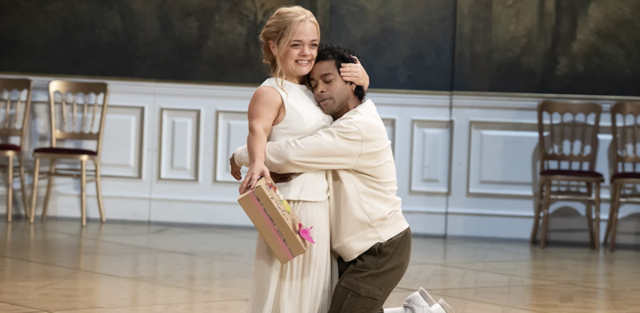
Ophelia (Francesca Mills) and Hamlet (Hiran Abeysekera) try to hold on to their love in National Theatre production at BAM (photo by Julieta Cervantes)
HAMLET
Brooklyn Academy of Music
BAM Strong Harvey
651 Fulton St.
Through May 17, $46-$226
www.bam.org/hamlet
One of the myriad great things about Shakespeare’s plays is their adaptability; they can be done as straightforwardly as possible or be transplanted into an endless number of settings, changing the time and place while staying true to the Bard’s words. Nevertheless, some productions get so caught up in their tinkering that they lose sight of the play itself.
Two current shows in New York City take different approaches to a pair of Shakespeare’s most popular tragedies, but each is a celebration of the language. I found myself discovering details in the National Theatre’s Hamlet at BAM and Bedlam’s Othello at the West End Theatre that made each work feel fresh and new across their nearly three hours.
BAM has a long history with Hamlet; it was their inaugural theatrical presentation, in 1861. It was also the National’s first play in London, in 1963. Continuing at the Harvey through May 17, director Robert Hastie (Operation Mincemeat) reimagines the dour Dane for the modern era in a dark and funny version with numerous delicate touches.
Hiran Abeysekera portrays Hamlet as a kind of nepo baby trying to find his way in a world that has suddenly shifted for him following the death of his father, the king (a terrific Ryan Ellsworth, also the Player King and the gravedigger), followed by his mother’s (Ayesha Dharker) almost immediate marriage to the king’s brother, Claudius (a splendid Alistair Petrie), who now wears the crown. It gets even more complicated when his father’s ghost appears and reveals that uncle Claudius poisoned him in order to ascend to the throne.
With vengeance on his mind, Hamlet doesn’t have enough room in his life for Ophelia (a sprightly Francesca Mills, donning angel wings), who loves him deeply. Her father, Polonius (Matthew Cottle), is Claudius’s chief counselor, and her brother, Laertes (Tom Glenister), is determined to defend her honor at any cost.
Hamlet finds comfort in his closest friend, Horatio (a delightful Tessa Wong), but is suspicious when two of his best buds from childhood, Rosencrantz (Hari Mackinnon) and Guildenstern (Joe Bolland), suddenly arrive; it’s not long before he gets them to admit that they were brought to Denmark by Gertrude to spy on him because of his recent odd behavior.
When a traveling theater troupe arrives to put on a play, Hamlet convinces the First Player (Maureen Beattie) to stage The Mousetrap with a bonus passage by Hamlet, telling the story of a man who kills his brother, the king, exactly how Claudius murdered his sibling, in order to wed his widow and become king himself. “The play’s the thing / Wherein I’ll catch the conscience of the King,” Hamlet says.
As Hamlet descends into madness, Fortinbras (Kiren Kebaili-Dwyer), the crown prince of Norway, prepares his troops to invade Denmark and bodies start piling up.
Hamlet begins in an elegant ballroom with realistic forest wallpaper and transforms into a theater for the fabulous play-within-a-play and a graveyard; the sets are by Ben Stones, who also designed the modern costumes, which for Hamlet includes a Blockbuster Video sweatshirt, a nod to Michael Almereyda’s 2000 film version in which Ethan Hawke delivers the “To Be or Not to Be” monologue while walking through a Blockbuster store, and a “Tobacco and Boys” T-shirt that references the unconfirmed Christopher Marlowe quote “All they that love not Tobacco and Boys are fools”; the phrase was also used by Shakespearean actor Stephen Fry in the title of his 1979 play, Latin! or Tobacco and Boys.
Hastie makes small tweaks to the script that practically leap off the page. Polonius tells Laertes, “To thine own selves be true,” altering “self” to “selves”; Ophelia loudly joins in when Polonius advises his son, “Neither a borrower nor a lender be”; and the “To Be or Not to Be” soliloquy is moved to later in the play, at a crucial point. The language is so front and center that the nearly endless stream of familiar phrases that became names of books, plays, and movies jumps out, from Infinite Jest and What Dreams May Come to The Undiscovered Country and Sleep No More.
As adorable as he is melancholic, Abeysekera (Life of Pi) grabs the audience’s attention from the beginning and never lets go, regularly making faces and gesturing at the crowd. When another character delivers a monologue directly to the audience, Abeysekera looks at them, and us, as if wondering what is going on, believing that only he can see and talk to us. And when he does speak to us, he has us in the palm of his hands, even with his millennial flourishes as he delivers some of Shakespeare’s most unforgettable soliloquies in his own style. He may not be Olivier, Burton, Branagh, Bernhardt, or Gielgud, but he doesn’t have to be; he just has to be Abeysekera, putting his own stamp on the part.
Through it all, the words stand tall, even conquering a few scenes that linger too long or go a bit off-kilter.
Of course, the play’s the thing.
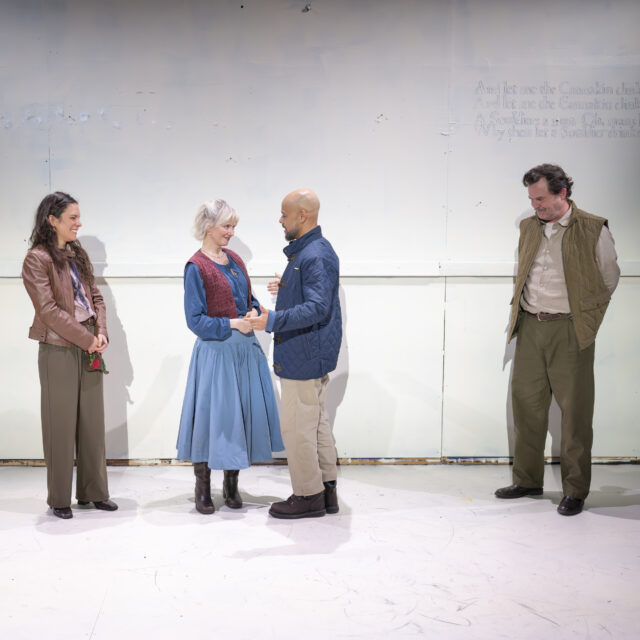
Susannah Millonzi, Susannah Hoffman, Ryan Quinn, and Eric Tucker play all the roles in Bedlam’s stripped-down Othello (photo by Ashley Garrett)
OTHELLO
West End Theatre at St. Paul & St. Andrew United Methodist Church
263 West Eighty-Sixth St. between Broadway & West End Ave.
Tuesday – Sunday through May 30, $24-$86
bedlam.org/w-o/othello
In the National Theatre’s Hamlet, eighteen actors take on twenty-six roles on multiple sets. In Bedlam’s Othello, a cast of four performs more than a dozen parts in a bare white space, with only a handful of small props: Susannah Hoffman is Desdemona and Cassio, Susannah Millonzi is Roderigo and Emilia, Ryan Quinn is Othello and Bianca, and director Eric Tucker is Iago. As with Hamlet, Shakespeare’s words take center stage, for nearly three captivating hours.
Angry that Othello named Cassio his first lieutenant instead of him, Iago is intent on bringing Othello down, through trickery and deceit. He conspires with the Venetian gentleman Roderigo to convince everyone that the Moorish general Othello used evil witchcraft to force Senator Brabantio’s daughter, Desdemona, into a secret marriage. “Your daughter and the Moor are now making the beast with two backs,” Iago tells the powerful politician, using race as a sword.
When Othello and Desdemona publicly declare their love for each other, Iago concocts a diabolical plan to persuade Othello that his beloved is having an affair with Cassio, thus ruining the general and his lieutenant, lifting Iago’s station, and allowing Roderigo to pursue his own lust for Desdemona.
“O beware, my lord, of jealousy! / It is the green-eyed monster which doth mock / The meat it feeds on,” Iago says to Othello. “That cuckold lives in bliss / Who, certain of his fate, loves not his wronger; / But O, what damnèd minutes tells he o’er, / Who dotes yet doubts, suspects yet soundly loves!”
To achieve his revenge, Iago must also pull the wool over the eyes of his wife, Emilia, who is Desdemona’s maidservant; Bianca, Cassio’s lover; the Duke of Venice; Gratiano, Brabantio’s brother; Lodovico, Desdemona’s cousin; and Montano, the governor of Cyprus.
“Reputation, reputation, reputation!” Cassio declares.
That’s precisely what Iago seeks to destroy in anyone who gets in his way.
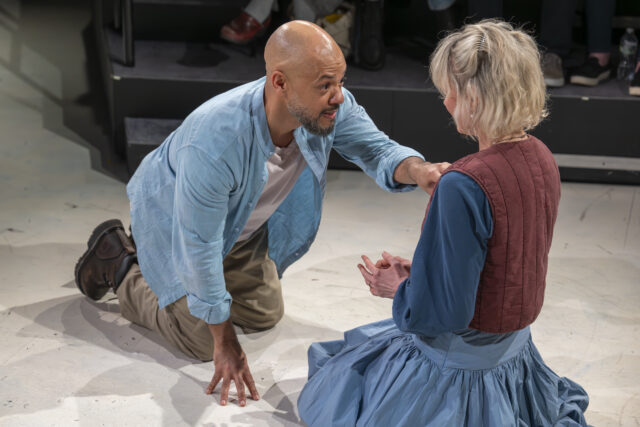
Othello (Ryan Quinn) and Desdemona (Susannah Hoffman) face doom and dread in Bedlam production (photo by Ashley Garrett)
The first act of Othello takes place with the actors performing on a dirty white floor in front of an unsteady white wall; initially, the only props are a bell and a black rope/noose, but a string of Christmas lights and a microphone are added for a karaoke scene. For the second act, the three rafters of seating are rearranged to form a circle closing in on the middle, where most of the action occurs, although the actors also stomp around behind the audience and up and down the aisles. Cheyenne Sykes’s lighting gets much darker, the characters at times using flashlights. The actors usually but not always make tiny adjustments to Sam Debell’s contemporary costumes to indicate when they are a different character, which can get a little awkward. The karaoke scene is awkward as well, straying from the simpler beauty of the rest of the show.
Hoffman and Millonzi excel in their multiple roles, and Quinn is an admirable, heart-wrenching Othello, but the key to the narrative lies in the hands of Iago, and Tucker, who also designed the tense sound, is a slyly devious master manipulator, his tongue often in his cheek as his plot unfolds; possessed of a rapier wit, he thinks quick on his feet, like an improv comic who’s not about to lose control of the upcoming punch line.
Bedlam’s first two productions, back in 2013, were four-actor versions of Bernard Shaw’s Saint Joan and Hamlet, so this Othello is a return to its roots following such other successful shows as Sense & Sensibility, Arcadia, The Good John Proctor, and Are the Bennet Girls OK? Because of the minimal staging, the words flow beautifully; you have to listen closely, resulting in picking up small elements you may have missed in bigger adaptations with major stars.
Through it all, the words stand tall, even conquering a few scenes that linger too long or go a bit off-kilter.
Of course, the play’s the thing.
[Mark Rifkin is a Brooklyn-born, Manhattan-based writer; you can follow him on Substack here.]