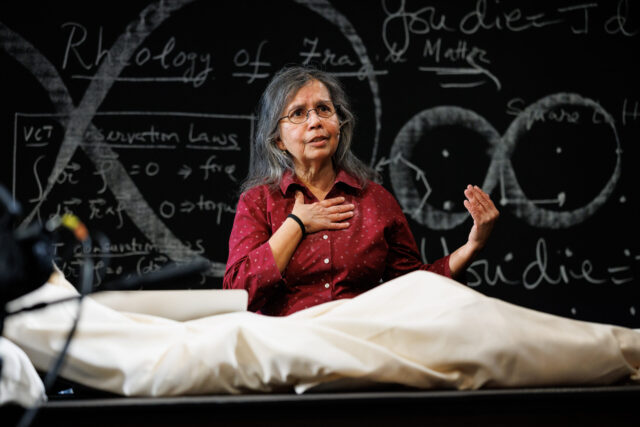
Physicist and professor Bulbul Chakraborty won an Obie for her performance in Rheology (photo by Maria Baranova)
RHEOLOGY
Playwrights Horizons, Peter Jay Sharp Theater
416 West 42nd St. between Ninth & Tenth Aves.
Through May 16, $53.50-$93.50
www.playwrightshorizons.org
When is a physics lecture not a physics lecture? When it’s also a genius theatrical meditation on family and death.
First presented last spring at the Bushwick Starr in association with HERE Arts Center and Ma-Yi Theater Company, Rheology is back for an encore run at Playwrights Horizons, where it is beguiling audiences with its intoxicating mix of science and multimedia art. Written and directed by Obie winner and Pulitzer finalist Shayok Misha Chowdhury, the ninety-minute play was created in collaboration with his mother, renowned theoretical physicist and professor Bulbul Chakraborty, who specializes in condensed matter and how nonthermal systems, particularly sand, respond to external stresses.
When the doors open, Chakraborty is already onstage, writing down formulas and equations across a long digital blackboard relating to field theory, Gauss’s Law, Faraday’s Law, and the rheology of fragile matter. In this case, the fragile matter is Chowdhury, who is seen in a photo as a child with his mother projected above the blackboard; the screen is also used to share scientific photographic and video information. In addition, a camera zooms in on an hourglass on her table, projecting it onto a side monitor, and a child’s sandbox beckons. (The video design is by Kameron Neal, Chowdhury’s partner, with set by Krit Robinson and live music by cellist George Crotty.)
As Chakraborty performs an experiment describing how the solid sand can behave like a liquid, she starts choking, bending over in distress. Several people in the audience began calling out to her, asking if they should contact 911; a woman sitting behind me was practically freaking out. I didn’t want to ruin the experience for her, but I felt I had to tell her that it was part of the show, that Chakraborty wasn’t dying right in front of us as we did nothing.
She suddenly stops, and a man in the audience asks her why. She explains that she usually pretends to choke longer but she could feel the energy in the room shift to genuine concern. The man then identifies himself as Chowdhury, and he describes what it was like growing up the only child of two physicists; as a bonus, his father, Partha Chowdhury, a graduate professor who specializes in gamma-ray spectroscopy and nuclear structure, was in the audience that night. Chowdhury talks about his nightmares about his mother’s eventual death — she is not ill, but we all die eventually — and so dreamed up this play to savor more experiences with her.
“The time we have left together is finite,” Chowdhury posits. “And it’s almost this . . . pressure I’ve been feeling, like I can’t be . . . in the moment when we’re together because I’m aware that each moment is a moment I’m supposed to be making the most of. Um . . . so . . . what I have done is forced her to . . . be in a show with me . . . so we can spend more time together . . . because as long as we’re doing this show she is literally . . . contractually obligated to be alive. . . . So what we’re doing here is a kind of exposure therapy for me. . . . Whenever I’ve expressed to her that I could not in fact survive her death, my mom is like: But how do you know that, that’s not a statement of fact, that’s a hypothesis, where’s the evidence? You need to gather evidence to support your hypothesis. And I was like: How do I do that? And she was like: I thought you did experimental theater? Why don’t you design an experiment to test your hypothesis? And I was like: You mean, kill you? And she was like: Could you do a simulation?”
And so they do an extremely realistic simulation in a way that regularly circles back to Chakraborty’s studies of the properties of sand, investigating them as both individual grains and how they react with other grains en masse, like a human being relating to other human beings, or to one specifically — for example, a loved one.
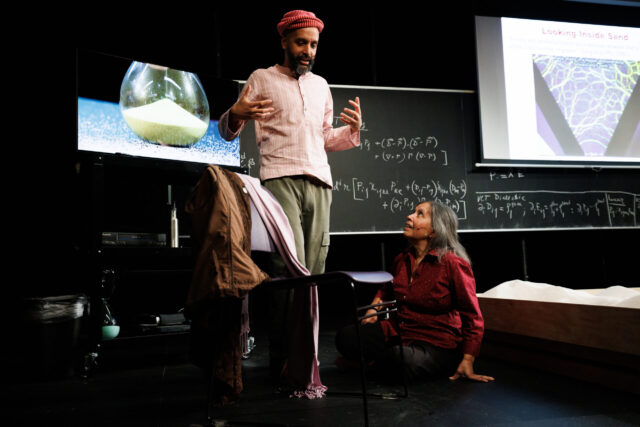
Misha Chowdhury faces his fears about his mother’s eventual death in deeply personal play (photo by Maria Baranova)
Not surprisingly, while Chakraborty accepts the facts that she, and the rest of us, are going to die, Chowdhury is far more emotional and dramatic about it, which results in a compelling dynamic between mother and son, scientist and theater maker. Beautifully presented, the show is likely to have each audience member considering their own relationship with death, be it theirs or someone close to them. For me, it instantly brought back memories of the deaths of my mother (at seventy-six) and father (at forty-seven) as well as that of my mother-in-law, who passed last October at the age of eighty-nine. In addition, it was fascinating to look over at Partha Chowdhury every once in a while and wonder what was going through his mind as he watched his wife “die” onstage and his son proclaim that he cannot go on without her.
Chakraborty, who won an Obie for her performance, is utterly charming and engaging playing herself; she appears to be a terrific teacher and a wonderful mother — and an expert improviser. Chowdhury (Public Obscenities, Prince Faggot) holds nothing back as he willingly, and entertainingly, shares his deepest, darkest fears with a combination of sadness and humor, emphasizing his fragility. It all comes together when he goes into the sandbox and attempts to build a castle, a powerful metaphor for everything that has come before it. Kudos should also go out to dramaturg Sarah Lunnie for the tight structure.
In his 1981 song “Every Grain of Sand,” which closes every concert on his neverending tour, Bob Dylan sings, “I hear the ancient footsteps like the motion of the sea / Sometimes I turn, there’s someone there, other times it’s only me / I am hanging in the balance of the reality of man / Like every sparrow falling, like every grain of sand.”
Rheology also concludes with poetry, by Indian polymath Rabindranath Tagore, followed by a moving hypothesis that goes far beyond scientific theory and a lecture on physics.
[Mark Rifkin is a Brooklyn-born, Manhattan-based writer; you can follow him on Substack here.]