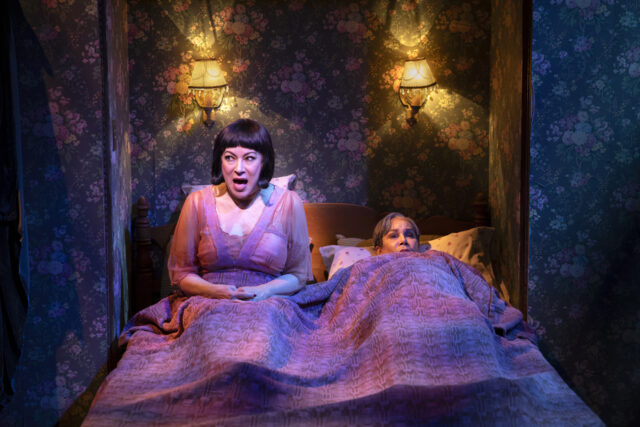
Mrs. Zero (Jennifer Tilly) has a lot to say to Mr. Zero (Daphne Rubin-Vega) in New Group experimental revival (photo by Monique Carboni)
THE ADDING MACHINE
Theatre at St. Clement’s
423 West 46th St. between Ninth & Tenth Aves.
Tuesday – Sunday through May 17, $39-$135; livestream May 7, $39.99, 7:00
thenewgroup.org
At the heart of the New Group’s revival of Elmer L. Rice’s 1923 satire, The Adding Machine, extended at the Theatre at St. Clement’s through May 17, is humanity’s fear of displacement and extinction — not by another species but by our own creations.
Ten years ago, Israeli theoretical computer scientist Moshe Vardi said, “We are approaching a time when machines will be able to outperform humans at almost any task. I believe that society needs to confront this question before it is upon us: If machines are capable of doing almost any work humans can do, what will humans do?”
Technological unemployment has been on the minds of humans since ancient times; warnings about robots and machinery taking over have been posited by Aristotle, John Maynard Keynes, Isaac Asimov, Rod Serling, Philip K. Dick, and Stanley Kubrick.
Pulitzer Prize winner Rice’s (Street Scene) prescient work now features “experimental” revisions by Thomas Bradshaw that make it relevant to the current day, as AI threatens not only the future of a wide range of workers but of humanity itself.
As the audience enters the theater, a light shines down on an adding machine that boldly sits center stage; a sign of progress, it may not appear threatening, but to many it can be seen as a villain whose presence, in this case, will lead to violence and a journey into the afterlife.
Among the most important changes Bradshaw has made is the addition of a friendly narrator (Michael Cyril Creighton) who announces at the beginning, “You are about to witness a heart-warming tale about modern life crushing the human spirit. This isn’t a place where life is ‘lived,’ but rather ‘endured.’ A world of worn-out routines, frayed tempers, and dreams so thoroughly flattened that no one even remembers having them. . . . Listen, I know this all might sound depressing and why the hell would you even want to endure this, let alone pay for it, but fear not! I promise there’s plenty of humor in watching humans try to navigate a society that keeps nudging them toward becoming polite and obedient. You may even recognize a few things from your own life. If so, I apologize in advance.”
That opening is followed by a long, biting monologue in which Mrs. Zero (Jennifer Tilly), in bed with her husband, Mr. Zero (Daphne Rubin-Vega), lets loose a verbose diatribe about going to the pictures, getting older, and their failed marriage, exacerbated by Mr. Zero’s attraction to a young woman who lives in their complex, his inability to get promoted at his accounting job, and how “Captain Standish doesn’t stand at attention for me anymore.” Tucked under the covers, Mr. Zero barely moves, as if he’s dead, ignoring his wife, who is tired of playing second fiddle.
“What about me? Where do I come in?” she argues. “You think I don’t know what it’s like — going to that office every day, adding numbers till you feel like one. But I do. My office is this house, these same four walls. And I been adding, too. Adding the days, my gray hairs, and the silences you could bury a life inside. Adding and adding until the total’s too much to bear.”
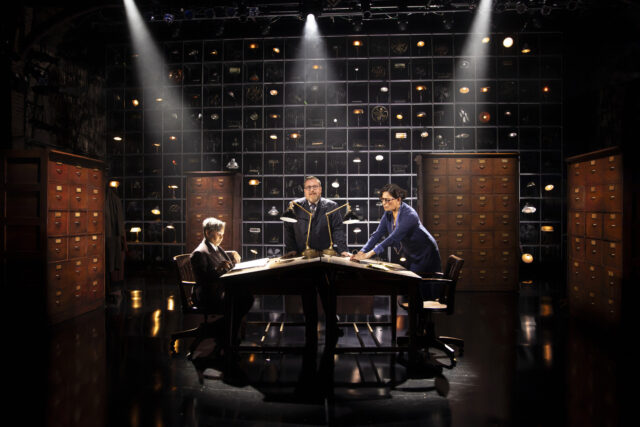
Humans performing office work are doomed in The Adding Machine (photo by Monique Carboni)
The next day, Mr. Zero believes he is going to be celebrated at work for his twenty-fifth anniversary. He earns his salary writing down numbers that his longtime colleague, the efficient Daisy Diana Dorothea Devore (Sarita Choudhury), reads aloud from receipts. He talks down to her, making her angry.
“You make me sick,” he says. She opines, “I wish I was dead.” They bicker like an old couple. He admits that maybe he would marry her, while she notes that it might be too late for them to have kids. He cuts her off, declaring, “Can’t you slow up? What do you think I am — a machine?”
When the cold-hearted boss (Creighton) tells Mr. Zero that he’s being replaced by an adding machine, the disgruntled employee murders him. At a dinner party that night, during which the host Zeros discuss sports, health, voting, immigrants, and other topics with the Ones, Twos, Threes, Fours, Fives, and Sixes (all played by Creighton), Mr. Zero is arrested, unapologetic for what he has done. At his trial, he delivers a numbers-laden, racist, misogynistic tirade about the societal ills that led him to kill his boss. Soon he finds himself in the Elysian Fields, where he is met by a series of surprises.
In The Adding Machine, life is a boring numbers game that can’t be won. As Lt. Charles (Creighton) explains to Mr. Zero, “Before there were numbers, there was counting. Before there was meaning, there was routine.”
There is little that is routine about the play, directed by New Group founding artistic director Scott Elliott, who has previously collaborated with Bradshaw on Intimacy, Burning, and The Seagull/Woodstock; they are not afraid to take chances and challenge the audience. Although not everything works — several of the afterlife scenes are awkward — what does succeed takes things from the sublime to the ridiculous, or, perhaps, the ridiculous to the more ridiculous.
It begins with casting. In the long-forgotten, misguided 1969 film, Milo O’Shea played Mr. Zero, Phyllis Diller was Mrs. Zero, and Billie Whitelaw portrayed Daisy Devore. In the play, Tilly (Don’t Dress for Dinner, The Women) is like a one-woman band as Mrs. Zero, her alternately squeaky, gravelly voice littered with musical grunts and sighs. Choudhury (the New Group’s Roar, The Flatted Fifth, and Rafta, Rafta . . .) is elegant and alluring as Daisy, an excellent foil to Mr. Zero, portrayed as a short, squat, angry man by two-time Tony nominee Rubin-Vega (Rent, the New Group’s Everything’s Turning into Beautiful) in a bulky suit and mustache. Creighton (The Amateurs, Stage Kiss) is warm and welcoming as the narrator, a tour guide, a man who has committed matricide, the boss, the lieutenant, Judy O’Grady, and other characters.
Derek McLane’s set consists of file cabinets that turn into other pieces of furniture, a back wall with dozens of lamps and fans in their own cubbies, and an electric chair that takes the place of the adding machine. The costumes are by Catherine Zuber, with stark lighting by Jeff Croiter and sharp sound by Stan Mathabane.
There is plenty of debate on how AI will affect people’s jobs. According to Authentic Ventures partner Robin Bordoli, “I think what makes AI different from other technologies is that it’s going to bring humans and machines closer together. AI is sometimes incorrectly framed as machines replacing humans. It’s not about machines replacing humans but machines augmenting humans.”
Journalist Kevin Drum counters, “Sometime in the next forty years, robots are going to take your job. I don’t care what your job is. If you dig ditches, a robot will dig them better. If you’re a magazine writer, a robot will write your articles better. If you’re a doctor, IBM’s Watson will no longer ‘assist’ you in finding the right diagnosis from its database of millions of case studies and journal articles. It will just be a better doctor than you.”
In the play, the fixer (Creighton) from the claims department tells Mr. Zero, “The machine is quicker, it never makes a mistake, it’s always on time. It presents no problems of housing, traffic congestion, water supply, sanitation.”
That’s something that is going to keep being heard as long as humans are on this earth.
[Mark Rifkin is a Brooklyn-born, Manhattan-based writer; you can follow him on Substack here.]