
MABOU MINES CINEMA
Anthology Film Archives
32 Second Ave. at Second St.
March 13 – March 19
www.anthologyfilmarchives.org
“Do I owe a debt to the cinema?” a character asks in Lee Breuer’s 1974 forty-minute video The Red Horse Animation, part of the weeklong Anthology Film Archives series “Mabou Mines Cinema.”
Actually, lovers and creators of experimental avant-garde film and theater owe a huge debt to Mabou Mines.
Founded in 1970 by Breuer, JoAnne Akalaitis, Philip Glass, Ruth Maleczech, and David Warrilow, Mabou Mines has been presenting unique, wholly original live works onstage for more than half a century, but the collective, currently under the artistic leadership of Mallory Catlett, Karen Kandel, and Carl Hancock Rux, also has a long history of low-budget DIY films that pushed the boundaries of what cinema can be.
From March 13 to 19, Anthology will be screening nine films across seven programs, with numerous shows followed by Q&As with special guests. Perhaps the most unusual work in the series is the theatrical premiere of Jill Godmilow’s 2001 Mabou Mines’ Lear ’87 Archive (Condensed), a nearly six-hour documentary of the making of the troupe’s 1990 adaptation of Shakespeare’s King Lear, which won multiple Obies and starred Maleczech as Lear, Greg Mehrten as the Fool, Ellen McElduff as Elva, Bill Raymond as Goneril, Ron Vawter as Regan, and Lute Ramblin’ as Cordelion. It will be shown in two parts; the March 14 show will be followed by a Q&A with Mehrten and journalist Alisa Solomon.
In Godmilow’s 1984 hybrid Far from Poland, the director, who passed away last September at the age of eighty-two, is determined to make a documentary about the Polish Solidarity movement despite being denied a visa, so she takes viewers behind the scenes into her process as she discusses the possibilities with Mark Magill, incorporates archival news footage, and re-creates interviews with Anna Walentynowicz (played by Ruth Maleczech), Elzbieta Komorowska (Hanna Krall), reporter Barbara Lopienska (Honora Fergusson), government censor K-62 (Bill Raymond), Polish dictator Wojciech Jaruzelski (David Warrilow), journalist Richard Fraser (John Fitzgerald), and shipyard worker Adam Jarewski (Mark Margolis). The March 17 screening will be followed by a Q&A with film historian Susan Delson and film scholar Ricky Herbst.
In 2009, I saw Mabou Mines Dollhouse at St. Ann’s Warehouse; in my review, I wrote, “Winner of two Obies — for director (and company cofounder) Lee Breuer and star Maude Mitchell — this unique reimagination of Henrik Ibsen’s controversial 1879 feminist classic features three leading men who are all under four and a half feet tall, with the three main women approaching six feet, immediately calling into question issues of strength, power, and social status.” The previous year, Breuer directed a film of the stage work, which Anthology will be screening on March 15 at 7:45, followed by a Q&A with professor Olga Taxidou and co-adaptor Mitchell.
The series was programmed by Breuer’s son Mojo Lorwin; below is a look at other highlights.

Mojo Lorwin finishes his father’s film, Moi-même, after more than half a century
MOI-MÊME (Mojo Lorwin & Lee Breuer, 1968/2024)
Friday, March 13, 6:30
Wednesday, March 18, 6:30
www.anthologyfilmarchives.org
In 1968, experimental theater director, playwright, and poet Lee Breuer began making a black-and-white improvised film during the May 1968 Paris riots, where he was living at the time. He and cinematographer John Rounds shot the footage but never added sound, edited it, or wrote a script. In 1970, Breuer cofounded the seminal New York City company Mabou Mines with Philip Glass, Ruth Maleczech, JoAnne Akalaitis, David Warrilow, and Frederick Neumann, winning numerous Obies among other accolades over the next half century, but he never finished the movie, which itself is about making a movie.
Breuer died in January 2021 at the age of eighty-three; one of his children, Mojo Lorwin, decided to complete the project, hiring voice actors and musicians and serving as writer, director, editor, and producer. The result is the hilarious Nouvelle Vague satire Moi-même (“Myself”), a sixty-five-minute foray into the world of François Truffaut, Jacques Rivette, Jean-Pierre Melville, Agnès Varda, William Klein, and Jean-Luc Godard, who makes a cameo, walking backward as Kevin shares a series of statements ending with “Everything is a movie.”
Kevin Mathewson stars as Kevin (voiced in 2024 by Declan Kenneally), an adolescent who is making a film with his alter ego (Patrick Martin). As he proceeds around town, he meets up with a strange driver (executive producer Russ Moro / 2024 composer Olivier Conan), a movie producer (Frederick Neumann / David Neumann, Frederick’s son), a starlet (Ginger Hall / Clove Galilee, Breuer and Maleczech’s daughter), the son of a baron (Warrilow / David Neumann), an Italian heiress (Renata / Tessie Herrasti), a revolutionary actress (Anna Backer / Tiera Lopper), her replacement (Judy Mathewson, Kevin’s younger sister / Ruma Breuer, Lee’s granddaughter), a sleazy agent (Mark Smith / Alon Andrews), a couple of goons (Pippo and Mike Trane / Frier McCollister), and the owner of a film shop (Lee Pampf / Thomas Cabus). He is often accompanied by his conscience (Maleczech / Alexandra Zelman-Doring) as he faces financial and creative crises.
Lorwin has fun with cinematic and societal tropes while maintaining the underground, DIY feel; for example, he doesn’t match the dialogue exactly to the movement of the characters’ mouths as they make such proclamations as “The movies aren’t fair,” “The movies are a game and everyone who plays is a cheater,” and “All I want is to be seen and heard.” The soundtrack consists of unexpected sound effects and songs and music by Frank LoCastro, Alex Klimovitsky, Eliot Krimsky, Conan, and others.
There’s lots of drinking and smoking, violent shootings, political ranting, discussions of art and love, vapid gatherings, a heist, a touch of psychedelia, and superfluous nudity, nearly everything you could possibly want in a French film.
“Film costs money, more than you’ve got,” the driver barks at Kevin. “Producers are perverts,” Kevin tells the actress while preparing a baby bottle of milk. Unable to afford film reels, Kevin says, “Film is more expensive than love and revolution.”
Describing the film to the agent, Kevin explains, “Here it is: It’s me, but it’s not me. You dig? I mean, it’s the film adaptation of me. I just need a little bread to turn boring old me into moi-même. Feels like doors are finally opening for me.” He delivers the last line as a door opens in front of him.
Perhaps the most important line of dialogue is given to Kevin from a man on the street, who tells him, “There are no rules.” I would add, “Viva la revolución!”
Moi-même is being shown March 13 and 18 at 6:30 at Anthology Film Archives and will be followed by Q&As with professor emeritus Arthur Sabatini, Kevin Mathewson, and Lorwin.
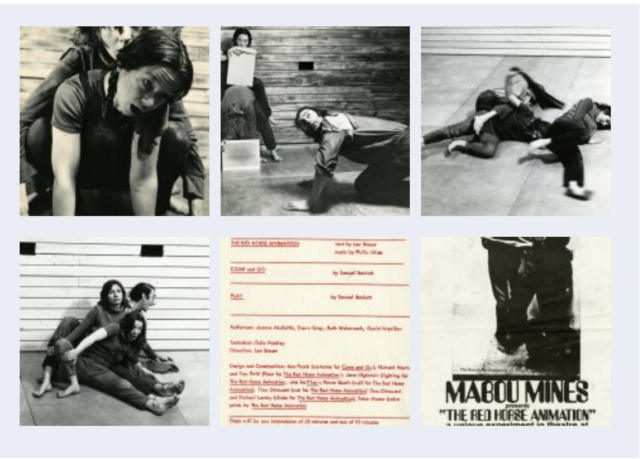
The Red Horse Animation captures a live Mabou Mines performance with cinematic additions
THE RED HORSE ANIMATION (Lee Breuer, 1974) / B. BEAVER ANIMATION (Lee Breuer, Chris Coughlan, and Craig Jones, 1979) / SISTER SUZIE CINEMA (Lee Breuer, 1982)
Friday, March 13, 8:45
Wednesday, March 18, 8:30
www.anthologyfilmarchives.org
The second program in the “Mabou Mines Cinema” series brings together a trio of cutting-edge shorts that embody the Mabou Mines approach to art while challenging the audience to adjust their expectations. The thirty-eight-minute Horse Animation captures Mabou Mines’ inaugural production, a piece that melds together movement, music, and text by Breuer that is a kind of manifesto as JoAnne Akalaitis, Ruth Maleczech, and David Warrilow crawl over one another across the floor, recite words in robotlike fashion (“I’m not myself. How in my illness I see something, my life, somewhere. And now it comes to me that I am a representation”), laugh, and turn into ghostlike digital projections by DeeDee Halleck, whose camera shoots the rest of the film in grainy black-and-white from a multitude of angles; the live music is by Philip Glass. In a 1970 Guggenheim program note, Breuer wrote about the piece, “The red horse, in its representational form, materializes and falls apart in the course of the performance. It lives in real time. ‘Lives’ in this sense means conveys meaning to its creators and observers. It tries to create its life outside the real performance time. It tries to live in dramatic time.”
In B. Beaver Animation, Breuer, Chris Coughlan, and Craig Jones zoom close in on Fred Neumann as he delivers a thirty-minute monologue about floods, snow, beavers, and dams; when he says early on, “To be specific, a force of nature,” he could be speaking about himself as he tears through the words like he’s in a race against time, with stutters and occasional breaks so he — and the audience — can catch a breath until he slows down for the dramatic finale.
And in Sister Suzie Cinema, the a capella quintet 14 Karat Soul performs gospel-tinged doo-wop songs while in a movie theater, the flickering light illuminating them in the darkness until they take flight in a nineteen-minute cinematic fantasia directed by Breuer in muted colors and written by Breuer and composer Bob Telson. The March 18 screening will be followed by a Q&A with Carl Hancock Rux, Telson, and singer Glenny T of 14 Karat Soul.
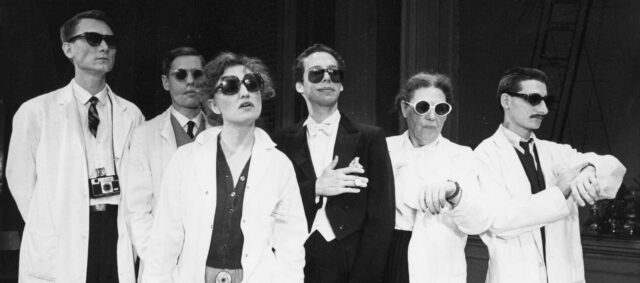
Dead End Kids is an unusual, haunting look at nuclear war from JoAnne Akalaitis
OTHER CHILDREN (JoAnne Akalaitis, 1979) / DEAD END KIDS: A HISTORY OF NUCLEAR POWER (JoAnne Akalaitis, 1986)
Monday, March 16, 7:00
Thursday, March 19, 7:00
www.anthologyfilmarchives.org
Other Children, JoAnne Akalaitis’s first film and not a Mabou Mines production, is a visually rich, poetic adaptation of Jane Bowles’s last work of fiction, the coming-of-age short story “A Stick of Green Candy.” The nineteen-minute film was shot in Cape Breton, Nova Scotia, in a small house, on the streets, and at a rocky clay pit. Juliet Glass stars as Mary, Erik Moskowitz as Franklin, George Rosenblatt as her father, and Joan Jonas as his mother; the verbatim dialogue is overdubbed by Glass, Moskowitz, Bill Raymond as the man, and Ellen McElduff as the woman and features such gems as this from Franklin’s mother: “I’d rather have a girl than a boy. There’s nothing much I can discuss with a boy. A grown woman isn’t interested in the same things a boy is interested in. My preference is discussing furnishings. Always has been. I like that better than I like discussing styles. I’ll discuss styles if the company wants to, but I don’t enjoy it nearly so well. The only thing about furnishings that leaves me cold is curtains. I never was interested in curtains, even when I was young. I like lamps about the best. Do you?” Jacki Ochs’s camera lovingly follows Mary, bringing her imaginary adventures to life as she leads an army of mountain-goat fighters, with gentle editing by David Hardy. In a rare title card with narration from the original story, we are told, “All at once she had had the fear that by looking into her eyes the soldiers might divine her father’s existence. To each one of them she was like himself — a man without a family.” The 16mm film, which was restored in 2022, concludes with the Hackberry Ramblers’ jaunty Cajun country instrumental “Just Once More.”
Other Children is screening on March 16 and 19 with Akalaitis’s 1986 feature Dead End Kids: A History of Nuclear Power, which captures Akalaitis’s Obie-winning 1980 play that incorporates numerous elements as it assesses the future of the world, with a cast that includes McElduff, Ruth Maleczech, Terry O’Reilly, Greg Mehrten, Fred Neumann, Glass, and Lee Breuer and Maleczech’s children Clove Galilee and Lute Ramblin’ in addition to David Byrne, who composed the synth soundtrack. The March 19 screening will be followed by a Q&A with journalist Don Shewey and McElduff.
Meanwhile, Mabou Mines is still going strong, having recently staged Samuel Beckett’s All That Fall, directed by Akalaitis, with such promising upcoming shows as the opera Barcelona, Map of Shadows and Rux’s Etudes.
[Mark Rifkin is a Brooklyn-born, Manhattan-based writer and editor; you can follow him on Substack here.]