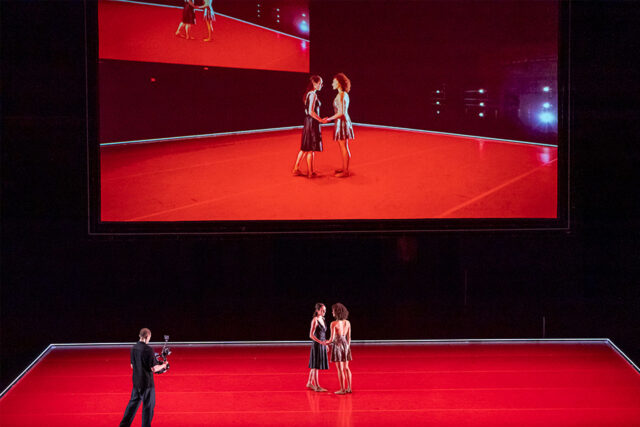
Benjamin Millepied’s Romeo & Juliet Suite offers numerous views of the action at Park Ave. Armory (photo by Stephanie Berger)
ROMEO & JULIET SUITE
Park Avenue Armory, Wade Thompson Drill Hall
643 Park Ave. at 67th St.
March 2-21, $55-$245
www.dancereflections-vancleefarpels.com
www.armoryonpark.org
“Oh no,” the person sitting next to me said at the start of Benjamin Millepied’s Romeo & Juliet Suite at Park Ave. Armory.
I couldn’t help but agree as we watched two dancers move a couch on a platform stage, followed by a cameraman in black who was documenting the action, the live video projected on a large screen. The men got onto the couch, which was facing away from the audience, but we could see what they were doing onscreen, since the cameraman was now in front of them. It was an odd way to begin the ballet, a multimedia adaptation of Sergei Prokofiev’s 1930s classic Romeo and Juliet, but it also signaled what was to come: ninety minutes of not knowing where to look as mostly unidentified characters — current and former members of Millepied’s LA Dance Project — performed on the stage, on the sides, and in various hallways and period rooms throughout the armory.
The score is bold and majestic. The choreography is often moving and beautiful. Camille Assaf’s naturalistic costumes, primarily blacks, brown, and grays, are set off by the usually heart-red platform and glow when the performers grab fluorescent light tubes and incorporate them in both inventive and curious ways. We get an inside look at various locations in the historic building, some not open to the public. A dark, mysterious masked ball with mirrors is held in a tight space. Romeo and Juliet (portrayed by three different pairs at each show: a man and a woman, two men, or two women) pose in silhouette against a white screen. A chase scene takes place under the rafters.
The problem is that we’re at a live performance and we spend much of the show’s eighty minutes essentially watching a movie, although it’s happening live. Even when the dancing is occurring on the stage, it is often being projected simultaneously, with cameraman Sebastien Marcovici, the company’s associate artistic director and rehearsal director, running about to capture it; it’s particularly intrusive during several duets between Tybalt (Renan Cerdeiro) and Mercutio (Shu Kinouchi) and Romeo (Daphne Fernberger) and Juliet (Rachel Hutsell). Many of the story’s most critical scenes can be seen only onscreen; in addition, no plot is ever described, so it helps if you know at least the basics of the Shakespeare play. There’s also a camera above the platform that offers a bird’s-eye view that is awe inspiring the first time but quickly becomes more like a scene from a Busby Berkeley movie starring Esther Williams. When the screen isn’t being used, it’s cast in shapes and colors that resemble a blurry Mark Rothko painting, as if hinting at the suicides to come.
And then there’s the balcony scene, which for me summed up the entire experience. (Just as an fyi, there was no balcony scene in the original play, which merely called for Juliet to be at a window.) Romeo and Juliet celebrate their newfound love by dancing in the glorious Veterans Room, then run upstairs and suddenly emerge on the upper ledge behind the screen. It’s a breathtaking moment — until Marcovici joins them, getting close to them so he can zoom in on their first kiss.
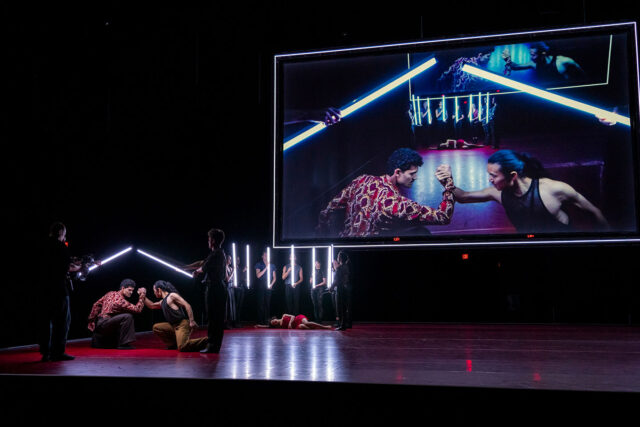
Mercutio (Shu Kinouchi) and Tybalt (Renan Cerdeiro) are at odds in multidisciplinary Romeo & Juliet Suite (photo by Stephanie Berger)
I’m sorry if I sound snarky; overall, I enjoyed the production, and there are numerous memorable moments that will stay with me. Fernberger and Hutsell are terrific, their movement packed with emotion, and the rest of the cast has a powerful energy. But it could have been so much more without all the bells and whistles; Millepied may have fared better had he incorporated the cinematic elements without getting camera happy, instead focusing more on the dance happening on the platform, in the room where the audience is sitting.
“Of all the places I’ve shown Romeo & Juliet Suite, the armory is by far the most fitting, as it provides the massive scale, flexibility, and grandeur needed to present this work at its fullest potential,” Millepied said about this iteration; previous versions have been presented at the Sydney Opera House, La Seine Musicale in Paris, and the Spoleto Festival in Charleston. He may have gotten a little carried away by the glorious armory, but there’s still a worthwhile dance to be found in his radically reimagined tale, if you know where to look.
[Mark Rifkin is a Brooklyn-born, Manhattan-based writer; you can follow him on Substack here.]