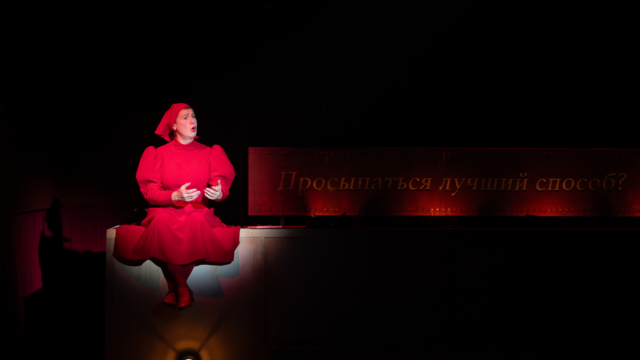
David Turner stars as the title character in Lauren Yee’s Mother Russia (photo by HanJie Chow)
MOTHER RUSSIA
The Pershing Square Signature Center
The Romulus Linney Courtyard Theatre
480 West 42nd St. between Tenth & Eleventh Aves.
Tuesday – Sunday through March 22, $74-$162
signaturetheatre.org
Asian American playwright Lauren Yee continues her geographic theatrical journey with the New York premiere of Mother Russia at the Signature, the third of what she calls her “cycle of communism plays in Asia in the twentieth century and its intersection with Western pop culture.” Cambodian Rock Band was a play with music about the second-generation immigrant experience and the Cambodian genocide of 1975–79, while The Great Leap was a culturopolitical fantasy about a basketball “friendship game” between American and China in 1981 that delved into the Chinese Cultural Revolution and the Tiananmen Square uprising.
In Mother Russia, Yee explores that nation’s conversion to capitalism in the wake of Mikhail Gorbachev’s introduction of Glasnost and Perestroika in the mid-1980s, the tearing down of the Berlin Wall in 1989, and the 1991 collapse of the Soviet Union. It’s 1992, and the character Mother Russia, hilariously portrayed by David Turner in an all-red nun’s habit / opera clown costume, prepares the audience for what’s to come.
“Do not bother to check. I am not in program. So you will not find me. Don’t worry, I am no one,” she says by way of introduction. “They think I will die before long. But! What do they know? . . . I have been let down by so many shitty men. Have you ever loved a shitty man? My life — if you can call this a life — has been one shitty man after another. So now I am here. With you sluts. You have kids? Never have kids. You are only as happy as your unhappiest child, and me? I have so many. And no matter what you do, they will never be happy.”
The only son of a lowly widow, twenty-five-year-old Dmitri Petrovich (Steven Boyer) thinks he is happy and successful; he runs a little metal-shack kiosk in St. Petersburg, selling condoms, bullets, candy bars, Nestlé’s Quik, Heinz Ketchup, Marlboro cigarettes, Coca-Cola, and other American goods, and he is in love with his girlfriend, Masha, the name of characters in Russian playwright Anton Chekhov’s Three Sisters and The Seagull. The shack has an ad for Folger’s coffee on its facade, in Russian except for the company logo, an example of the intrusion of capitalism. Meanwhile, Dmitri still dreams of being a spy for the KGB. One day a man enters the shop and Dmitri instinctively pulls a (Chekhovian) gun on him until he recognizes it is his old pal Evgeny Evgenievich (Adam Chanler-Berat), who had moved to Moscow three years earlier with his father, a powerful party leader who has now become “a burgeoning capitalist.”
“Oh, seems like just yesterday my mom was scrubbing the horseshit out of the floor of your dad’s government dacha!” Dmitri proclaims.
However, it turns out that Evgeny is not there to say hello to Dmitri but to shake him down, which is the job his father has forced him to do even though he is no good at it. Nonetheless, the naive Dmitri trusts Evgeny enough to let him in on a secret: that he is being paid handsomely in vouchers to secretly record the comings and goings of Yekaterina Mikhailovna Shevchenko (Rebecca Naomi Jones), a former famous activist and singer known as Katya M who defected to the West but has now returned as a quiet teacher whose past has been forgotten — except for the man who is paying Dmitri to track her.
Evgeny declares that he is a big fan of Katya M’s and wants to participate in the surveillance, begging Dmitri to hire him. “You want to be my servant?” Dmitri asks. Evgeny responds, “More like an employee,” having a hard time forming that last word.
Soon Evgeny is not only listening in on Katya at home and school but also following her on the bus, where they strike up a conversation. His obsession grows as he seeks relationship advice from Dmitri while hiding his identity from Katya. Both he and Katya are plagued by unseen fathers: Evegeny seeks approval from his ever-silent father, closed off from him behind a door, while Katya wants the truth about what happened to her father, a poet who was disappeared many years before.
In one of the funniest moment of the play, Dmitri and Evgeny devour a McDonald’s “filettofish” sandwich together. “Is this what capitalism tastes like?” Dmitri says with a rush of excitement.
It isn’t long before everyone is getting a taste of capitalism and Western society, filtered through Adam Smith’s theory of the invisible hand.
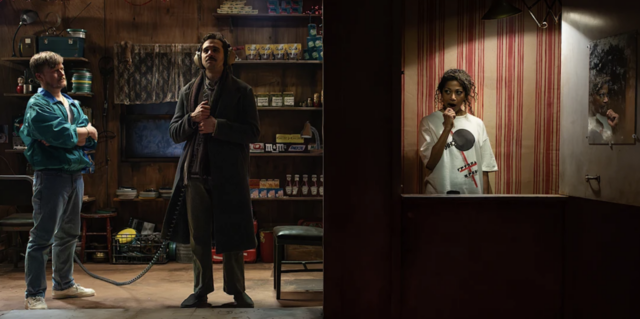
Dmitri (Steven Boyer) and Evgeny (Adam Chanler-Berat) spy on Katya (Rebecca Naomi Jones) in New York City premiere at the Signature (photo by HanJie Chow)
“There is not enough of me in this play,” Mother Russia says at one point. “Have you noticed this? Right?”
We noticed; there’s not enough of Mother Russia, and David Turner, in the play. She shows up in various places in interstitial scenes — sitting in the audience or on the ledge of Dmitri’s shack — to share her wisdom about the nation, embodying it with humor and angst while delving into history. “Back in the day, we would all have same couch. This is true!” she recalls. “Now you go to store, and all you see are choices.” After Evgeny claims that these are “unprecedented times,” Mother Russia goes into a riotous monologue about the history of Russia, arguing, “What bullshit. You know what was a hard year? Seven. Seven was a hard year.”
Turner (By the Way, Meet Vera Stark, Arcadia) is enchanting as the acerbic Mother Russia; he also portrays Katya’s mother in one critical scene. Boyer (Hand to God, Moscow Moscow Moscow Moscow Moscow Moscow) is sweetly appealing as the not-too-smart Dmitri, Chanler-Berat (Next to Normal, Nantucket Sleigh Ride) is steady as the deeply conflicted Evgeny, and Jones (Big Love, Oklahoma!) is alluring as Katya, although her story has a few key plot holes. As funny as the play is, there are several overly goofy and silly scenes and awkward moments, but it all works out in the end.
Western pop culture is central to the play, more than in just Katya’s former life as a pop star. Outside the theater, in the lobby, is a poster for “The Mother Russia Mixtape,” which notes, “The musical genre heightened the appeal of anti-Soviet countries, causing dissent and the rise of counterculture among Russian youth.” It includes sixteen influential tracks, from the Beatles’ “Back in the USSR” and Prince’s “Ronnie, Talk to Russia” to Sting’s “Russians” and Billy Joel’s “Leningrad” along with Sergey Kuyokhin’s “Intro Pop-Mechanics” and Kino’s “I Want Changes.”
The preshow music features such late-1980s, early 1990s Russian rock songs as Mumiy Troll’s “Медведица” (“A Bear”) and Kombinatsiya’s “Бухгалтер” (“Accountant”); Yee and director Teddy Bergman (KPOP, Empire Travel Agency) shape the play like a pop song, with Mother Russia serving as a kind of chorus and bridge to the stanzas by Dmitri, Evgeny, and Katya, with a bonus dance number set to a pumped-up version of the theme from Swan Lake. The play also references Vanilla Ice, Die Hard, Rambo, Robert De Niro, American baseball teams, and Meryl Streep as well as Anton Chekhov and his wife, Olga Knipper.
“I miss communism!” Dmitri shouts near the grand finale.
In today’s world, maybe that’s what capitalism tastes like.
[Mark Rifkin is a Brooklyn-born, Manhattan-based writer; you can follow him on Substack here.]