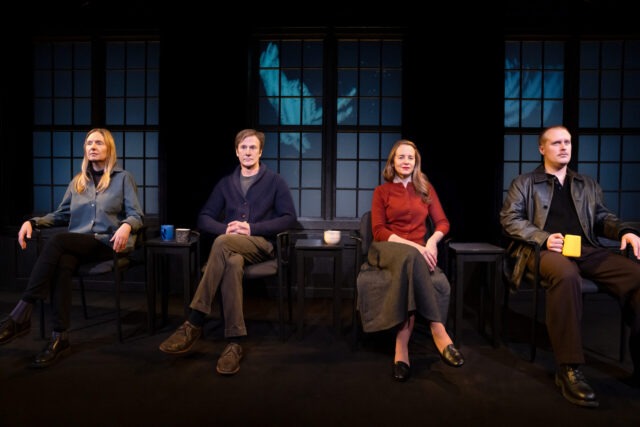
Hope Davis, Josh Hamilton, Maria Dizzia, and John Early star in Wallace Shawn’s What We Did Before Our Moth Days (photo by Julieta Cervantes)
WHAT WE DID BEFORE OUR MOTH DAYS
Greenwich House Theater
27 Barrow St. at Seventh Ave. South
Wednesday – Monday through May 24, $144-$174
mothdays.com
“OK. Yes, we are bored. We’re all bored now,” André Gregory says to Wallace Shawn in Louis Malle’s classic 1981 film, My Dinner with André, in which the two protagonists sit in a restaurant, eating, drinking, and talking for what was initially supposed to be three hours. Some professional and amateur critics agreed with Gregory.
Director Gregory, now ninety-one, and playwright Shawn, who is eighty-two, have been collaborating for more than fifty years, beginning in 1975 with Our Late Night and continuing with such other plays as Grasses of a Thousand Colors in 2009 and The Designated Mourner in 2013. They have reunited again for What We Did Before Our Moth Days, a three-hour absurdist comedy in which four characters sit in chairs and deliver monologues. Yes, for three hours (including two intermissions).
It’s worth every minute.
Riccardo Hernández’s set essentially announces what the audience is in for; there are four plain chairs onstage, three with a small wooden table to their right, one to the left. Behind them are three large windows onto which, before and after the show and during intermission, Oscar-nominated documentarian Bill Morrison projects moths flitting about to original music by sound designer Bruce Odland. There’s a religious atmosphere to the space, like an open confessional, and that soon becomes the case as the characters bare their souls — each in their own way — to the audience, which serves as a kind of priest or rabbi.
The characters enter one at a time, in naturalistic costumes by Hernández that look like they could have come from the actors’ closets. Tim (John Early) sits stage left, followed by Elle (Maria Dizzia), Dick (Josh Hamilton), and Elaine (Hope Davis), the only one without a cup of tea. Since there is little physical movement in the play, details such as who is drinking what can assume outsize importance, although one cannot track every minor change as a major metaphorical statement.
Since nearly the entire play unfolds with the actors seated — making their silent entrances and exits for each act downright thrilling — the dialogue has to sparkle and shine, and the performances must bring it vividly to life, defining the characters and laying out the plot. All the participants do so with expert precision. The initial interaction between actor and audience is key, and Shawn and Gregory pull it off with grace and elegance — and plenty of sardonic humor.
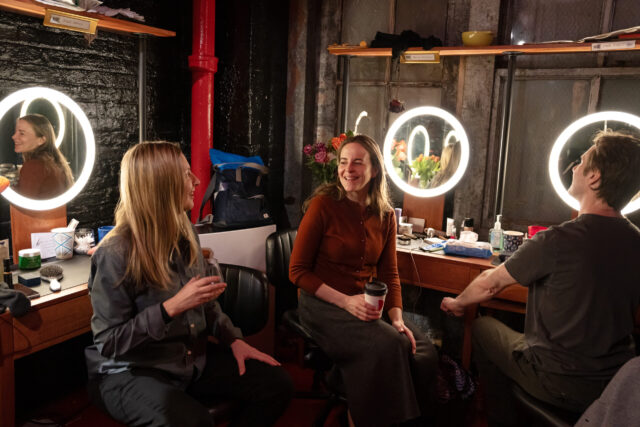
Hope Davis, Maria Dizzia, and Josh Hamilton chat in the dressing room of the Greenwich House Theater (photo by Julieta Cervantes)
The first to speak is Tim, who delivers a long, satirical monologue about his relationship with a teenage girl. He shares his story with a benign innocence that is both funny and awkward, shifting somewhat uncomfortably in his seat while attempting to gain the audience’s trust, searching the crowd for sympathetic eyes. Describing his situation, he says, “I got back in my car, but just before setting off for the familial apartment where my mother was now waiting alone with my father’s body, I made a quick phone call to my best friend, a girl called Rapunzel whose house was just down the street from mine in the little town where I lived. I just had to tell her that my father had died. Rapunzel was a tall girl with a deep voice and a big face that looked partly like the face of a wolf and partly like the face of a calf, and as I was twenty-five and she was thirteen, there was an age difference there. Her parents were divorced, and she lived with her father, a disturbed and horrible man who would often pull me into his bedroom when I’d come to visit his daughter and keep me more or less imprisoned there as he passed on to me the latest facts about his love affair with a wealthy married woman whose frightening gluttony in regard to sex, he would explain to me rather frantically, his eyes darting wildly around the room, was so extreme as to be, he thought, possibly dangerous, medically, to him.”
Next up is Elaine (Hope Davis), who is far more precise in her deportment, looking straight ahead, more matter-of-fact as she recalls visiting the body of her dead lover, Dick, in his bedroom, explaining, “I’d called Dick on the phone that [his wife] never answered, and, when she picked up, I knew what she would say, though her voice was different from the voice I’d always imagined she’d have. Now I felt sick, but all the same I went up to her, and I touched her arm, and I said, ‘Please, I’m sorry, I need to see him.’ She caught her breath and took a step back. I went into the room, and then she closed the door, or maybe she slammed it in a stifled sort of way. And there on an unmade bed in his wife’s apartment my lover lay before me, face up in his pajamas, partly under the covers, but the expression on his face was one I’d never seen, a sort of half-grimace, that weird ‘snapshot’ look people have when a photograph catches them at the wrong moment, and yes, he was dead, all right. There was no ambiguity about it, as perhaps I’d expected there to be. He was simply a corpse.”
Moments later, Elle (Maria Dizzia), Dick’s wife, speaks for the first time, sharing a strange memory: “There was a story I read to Tim at bedtime more than once when he was a very young boy about the monkey god Hanuman, and I remembered how I’d felt when I read him the section in which Hanuman tore open his own chest with his bare hands to show the image that stood in his heart. And I remembered saying to Tim, ‘You know, your father’s image stands in my heart.’” Elle is constantly making prolonged eye contact with individual members of the audience, even when she’s not speaking, as if making sure they understand what has happened, particularly to her, but not in a self-centered way.
Finally, we hear from Dick (Josh Hamilton), who stares into the distance, avoiding eye contact, sitting rigidly upright, like a deer in the headlights — or a moth drawn to a flame. He states, “I’d probably figured out by the age of eight that everybody had many birthdays in the course of their life but only one day on which they died, and, as I sometimes made up my own private names for things, for some reason that I don’t remember I decided to call the day on which a person died not their death day but their ‘moth day’ — partly I’m sure because I always found moths to be quite unpleasant — they were vague and powdery and fluttery — and they weren’t horrible or terrifying, but they seemed to be blind, and I didn’t like the way that they would suddenly appear and bump into me — and I guess I sort of pictured that when people died, they were sort of gently and vaguely and flutteringly escorted into death by a flock of blind moths. Well, this is all by way of saying that my own moth day, to everyone’s surprise, turned out to take place only a few days before what would have been my forty-fifth birthday.”
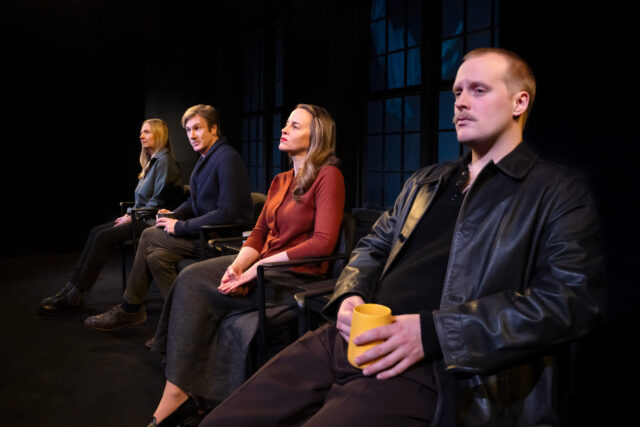
Three hours of watching four actors deliver monologues in chairs fly by in Moth Days (photo by Julieta Cervantes)
Those first “confessions” beautifully set the stage for everything that follows as we learn more about the characters, their strengths and insecurities, and, perhaps most critically, how they view themselves, their self-worth after an unexpected tragedy. There has been a surfeit of plays about grief since the pandemic, but Moth Days attacks the theme in a unique and affecting way, avoiding sentimentality or melodrama. While the play is certainly not interactive or immersive, the connection between each character and the audience is so palpable, so intense, that you’ll feel like you’re experiencing the events being described as they unfurl in Shawn’s unique language. Jennifer Tipton’s lighting may focus on the speaker, a spot illuminating them from above, but be sure to gauge the other characters’ reactions, or lack thereof, to what is being said. It’s utterly fascinating to watch, making it all the more breathtaking when that structure is broken for a few exhilarating minutes.
Tony nominee Davis (God of Carnage, Pterodactyls), actor, comedian, writer, singer, director, and producer Early (Showgasm, Search Party), Tony nominee Dizzia (Pre-Existing Condition, If I Forget), and Independent Spirit Award nominee Hamilton (The Antipodes, The Coast of Utopia) maintain just the right balance among their characters, calmly waiting their turn to convey their point of view, revealing their psychological makeup as they carefully avert judging the others.
According to the January 2024 Nature magazine article “Why flying insects gather at artificial light,” “Under natural sky light, tilting the dorsum towards the brightest visual hemisphere helps maintain proper flight attitude and control. Near artificial sources, however, this highly conserved dorsal-light-response can produce continuous steering around the light and trap an insect.” Each of the characters in What We Did Before Our Moth Days is trapped in their own way, drawn to a flame whether they want to or not, attempting to steer around the light. It can also be interpreted as a metaphor for theater itself, whether it takes place in complicated changing sets or four people just sitting around drinking and talking, testing the audience’s comfort level for three hours.
In My Dinner with André, the original script of which was cut by Malle to a more amenable 110 minutes onscreen, Gregory says, “Wally, don’t you see that comfort can be dangerous? I mean, you like to be comfortable and I like to be comfortable too, but comfort can lull you into a dangerous tranquility.”
Prepare to be comforted by this extraordinary, and safely tranquil, production.
[For those who, like me, cannot get enough Wallace Shawn, he will be performing his Obie-winning 1991 solo play The Fever on Sunday and Monday nights at Greenwich House. Mark Rifkin is a Brooklyn-born, Manhattan-based writer; you can follow him on Substack here.]