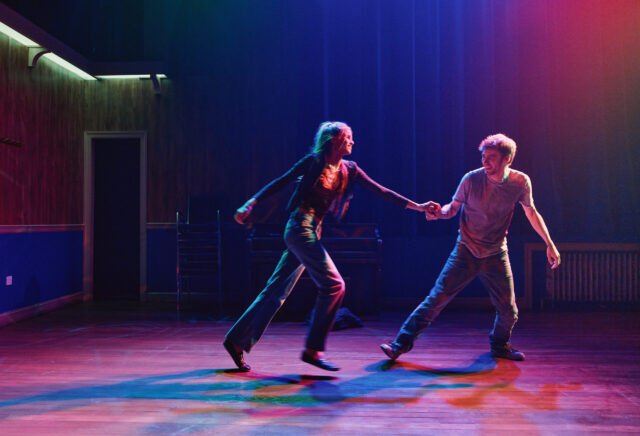
Abbey Lee and Owen Teague star as a couple seeking escape from the world in Blackout Songs (photo by Emilio Madrid)
BLACKOUT SONGS
Robert W. Wilson MCC Theater Space
Susan & Ronald Frankel Theater
511 West Fifty-Second St. between Tenth & Eleventh Aves.
Tuesday – Saturday through February 28, $59-$129
www.blackoutsongs.com
“I spoke about wings / You just flew / I wondered, I guessed, and I tried / You just knew / I sighed / But you swooned / I saw the crescent / You saw the whole of the moon,” Mike Scott sings in the 1985 Waterboys tune “The Whole of the Moon.” The propulsive song appears several times in Joe White’s scintillating, Olivier-nominated Blackout Songs.
Running at the Susan & Ronald Frankel Theater through February 28, the show stars Owen Teague and Abbey Lee as an initially unnamed American college student studying painting and a free-spirited British wannabe poet who meet at their first AA meeting. While she looks stylish in jeans, a faux fur coat, a belly-revealing shirt, and sunglasses, he is ragged and unsteady, with torn pants and a denim jacket. (The costumes are by Avery Reed.) He speaks in a stammer, wearing a neck brace that he can’t explain.
Finding a tooth in her pocket, she says, “Some people might (panic), you know, but my brain, my brain’s just gone ‘pfff, don’t worry about it.’ Gone. And that’s — Well, that’s what, exactly? That’s mercy, isn’t it? This is what mercy looks like, you go out, get pissed, get hurt, fall in love, whatever, doesn’t matter, in the morning it’s gone anyway, new day — do you know you’re shaking?” He doesn’t.
That opening sets the stage for the rest of the play, in which the two alcoholics fall in and out of love, disappear for extended periods, and remember and forget significant parts of their toxic relationship. They are both completely right and completely wrong for each other; you can’t help but root for them even when it’s clear they are caught on a dangerous downward spiral, unable to avoid the “medicine” they still think can help them. They role-play, attend a funeral, and dance in a bar, as beautiful moments intersect with bad decisions. One night, when he shows up bleeding from the mouth, she says, “I think it’s sexy, actually. Desperately romantic. You’re so doomed, aren’t you.” He later professes, “There’s no life without you.”
They exist in an amorphous time and space, where no one else is ever around, just the two of them reveling in and falling prey to their inner demons. When she talks about her father, who essentially abandoned her when she was six, he asks, “Don’t you think you’re memorable? Is that what you think — Cos he — Cos he sent you away, that means he tried to forget you?” She responds, “OK, alright, thanks, Dr. Freud, but I’m done here — Let’s go get a drink.”
The past and the present intertwine as the man and the woman contemplate their future, minute by minute, depending on what they can remember.
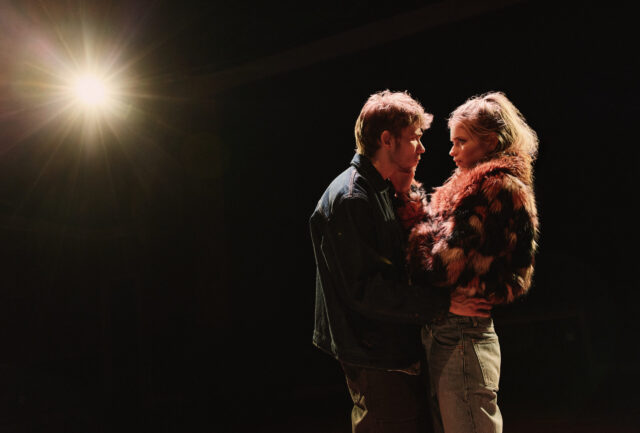
Stacey Derosier’s extraordinary lighting nearly steals the show in Blackout Songs (photo by Emilio Madrid)
Blackout Songs unfolds in a mostly empty space designed by three-time Tony winner Scott Pask, with a small pub table on one side against the wall, a folding table with coffee and snacks on the other, and a church pulpit near a far corner, next to large windows that later reveal a glowing cross. In the first scene, the woman is convincing the man to leave the meeting and get some medicine; looking directly at the audience, she says to him, “Don’t look at them,” as if we’re not only watching the play but are also fellow recovering addicts at the meeting — and we have no right to judge them because we all have our failings.
The concept of the moon is a theme throughout the story; in addition to the Waterboys song, the man recalls the beauty of the moon when showing the woman one of his paintings, and he later says, “Won’t forget this, will you. Full moon, holy wine, it’s like a song or something. You know the world is different under a full moon? People are. People fall in love. Cos it pulls liquid around, doesn’t it. Tides. And there’s liquid in us too. Blood and. Other liquids. Chemicals. The brain is the moistest organ in the body. Moon drunk is different.”
Brian Hickey’s striking sound and original music and Stacey Derosier’s extraordinary lighting — almost a character unto itself — help define the shifts in time to startling effect. The production, under Rory McGregor’s (The Wasp, Buggy Baby) expert direction, evokes such other complex works as Nick Payne’s Constellations, in which a couple’s relationship constantly changes in the quantum multiverse, Philip Ridley’s Tender Napalm, about an unnamed man and woman whose intense passion leads them on mysterious mini-adventures, and David Ives’s Venus in Fur, in which a theater director and an actor turn an audition into a reality-bending treatise on gender, sexuality, and degradation, as well as Blake Edwards’s 1962 film Days of Wine and Roses, about a married couple who trap themselves in a haze of alcohol. (McGregor directed Tender Napalm at Theaterlab in late 2024, with a crew that included Reed, Hickey, and Derosier.)
Blackout Songs boasts a trio of firsts: Two-time Olivier nominee White’s (The Little Big Things, Mayfly) and Lee’s (Florida Man, Black Rabbit) American stage debuts and Teague’s (Kingdom of the Planet of the Apes, You Hurt My Feelings) US debut. Lee is a force of nature in the play, her character never slowing down, always on the move, while Teague lends a sensitive air to the man, who thinks he knows what he wants but keeps making choices that hold him back. It’s a beguiling, heart-wrenching ninety-minute pas de deux as two lost souls try to find love and escape together.
The play does have a hard time figuring out how to end, but by then you’ll be so entranced by the two characters, and the two actors, that you won’t mind, especially if you’re addicted to good theater.
[Mark Rifkin is a Brooklyn-born, Manhattan-based writer and editor; you can follow him on Substack here.]