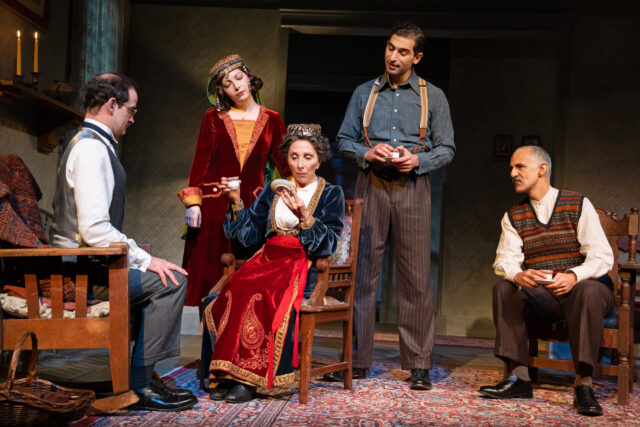
Lawyer Wallace McCamant (Will Brill) seeks to help Armenian immigrants gain US citizenship in Meet the Cartozians (photo by Julieta Cervantes)
MEET THE CARTOZIANS
Second Stage Theater at the Pershing Square Signature Center
The Irene Diamond Stage
305 West 43rd St. between Eighth & Ninth Aves.
Tuesday – Sunday through December 14, $69-$125
2st.com/shows
Talene Yeghisabet Monahon makes a giant leap forward with her exquisitely rendered new play, Meet the Cartozians, a timely and sensitive tale of immigration, assimilation, racial profiling, and culture. The first act takes place in 1923–24 in Portland, Oregon, as Tatos Cartozian (Nael Nacer), an Armenian-born Christian, and his family must fight to prove he is white to prevent the US government from canceling his naturalization. The second act occurs one hundred years later in Glendale, California, as four American-born Armenians prepare to share stories celebrating their heritage on a reality show hosted by an immensely popular celebrity influencer (Tamara Sevunts) who is a descendant of that family.
“We are all trying to uh, let’s say, make sense? Of why this is happening now,” Hazel (Obie winner Susan Pourfar), Tatos’s daughter, says to their well-heeled lawyer, Wallace McCamant (Tony winner Will Brill), in 1923, a sly reference to the treatment of immigrants and people of color today.
A century later, Alan O’Brien (Brill), a production tech on the TV program Meet the Cartozians, tells the guests, “So let me get this straight. The original Cartozians fought to be white so that Armenians could have privileges, right? And now, it sort of feels like Armenians are fighting to not be white . . . so you can like, get more privileges. Am I right about that?”
In 1923, Tatos, a soft-spoken man who speaks heavily accented broken English, lives in a lovely home with his wife (Sevunts), their daughter, Hazel, and his mother, Markrid (two-time Tony winner Andrea Martin). While Hazel and her brother, the impeccably attired Vahan (Raffi Barsoumian), are adapting to the American way of life, the stern Markrid is trying to preserve as much Armenian tradition as she can. After insisting that Wallace take a piece of her homemade kadayif, a sweet dessert, and seeing that he has not finished it, she is offended. Hazel asserts, “I’m sorry. In Armenia, it is a bit rude not to eat. But in America, I think maybe it is rude to force someone to eat.” When Markrid brings out a plate of the sesame-based simit, Wallace declines to taste one, further upsetting Markrid.
Talking about the case, Wallace says, “In 1790, the good men who founded this country extended the offer of naturalized citizenship to all ‘free white persons of good character.’ That was who they felt oughta become American citizens.” Vahan, who works with his father, sister, and naturalized uncle in the family’s successful oriental rug business, proclaims that they are solid white Christians, but Wallace explains that other factors are involved, including skin and hair color, eye and face shape, and “the terrific tendency of Armenians to intermingle and procreate with white populations all over the world.” Wallace commiserates with the Cartozians, pointing out that his paternal grandfather emigrated from Ireland during the potato famine and experienced bigotry when he first came to America.
They also refer several times indirectly to the genocide of approximately 1.5 million Armenians at the hands of the Ottoman Empire during WWI, leaving them without a nation. “It is no longer a place,” Tatos says. Hazel counters, “I think it is fine to say Armenia still. I say Armenia when I speak of home.” Tatos responds, “This is our home. Portland. America.”
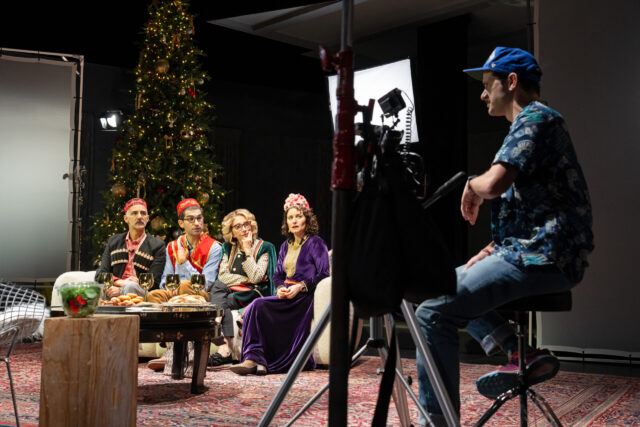
The cast of Meet the Cartozians portrays different characters in 1924 and 2024 (photo by Julieta Cervantes)
In 2024, Robert Zakian (Nacer), Rose Sarkisian (Martin), and Nardek Vartoumian (Barsoumian) are in the home of Leslie Malconian (Pourfar), which features a Christmas tree, a rack of clothes, film equipment, an oriental rug, and an empty chair facing a table and a couch. The four TV guests, who have never met before, select over-the-top costumes that are supposed to represent their heritage, but they have become so Americanized that they don’t really know that much about where they came from.
When Leslie brings out two plates of homemade simit, one gluten-free, Rose starts an argument about Armenian cuisine, which she is not fond of. “I miss the food Mama made,” Robert says wistfully, a potent comment since the actors portraying Robert and Rose played Tatos and Markrid in the first act. Alan, whose family, like Wallace’s, emigrated from Ireland, tries to commiserate with the Armenians, pointing out that his paternal grandfather experienced bigotry when he first came to America and was not considered to be white; Brill plays both Alan and Wallace.
As the characters await the arrival of the host, they get into heated discussions about Armenian history, cultural appropriation, skin color, politics, and the genocide. Praising an episode of the series in which the host visited Armenia, Rose notes, “Most people in the world never knew what the Armenian genocide was before that. Many people didn’t even know that Armenia was a country before that.” Nardek adds, “A lot of people still don’t, sadly.”
They certainly will know after seeing Meet the Cartozians.
The play was inspired by the pop-culture phenomenon Keeping Up with the Kardashians, the reality show that detailed the lives of the Armenian American Kardashian clan for twenty seasons, and the actual 1925 court case United States v. Cartozian, in which the Portland firm of McCamant & Thompson represented rug dealer Tatos Osgihan Cartozian in his quest to gain American citizenship.
Monahon, a Massachusetts-born, New York City–based actor and playwright of Armenian and Irish descent, has previously explored historical fiction in The Good John Proctor (the Salem witch trials), Jane Anger (the 1606 London plague), and How to Load a Musket (Revolutionary and Civil War reeanactors). In Meet the Cartozians, Monahon has superbly melded fact and fiction, expertly linking the two different time periods and relating the action in both eras to today’s arrest, deportation, and murder of legal and illegal immigrants, often based on racial profiling. Tatiana Kahvegian’s sets and Enver Chakartash’s costumes further delineate the differences Armenians experienced in 1924 and 2024.
Monahon and Tony-winning director David Cromer (Prayer for the French Republic, A Case for the Existence of God) have created believable characters involved in convincing situations that, although they are specifically about Armenian Americans, also relate to so many others who have come to the United States in search of a better life. The outstanding cast includes three actors of Armenian descent, Barsoumian, Sevunts, and Martin, whose name adorns the Andrea Martin Performing Arts Auditorium in Armenia.
As funny as Meet the Cartozians is, it also tackles ongoing complex sociopolitical issues that are pervasive in modern-day America, under the current administration; even Kim Kardashian herself went public with criticism of President Donald Trump’s immigration policies, particularly how ICE is tearing families apart. Somewhere, the Cartozians are smiling down on her and Monahon as the battle continues.
[Mark Rifkin is a Brooklyn-born, Manhattan-based writer and editor; you can follow him on Substack here.]