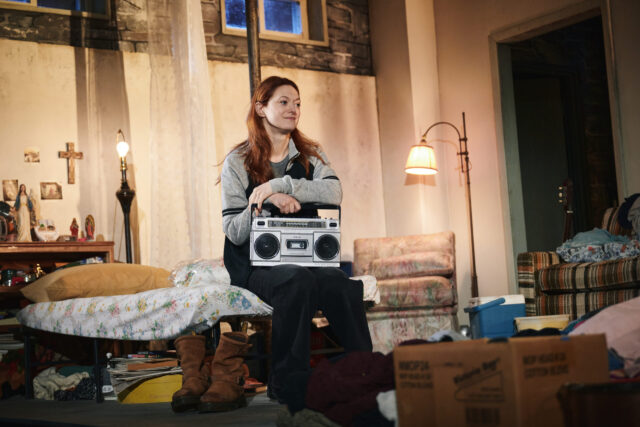
Polish immigrant Renia (Marin Ireland) dreams of a better life in Martyna Majok’s reimagined Queens (photo by Valerie Terranova)
QUEENS
MTC at New York City Center – Stage I
131 West Fifty-Fifth St. between Sixth & Seventh Aves.
Tuesday – Sunday through December 7, $109-$139
www.manhattantheatreclub.com
www.nycitycenter.org
Polish-born American playwright Martyna Majok tells stories that challenge the audience, taking risks as she explores the lives of the disenfranchised, the disabled, the underrepresented, and undocumented immigrants in search of the unreachable American dream. In Cost of Living, which earned her the Pulitzer Prize, it all came together without compromise; I wrote of the Broadway version, “The separate storylines merge at the end in an uneasy finale that acknowledges that we all encounter tremendously painful issues in life, regardless of our physical or psychological situations, which is further established during the curtain call.”
Her three other plays were not quite as successful despite intriguing setups and intricate narratives. About Ironbound, I noted, “The rest of the cast play their roles well, but their characters and tales are nowhere near as interesting and compelling as Darja’s, and they become somewhat quaint and repetitive as the show goes on and overdoes the obvious distinctions between rich and poor.” And I wrote that Sanctuary City “takes a head-scratching turn as the ending approaches, detracting from everything that came before it, which was powerful and moving.”
Queens, which originally ran at LCT3 in 2018 and is now at MTC’s New York City Center – Stage I through December 7 in a newly reimagined version, displays too many of the same issues; the play features characters and situations that you want to embrace and understand, but Martok and director Trip Cullman (Cult of Love, Six Degrees of Separation) are unable to weave their way through a web of fascinating ideas that don’t quite mesh. As with Ironbound and Sanctuary City, there’s a strong play in there that refuses to emerge.
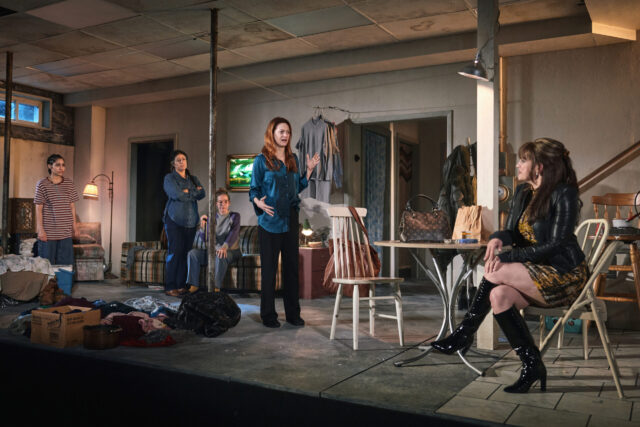
A group of women seek common ground in MTC production at City Center Stage I (photo by Valerie Terranova)
Over the course of sixteen years, seven immigrant women move in and out of a crowded basement apartment in Queens, desperate to find a better life in America: the Belarusian Pelagiya (Brooke Bloom), the Polish Agata (Anna Chlumsky), the Polish Renia (Marin Ireland), the Ukrainian Inna (Julia Lester), the Afghan Aamani (Nadine Malouf), the Ukrainian Lera (Andrea Syglowski), and the Honduran Isabela (Nicole Villamil).
“Any regrets? In your life? In this building?” Inna asks Renia. Although she doesn’t want to admit it, Renia has plenty, having made choices that did not necessarily work out the way she expected. Inna punches her in the face before going inside and renting a room.
The basement is cluttered with clothing, a guitar, and other objects that are memories of those who came before, haunting Renia. (The effective set is by Marsha Ginsberg.) “What is your reason?” the memory of Pelagiya asks her. Aamani adds, “The reason you are here. Looking to live someplace away from the rest of your kind of people. What happened.”
The narrative then shifts to December 2001, when Renia has arrived in New York with little money in her pocket. Pelagiya wants to know what brought her there. “It’s no story,” Renia says. “It’s always story,” Pelagiya insists. Renia responds, “I need place I can stay. I come here. End of story.” Of course, it’s only the beginning of what turns out to be a dark, painful story. Even a somewhat pathetic party the women hold is tinged with fear and sadness. The appearance of the Honduran American Glenys (Sharlene Cruz) injects a burst of youthful energy, but it’s not enough to sustain the play’s 135 minutes (with intermission).
Queens does serve as a fascinating counterpoint to Bess Wohl’s dazzling Liberation, the current Broadway transfer about six diverse women who meet regularly in a rec center basement in Ohio in the 1970s to discuss the role of women in society, how it impacts their lives individually and what they can do to help change the status quo publicly; both shows delve into the relationships among women as well as mothers and daughters. The Queens women, however, have a different kind of baggage — obviously, they lack the relative privilege of the characters in Liberation, and face colossal odds stacked against them, coming from countries where women are still in search of freedom, fifty years after the Liberation women began changing America. Still, women’s search for the most basic of freedoms is the motor that drives Queens, even if the ride is bumpy and the destination uncertain.
[Mark Rifkin is a Brooklyn-born, Manhattan-based writer and editor; you can follow him on Substack here.]