
Stephen Kunken stars as conniving lawyer Donald Pearlman in Kyoto (photo © Emilio Madrid)
KYOTO
Lincoln Center Theater at the Mitzi E. Newhouse
150 West 65th St. between Broadway & Amsterdam Ave.
Tuesday – Sunday through November 30, $140.50-$242.50
www.lct.org
If the prospect of sitting through Kyoto, a 160-minute play at Lincoln Center’s Mitzi E. Newhouse Theater, set at a series of 1989–97 climate change conferences, doesn’t fill you with anticipation, consider Oslo, a nearly three-hour drama about the 1993 Oslo accords that began at the Newhouse in 2016, moved to the Vivian Beaumont, and deservedly won the Tony for Best Play. Kyoto is a worthy successor in the arena of political theater, a gripping behind-the-scenes thriller that commands our attention even as we are aware of the general outcome; decades later, there is still a battle over global warming, whether it’s man-made and a legitimate threat to the immediate future of the Earth.
Stephen Kunken is sensational as conniving American lawyer and lobbyist Don Pearlman, who serves as participant and narrator, speaking from beyond the grave; he died in 2005 at the age of sixty-nine, having built a controversial legacy. The play begins with him directly addressing the audience, explaining, “I think we can all agree on one thing: the times you live in are fucking awful. Everywhere you look there’s some kind of disagreement, something angry, something vicious, something acutely historic. There’s some maladjusted kid who takes a gun into his school. Countless limbless civilians blown up daily on your newsfeed. A CEO leaking blood on the sidewalk, dying, shrieking, shot. There’s food shortages, global pandemics, runaway inflation, culture wars, trade wars, real wars, possible third world wars, the death of democracy, collapse of the rules-based order and, on top of all of that, a planet that is literally burning down. And if you’re a guy like me looking at a time like now, the main thing you think is: man . . . the 1990s were freakin’ glorious.”
The show takes place on a circular stage that morphs from a scientists meeting in England in May 1990 to an IPCC Plenary Session in Sweden in August, the World Climate Conference in Geneva in November, talks in Virginia and the United Nations in 1991–92, Berlin in 1995, and ultimately the Kyoto International Conference Centre in December 1997 for COP3 (Conference of the Parties). Projections on a rear screen feature live video feeds and archival footage (of George W. Bush, Al Gore, and other players, designed by Akhila Krishnan).
Along the way, Pearlman butts heads with and attempts to manipulate an international collection of experts, based on real people, who have differing views on how to proceed, including Argentinian lawyer and conference leader Raul Estrada-Oyuela (Jorge Bosch), Austrian-born American Global Climate Coalition atmospheric physicist Fred Singer (Peter Bradbury), Swedish meteorologist and Intergovernmental Panel on Climate Change founder Bert Bolin (Daniel Jenkins), American climate scientist Ben Santer (Jenkins), Saudi oil economist Mohammed Al Sabban (Dariush Kashani), Chinese professor Shukong Zhong (Feodor Chin), a Kiribati AOSIS spokesperson (Taiana Tully), German president Angela Merkel (Erin Darke), UK deputy prime minister John Prescott (Ferdy Roberts), Japanese environment minister Hiroshi Ohki (Rob Narita), British physicist John Houghton (Roberts), Tanzania professor Mark Mwandosya (Roslyn Ruff), the head of the US delegation (Kate Burton), and a UN Secretariat (Imani Jade Powers). While some fall in line, others are ready to fight, especially over the specific language in their assessments reports and draft protocols, arguing about such single words as appreciable.
Don is approached by the Seven Sisters, representatives of the world’s biggest oil companies, who want Don’s support — and get it through not-so-subtle threats. “We feel that without proper oversight, words like targets and timetables will be used to harm us,” one advises Don. Another adds, “To harm America, Don.” Don cancels his long-promised vacation with his wife, Shirley (Natalie Gold), and sets out to do the bidding of the Seven Sisters, breaking rules, undermining the conferences’ goals, and seeming to enjoy throwing wrench after wrench into the machinery.
“I know what people like you think of lawyers like me. You theater, artsy, liberal types who pay your bills in empathy,” he tells the audience. “But none of your concerns interest me. I’m the only one who can tell this story. Because I’m the only one who was there. Start to finish, I saw it all. Did it all. Fought for it all. And you may not like it all, but if you want to know it all, you can’t have it all your own way.”
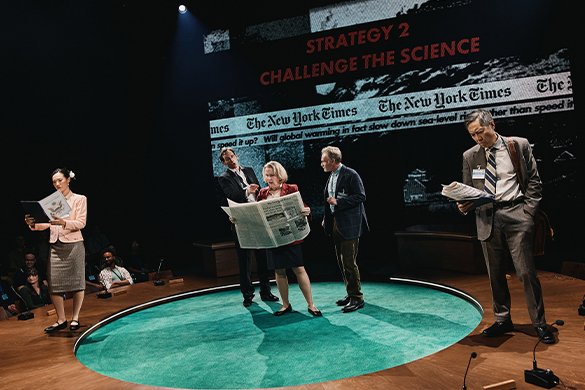
Gripping fact-based play revisits a decade of climate-change conferences (photo © Emilio Madrid)
Writers Joe Murphy and Joe Robertson (The Walk with Little Amal) and directors Stephen Daldry (Skylight, Billy Elliot: The Musical) and Justin Martin (Prima Facie, Inter Alia) previously collaborated on the breathtaking, immersive hit The Jungle, which transformed St. Ann’s Warehouse into a Calais refugee camp. As in that production, in Kyoto they avoid preaching to the choir or making pronouncements on climate change, instead letting the action unfold while keeping the audience on the edge of their seats. In fact, some audience members have special chairs next to the characters around the circular stage and occasionally are engaged in conversation with them. (The set is by Miriam Buether, with business-style costumes by Natalie Pryce, lighting by Aideen Malone, crisp sound by Christopher Reid, and original music by Paul Englishby.)
There’s a lot of talk and scientific jargon, but it never gets boring. Tony nominee Kunken (Nikolai and the Others, Enron), who has been with the show through its original run at Stratford-upon-Avon and its subsequent move to the West End, is fully in charge of the proceedings, imbuing Pearlman with a balance between true believer, evil mastermind, and expert controller; you might not like or trust Pearlman, but you can’t take your eyes off him, as he in so many ways represents what is wrong with how important decisions that affect the entire world are made, then and now. Olivier nominee Bosch (Invencible, Speaking in Tongues) provides solid support as Pearlman’s archnemesis.
Nominated for an Olivier Award for Best New Play, Kyoto is an engrossing and riveting story, a cautionary tale that says much about why we are in the mess we are today, with no clear way out.
[Mark Rifkin is a Brooklyn-born, Manhattan-based writer and editor; you can follow him on Substack here.]