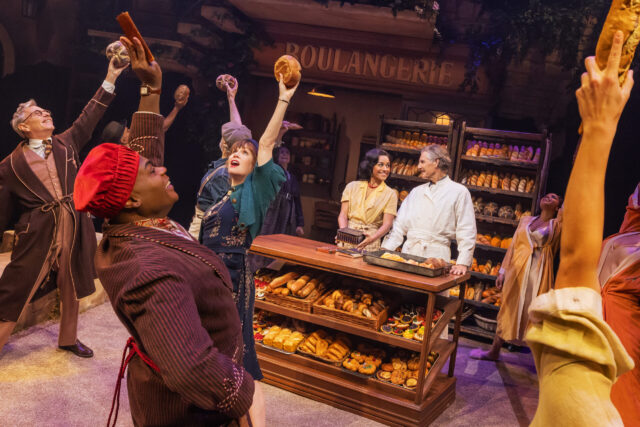
The French village of Concorde rejoices when a new baker comes to town (photo by Matthew Murphy and Evan Zimmerman)
THE BAKER’S WIFE
Classic Stage Company, Lynn F. Angelson Theater
136 East Thirteenth St. between Third & Fourth Aves.
Tuesday – Sunday through December 21, $66-$206
www.classicstage.org
Why did it take nearly half a century for The Baker’s Wife to at last get a major New York City production? That’s a question you’ll likely be asking yourself after seeing this delightful musical at Classic Stage, marveling at what you’ve just experienced.
The show — based on Marcel Pagnol’s 1938 classic film La Femme du Boulanger, which was adapted from Jean Giono’s 1935 semiautobiographical novel Jean le Bleu — was on a pre-Broadway national tour in 1976 when it was abruptly pulled by producer David Merrick. It was reworked for a 2005 run at the Paper Mill Playhouse in New Jersey and was presented by the Gallery Players in Brooklyn for sixteen performances in 2015 and by J2 Spotlight for a ten-day showcase in 2022. Thus, this revival has been a long time coming.
The fun begins as you enter the theater, which has been transformed by Jason Sherwood into the 1935 village of Concorde in Provence, bedecked on all four sides with wandering plants, old-fashioned signage, a bakery (Boulangerie), balconies above the shop and in a far corner, double windows that open up, and small tables that seat characters at a café as well as a handful of audience members. Several men are already onstage, two playing a guitar and an accordion, the others engaged in a game of pétanque. The play proper begins as husband-and-wife café owners Claude (Robert Cuccioli) and Denise (Judy Kuhn) set the tables; Denise then turns to the audience and explains that nothing much ever changes in their town — except that their baker died and they are anxiously awaiting their new pâtissier, as they have been without bread and pastries for seven weeks, which is unconscionable.
“He could have arranged for another baker. He knew he was going to die,” Antoine (Kevin Del Aguila), the local lush, complains about the previous dough expert. The teacher, Martine (Arnie Burton), replies, “How did he know? He was drunk, he fell in a pit, and broke his neck.”
As calm and peaceful as everything appears at first, the rousing song “If It Wasn’t for You” establishes that all is not so well in Concorde, which in French means “harmony.” The priest (Will Roland) is not happy that the mayor, le Marquis (Nathan Lee Graham), is cavorting like a pimp with his “nieces,” the sexy trio of Simone (Savannah Lee Birdsong), Inez (Samantha Gershman), and Nicole (Hailey Thomas). The priest is also at odds with Martine and his recent teaching. Claude bosses around Denise, while Barnaby (Manu Narayan) suppresses his wife, Hortense (Sally Murphy). The hunky Dominique (Kevin William Paul) is not about to tie himself down with one woman, assisted by his friend Philippe (Mason Olshavsky). And the stern spinster Therese (Alma Cuervo) just wants to be left alone. “Ooh, life is hard enough for me / With all my cares and labors / Why must I be burdened with / Such irritating neighbors?!,” they sing.
When the baker, Aimable Castagnet (Scott Bakula), finally arrives, the villagers assume that the stunning young woman with him is his daughter, but it is actually his wife, Geneviève (Ariana DeBose). While the amiable Aimable is excited about this new opportunity, Geneviève seems a bit tentative, as if moving to this far-off location might be a little overwhelming. He asks her if she really likes it, and she says that she does, but it isn’t long before she is considering the attention heaped on her by Dominique, who wants to show her around the area and take her to the waterfall. She reminds him that she is married, and he wonders if Aimable would be jealous. “Jealous? Why should he be jealous?” she says. He answers like a rapscallion, “Because someone like you . . . If you were mine, I wouldn’t leave you alone for a second.”
Geneviève asks Aimable if he ever gets jealous, and he responds, “Jealous? Because other men find you beautiful? Why should I be jealous? I have a diamond and it’s shining in their eyes. Let them be jealous of me. . . . I’m going up to take a little nap.” When he tells her he loves her and she does not say the same in kind, it’s clear he might have something to worry about, but he is too wrapped up in his own world to figure out what is happening. And after something does, it affects his baking skills to the point that the villagers have to take extreme action to get their beloved bread every day.
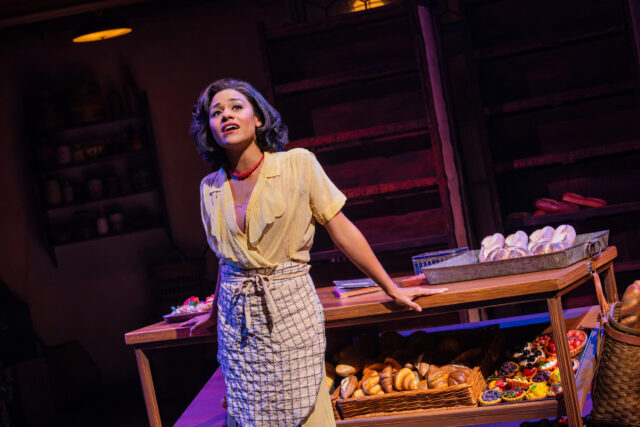
Geneviève (Ariana DeBose) takes stock of her life in The Baker’s Wife at Classic Stage (photo by Matthew Murphy and Evan Zimmerman)
There’s a central flaw in the casting of the show — even though Geneviève is young and gorgeous and Aimable is a clueless, boring man more than twice her age, one can still imagine why she would be attracted to him because he is played by Bakula, who might be a senior citizen but is a handsome and virile guy in his later years. In the film, the baker, portrayed by Raimu, is a shlubby, silly, clownlike figure, and it’s easy to imagine him being potentially cuckolded. With Bakula in the husband role, Geneviève’s attraction to Dominique seems to happen far too quickly. But the quality of the performances makes that a minor quibble that is skillfully overcome.
Seductively directed by Gordon Greenberg (The Heart of Rock and Roll; Dracula, a Comedy of Terrors), who has been associated with the show since 2002, The Baker’s Wife features lovely music and lyrics by Oscar and Grammy winner and five-time Tony nominee Stephen Schwartz (Pippin, Wicked) and a thoughtful if straightforward book by Tony winner Joseph Stein (Fiddler on the Roof, Zorba). The enchanting music direction by conductor Charlie Alterman and orchestrations by David Cullen range from the villagers’ delicious “Bread,” expressing their glee at Aimable’s first morning as their baker (“What is there like fresh, warm bread?”), and Geneviève’s “Meadowlark,” the show’s breakout hit (“Who does he think he is?” she declares about Dominique), to “Romance,” in which the women surprisingly find themselves not surrounded by men (“How quickly the bloom is off the rose”), and Denise’s exquisite “Chanson,” which opens the first and second acts (“And then one day, suddenly / Something can happen / It might be quite simple / It may be quite small / But all of a sudden / Your world seems different”). The nine-piece band is highlighted by Alterman’s keyboards and Jacob Yates’s accordion, which help maintain the charming French feel, as does Stephanie Klemons’s fun and playful choreography.
DeBose (Pippin, Hamilton) and Bakula (Guys and Dolls, The Connector) — who played Dominique forty years ago — are wonderful together, the former capturing Geneviève’s youthful fascination, the latter embodying Aimable’s inability to see reality. Among the other standouts are Tony nominees Kuhn (Fun Home, Chess) and Cuccioli (Jekyll & Hyde, Les Misérables) as the café owners who eventually reach an important understanding, Murphy (The Minutes, Downstate) as the meek Hortense, and Tony nominee Del Aguila (Some Like It Hot, Frozen) as Antoine, who is in a way the conscience of the community.
The musical is also a celebration of women and the freedom to make their own choices. “Men! Pigs! Thank God I never married,” Therese declares. To which the marquis adds, “You know what’s wrong with the marriage vows? . . . Till death do us part. . . . That’s too long . . . much too long.”
Just as there are many types of bread, bread serves as a metaphor about life’s ups and downs. “Man does not live by bread alone,” it says in the Bible, which also states, “Give us this day our daily bread.” Mother Teresa explained, “There is more hunger for love and appreciation in this world than for bread.” The phrase “breaking bread” means that people have united over food. In most cultures it is the man who is responsible for “putting bread on the table.” And when someone is in prison, it is said that they will have to exist on “bread and water.”
In The Baker’s Wife, bread brings people together, in friendship, in romance, and in community, although it can also tear them apart, as when Barnaby refuses to allow Hortense to have a strawberry tart because he hates them, or when Aimable burns the bread one morning. But as Omar Khayyam once said, “A loaf of bread, a jug of wine, and thou.”
And a delectable musical.
[Mark Rifkin is a Brooklyn-born, Manhattan-based writer and editor; you can follow him on Substack here.]