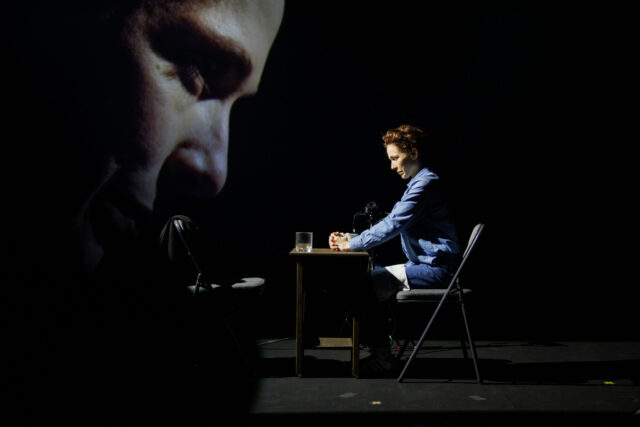
Jen Tullock cowrote and stars in one-person show at Playwrights Horizons (photo by Maria Baranova)
NOTHING CAN TAKE YOU FROM THE HAND OF GOD
Playwrights Horizons, the Peter Jay Sharp Theater
416 West 42nd St. between Ninth & Tenth Aves.
Tuesday-Sunday through November 16, $63.50 – $118.50
www.playwrightshorizons.org
“Do you remember the first time you saw her, or I mean, has writing about it changed your memory of her?” a voice asks author Kristin Frances Reinhardt in Jen Tullock and Frank Winters’s Nothing Can Take You from the Hand of God. Frances doesn’t answer the question in this intense solo show about first love, childhood trauma, forgiveness, and what and how we remember our past, filtered through family and religious dynamics and time.
Tullock performs all eleven roles in the seventy-minute multimedia production, from Frances’s brother, Eli, and mother, Raelynn, to her animated literary agent, Aubrey, and Kenny Weaver, the pastor of the Northeast Missions Church in her hometown. The play begins at a literary event launching Frances’s latest memoir, Never the Twain Shall Meet: Losing God and Finding Myself, the follow-up to Sorry I’m Late, about queer dating in Los Angeles. The new book explores Frances’s battles with her parents and the church over her sexual orientation as they go to extremes to try to force the gay out of her.
The action starts when agent Aubrey informs Frances that an organization discussed in the book, the Northeast Christian Church, got hold of an advance copy and is threatening to sue unless the author removes sections the church deems libelous for “wrongful likeness.” Frances decides to return home, believing she can straighten things out with the people she wrote about, primarily one specific young Polish woman with whom she fell in love, now a single mother who does not want to speak to her.
The narrative weaves in and out of the past and the present as the plot moves to Eli’s Backyard Bible Study class, a talent show audition, a coffee shop, a popular creek, a barbecue at Raelynn’s house, and the church, all the while intercutting discussions between Frances and Aubrey and readings and questions at the book event. For example, at one point the play switches back and forth between the book launch, with the host and audience heard in voiceover, and Pastor Jeremy Young at the church, with Tullock seamlessly shifting from Frances to Jeremy, making it feel like it’s all one conversation:
Jeremy: You know what my dream is? With this place? I want to make it so nobody has to write a book like you did. Not ever again. That’s the work that we’re trying to do.
Host: Wow.
Jeremy: Would you agree with that?
Host: Oh, gosh. That’s beautiful.
Jeremy: Well, I am so glad to hear you say that; I’m relieved, frankly. That means the world to me. Now let me ask you a question. Do you ever worry if you made any of it up?
Frances: Sorry, excuse me?
Host: Do you ever think about who your work is reaching?
Jeremy: Now, I’m not a lawyer — this may come as a shock to you, but I do know that even by the standards of Kentucky Common Law there is something called — let me see if I can get this right — Intentional Infliction of Emotional Distress. I know, it’s wordy.
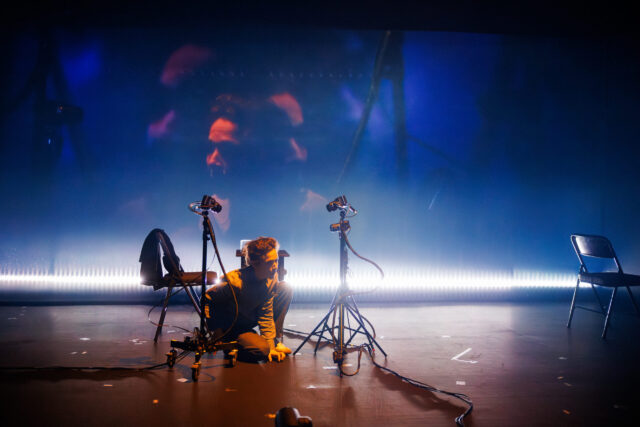
Nothing Can Take You from the Hand of God is a technical whirlwind (photo by Maria Baranova)
Tullock gives a tour-de-force performance, quickly changing accents and body language while also adjusting several onstage looping stations and small cameras that record real-time visuals of her that are projected onto screens around her, as if each character contains their own multitudes, going beyond stereotypes. The claustrophobic set, featuring two chairs, a small table, and the tech equipment, is by Emmie Finckel, with almost dizzying projections by Stefania Bulbarella, sharp lighting by Amith Chandrashaker, and expertly rendered sound by Evdoxia Ragkou.
The play is furiously directed by Jared Mezzocchi (Russian Troll Farm, On the Beauty of Loss), who previously collaborated with Tullock (On the Head of a Pin, You Shall Inherit the Earth!) on the marvelous site-specific Red Hook show The Wind and the Rain; there is so much going on at any one time that it takes a while to pick up its unique structure, which can get overwhelming and confusing at certain moments.
Inspired by events from her own life and her family’s involvement in the evangelical church, Tullock and cowriter Winters (On the Head of a Pin, Student Body) don’t sugarcoat the story by creating heroes and villains; each character in the play is complicated and well developed, flaws and all. In the book and the show itself, Frances is an unreliable narrator, one who is able to make the audience take a long, hard look at their own past and wonder how many of their memories might have wandered from the truth over the years.
“Do you still believe in anything?” an audience member asks Frances at the book event.
It’s a question many of us should be asking ourselves in these dark, troubled times.
[Mark Rifkin is a Brooklyn-born, Manhattan-based writer and editor; you can follow him on Substack here.]