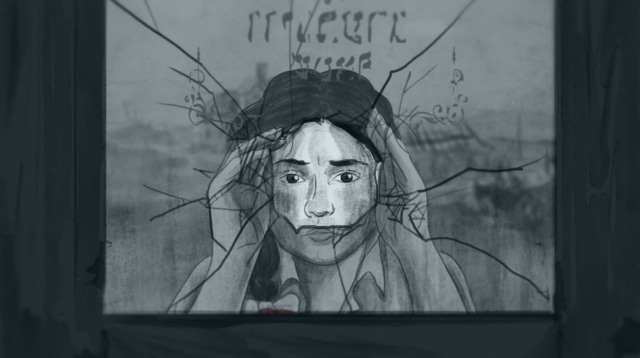
Among Neighbors explores horrific events that linger in a small Polish town (courtesy of 8 Above)
AMONG NEIGHBORS (Yoav Potash, 2025)
Quad Cinema
34 West 13th St. between Fifth & Sixth Aves.
Opens Friday, October 10
212-255-2243
quadcinema.com
www.amongneighbors.com
“It’s much easier to sell a pleasant history than a difficult history,” professor Dariusz Stola says in Yoav Potash’s remarkable documentary, Among Neighbors.
Ten years in the making, the film is a gripping, deeply emotional murder mystery surrounding the killing of Jews in the small town of Gniewoszów, Poland — months after WWII had concluded. In 2014, Potash was invited by Aaron Friedman Tartakovsky and his mother, Anita Friedman, to film the rededication of a Jewish cemetery in the shtetl where Anita’s father was from, but as Potash spoke with residents, he discovered long-buried, dark secrets involving violence and the whitewashing of what had occurred there.
Nine years earlier, the Friedman family had faced physical threats when they tried to visit the Gniewoszów firehouse, which was formerly the old synagogue. In 2018, the Polish government amended the Act on the Institute of National Remembrance, criminalizing any speech or action that suggested the country was complicit in the Holocaust. In 2020, Stola was forced to resign from his role at the Polin Museum of the History of Polish Jews over disagreements about what the institution could and could not display.
Potash, who wrote, directed, produced, and coedited the film and served as one of the cinematographers, meets with several longtime Polish residents, who will say only so much. Henryk and Sławomir Smolarczyk don’t feel there is anything strange about their collection of dusty Jewish tombstones from the destroyed cemetery. Janina Grzebalska recalls playing with Jewish children, attending Jewish weddings, and enjoying matzah. One unidentified woman who came to Gniewoszów for work in 1953 asks, “Is this about the Jewish issues? It was already silenced.”
But Potash starts uncovering the truth from Pelagia Radecka, who, for the first time, reveals the story of her relationship with the Weinbergs, the Jewish family who operated a fabric shop across the street from her house and were victims of a horrific tragedy. Haunted by her memories, Radecka has been trying to find out what happened to her friend, Janek Weinberg, for seventy years. Meanwhile, the granddaughters of Gniewoszów painter Harry Lieberman put Potash in touch with Yaacov Goldstein, who was separated from his family during the Holocaust and shares his unforgettable tale of survival. Pelagia’s and Yaacov’s harrowing stories are brought to life through archival footage, photographs, home movies, and spellbinding hand-drawn black, gray, and white animation (highlighted by powerful splashes of blue and yellow) as they narrate their experiences.
“They were our neighbors,” Pelagia says, shocked by what she had witnessed.
Yaacov declares, “I am a survivor of the Holocaust. And to say that Polish people didn’t help the Germans, did not hate, and didn’t kill Jewish people — it’s against the truth!”
Potash (Crime After Crime, Food Stamped) also speaks with matzevot photographer Łukasz Baksik and mass graves investigator Aleksander Schwarz, the latter noting, “We have so many cases, you wouldn’t believe.”; Michael Schudrich, the Chief Rabbi of Poland; journalist Konstanty Gebert, who points out, “This one small town represents what happened in hundreds of small towns. The Germans come in, and it’s the end of normal relations between Jews and non-Jews.”; and historian Magda Teter, who puts it all into perspective, relating it to what is going on in America and around the world: “The assault on history and the criminalization of history in many countries today is part of a larger assault on democracy and democratic values.” Meanwhile, Polish ambassador Piotr Wilczek asserts, “There are only individual, very rare cases of antisemitism in Poland. The problem is really in many countries. So I really don’t know why Poland is singled out in such a way.”
In January 2024, Igor Golyak’s theatrical adaptation of Tadeusz Słobodzianek’s Our Class detailed the real-life 1941 pogrom in the small Polish village of Jedwabne, where Catholic children turned against their Jewish schoolmates, leading to a mass murder that was covered up for decades. In the 2021 documentary Three Minutes — A Lengthening, director Bianca Stigter does a deep dive into one hundred and eighty seconds of vacation footage taken in 1938 in the small town of Nasielsk, Poland, attempting to identify the people in the images and figure out what happened to them; of the three thousand Jews who lived in Nasielsk at the time, fewer than a hundred survived the Nazi invasion.
Meanwhile, antisemitism is on the rise yet again in America, where the current administration is erasing certain parts of our history and rewriting others, especially those concerning minorities and diversity. Immigrants are being vilified with grotesque language and shameful policies. Thus, Among Neighbors is not just about a small village in Poland; it is about respect, dignity, compassion, and the truth everywhere, at any time. When Yaacov says, “It was like we were not human beings,” it is hard not to think that he is referring to the treatment of Black and brown people in the United States. That point strikes a chord when Stola says, “They felt, in Poland, at home, that this is a safe place.”
Are there any safe places anymore?
Among Neighbors, which features an extraordinary ending that requires multiple tissues, runs October 10–16 at the Quad, with Potash participating in Q&As on October 10 at 7:20 (with filmmaker Yael Melamede), October 11 at 7:20 (with actor Simon Feil), and October 12 at 3:30 (with professor Annette Insdorf).
[Mark Rifkin is a Brooklyn-born, Manhattan-based writer and editor; you can follow him on Substack here.]