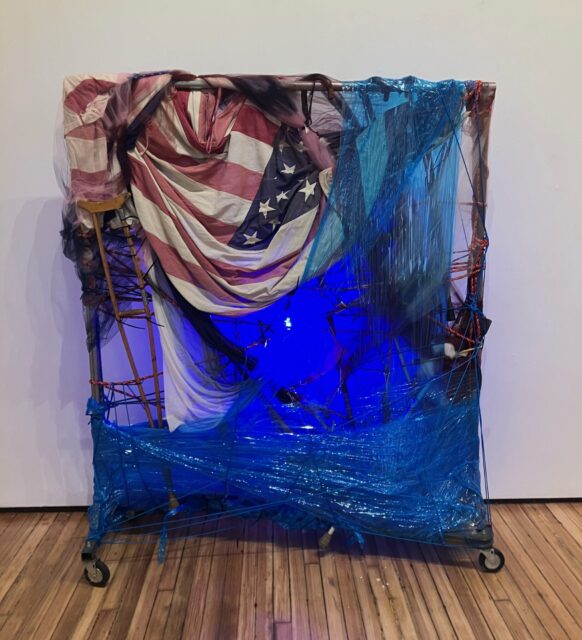
Abigail DeVille’s Libertas (Study in Blue) asks, “How have we fought for the proliferation of truths, not the lies that frame the history and governance of this great republic?” (photo courtesy of the artist and Art at a Time Like This)
DON’T LOOK NOW: A DEFENSE OF FREE EXPRESSION
127 Elizabeth St. between Broome & Grand Sts.
Opening reception Friday, October 10, free, 6:00
Exhibition continues Tuesday – Saturday through October 25, free, noon – 6:00 pm
artatatimelikethis.com
Founded by Anne Verhallen and Barbara Pollack as an immediate response to the pandemic lockdown, the nonprofit Art at a Time Like This is dedicated to the idea that “art can make a difference and that artists and curators can be thought-leaders, envisioning alternative futures for humanity.” Art at a Time Like This has presented nearly two dozen online and in-person exhibitions and programs since March 2020, such as “Dangerous Art, Endangered Artists,” “First Responders,” and “Restoration: Now or Never.”
The organization’s latest is “Don’t Look Now: A Defense of Free Expression,” opening October 10 at 127 Elizabeth St. The show consists of “25 Artists Exercising Their First Amendment Rights,” from Marilyn Minter’s Plush #5, Sari Nordman’s Anxiety River, and Martha Wilson’s Martha Does Donald to Yvonne Iten-Scott’s Origin, Shepard Fairey’s My Florist Is a Dick, and Clarity Haynes’s Big Birth, all of which have been censored in some way.
For example, Jean-Paul Mallozzi’s Ansiedad: I Can’t Get Off had to be partially modified in order to remain in South Florida Cultural Consortium’s “Mangroves to Masterpieces” at Florida Atlantic University, Jessica (Mehta) Doe’s 500 Years Ago was moved to a closed-off room at the University of Notre Dame, and Shey “Ri Acu” Rivera Ríos (Prayers to Nana Buruku) was to be included in the three-artist exhibition “Nothing Living Lives Alone” at Providence College in March 2024, but the exhibit was canceled by the administration, which decided that pieces by Rios (that were not in the Providence presentation) “show contempt for the Catholic faith.”
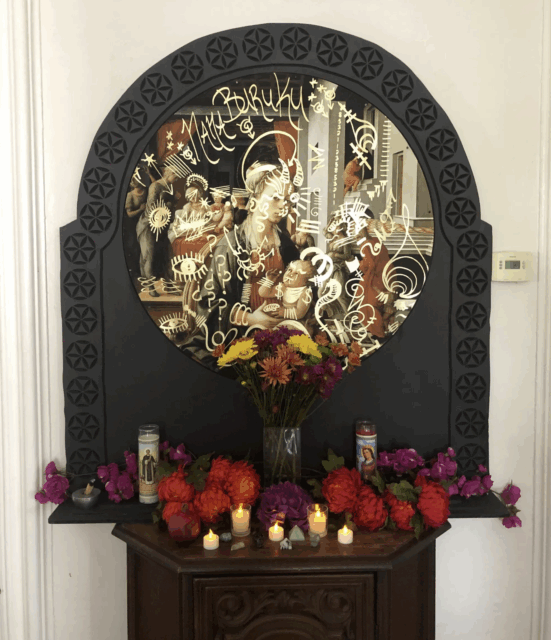
Shey Rivera Ríos, Prayers to Nana Buruku Altar, 2017 (photo © 2025 Shey Rivera Ríos)
I recently asked three of the “Don’t Look Now” participants when they became personally aware of censorship and the importance of the First Amendment; below are their responses.
Susan Silas
Honestly, I don’t remember a time when I didn’t know about censorship and the First Amendment. That may have been part and parcel of growing up in an immigrant household with Holocaust survivor parents.
As for my own direct personal experience with Instagram and Facebook, so much of my work contains nudity, it was inevitable. I was already aware that others were being censored, and also of the arbitrary nature of that censorship based on how algorithms search. For example, I had an image from my series “love in the ruins; sex over 50” that depicted actual intercourse stay up because we were one on top of the other, so nipples weren’t exposed, while an image like the one in the exhibition, which is not dissimilar to depictions of Adam and Eve in sixteenth-century paintings, was taken down in twenty seconds for “offending community standards.”
I guess I also object to these platforms deciding who my community is. My community is not offended.
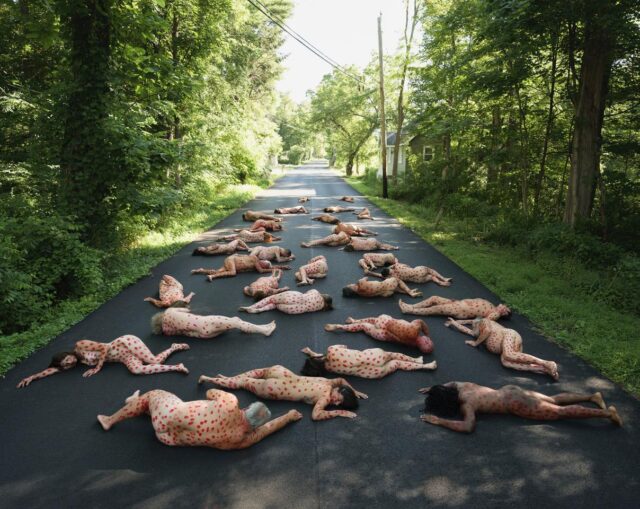
Spencer Tunick’s Remedy, taken in New Paltz, New York, was rejected by Instagram (photo © 2025 Spencer Tunick)
Spencer Tunick
My art censorship started in the mid-’90s when my friend Michael Weiner and I were arrested at Rockefeller Center. My idea was to have him pose nude draped, facedown, on top of the oversized outdoor red Christmas balls. I did get the shot, but we were held afterwards in a jail cell inside 30 Rock. Ron Kuby and William Kunstler represented us and the charges were dismissed.
It’s legal to be nude for art in New York within a time, space, and manner. We were making art before sunrise in the twilight hours on a weekend, when no one was on the street. We were exercising our (visual) First Amendment rights, plus there were no signs that explicitly stated, “Don’t climb the balls.”
This arrest was the beginning of five arrests and a future case that made its way up to the US Supreme Court, where I won and New York City mayor Rudy Giuliani was reprimanded by the federal judges.
As for the present, my work has been censored on social media since 2012, even though I am adhering to their nudity rules, which includes self-censoring frontal nudity and close-ups of buttocks. So even though I am still following their nudity rules, they still find ways to threaten deletion of my accounts and make my accounts unrecommendable. This suppression is too harsh.
In response to social media and online censorship, I helped found the website Don’t Delete Art. I am the cofounding curator; it’s a collaboration with artists and free speech organizations. My recent contribution was the idea of a “tips” page to help artists avoid suppression and deletion.
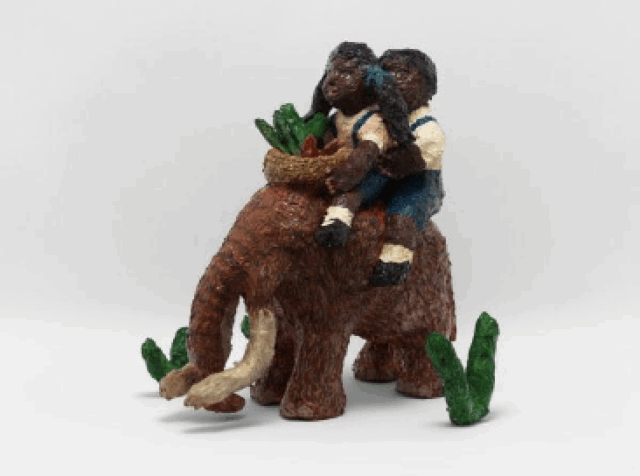
Kelly Sinnapah Mary’s The Fables of Sanbras – Cake and Conquest was part of a canceled show at the Art Museum of the Americas this year (photo © 2024 Kelly Sinnapah Mary)
Danielle SeeWalker
It’s difficult to pinpoint an exact moment or instance that I became aware of censorship and the importance of the First Amendment, but through lived experience and witnessing the silence surrounding my people’s stories it became clear that I was born into a sort of censorship. Growing up Native, I noticed early on how little of our truth was ever told — in school the narrative being taught was very different than what I was being told at home and by my elders. Our languages, our ceremonies, our ways of seeing the world were pushed aside or erased completely through boarding school and colonization. From an early age, I had the realization that what I was being taught in the mainstream world didn’t match what my family and community had lived. That silence — that absence — was/is censorship.
For my people, this isn’t something that happened long ago; it’s something we still live with. Our voices are still dismissed, our issues ignored, our history rewritten. We’ve been fighting for the right to speak, to pray, to tell our own stories since time immemorial. When my grandmother was born, she wasn’t even considered an American citizen, yet she and our ancestors have been on these lands since time immemorial. My father grew up in a time when not all Native Americans were able to legally vote. The First Amendment, to me, isn’t just about freedom of speech — it’s about the right to exist and to be heard in a country that has tried over and over again to silence us (and get rid of us).
When I think about it, I realize how powerful it is just to speak our truth. Every time a Native person shares their story, teaches their language, or corrects a false history, it’s an act of resistance. It’s reclaiming space in a world that once told us we didn’t belong. That’s what the First Amendment means to me — not just words on paper, but a promise we keep alive every time we refuse to be silent. Our existence is our resistance.
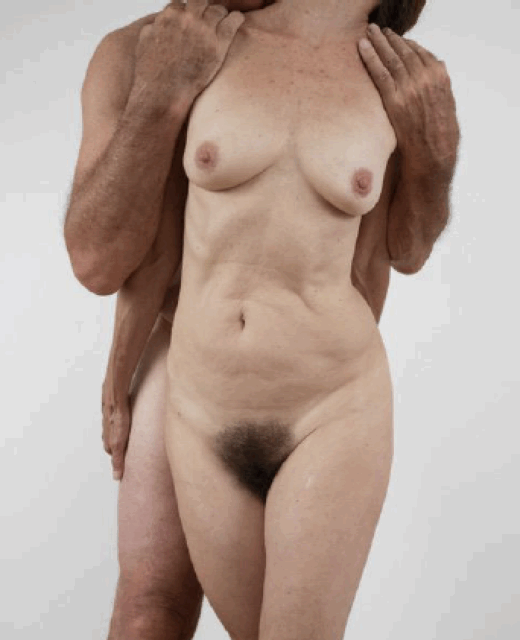
Susan Silas, Torsos, from the ongoing series “love in the ruins; sex over 50,” 2017 (photo © 2017 Susan Silas)
On October 18 at 2:00, Art at a Time Like This will host the free panel discussion “Censorship Now: Who Fears Free Expression?” with National Coalition Against Censorship’s Arts/Advocacy Program director Elizabeth Larison, Artnet contributor Brian Boucher, and former Whitney Independent Studies Program associate director Sara Nadal-Melsió, addressing the questions “What’s so scary about freedom of expression? And what do we fear will happen if we fail to respond to the latest challenges?”
[Mark Rifkin is a Brooklyn-born, Manhattan-based writer and editor; you can follow him on Substack here.]