
Georg Friedrich Haas’s 11,000 Strings envelops Park Avenue Armory’s Wade Thompson Drill Hall in sound and light (photo by Stephanie Berger)
11,000 STRINGS
Park Avenue Armory, Wade Thompson Drill Hall
643 Park Ave. at 67th St.
Through October 7
212-933-5812
www.armoryonpark.org
“The idea of this commission did not come from myself because of an easy reason. I never would have dared to make this suggestion. Nobody would have believed that this is possible,” composer Georg Friedrich Haas says about 11,000 Strings, his extraordinary concerto grosso continuing at Park Ave. Armory through October 7. The stirring production encircles the entire audience with fifty specially microtuned upright pianos that face the walls of the fifty-five-thousand-square-foot Wade Thompson Drill Hall, while the twenty-five members of the Klangforum Wien face the audience, playing the harp, saxophone, cello, violin, accordion, and more.
There is no conductor; instead, the pianists, from Juilliard, the Manhattan School of Music, the Mannes School of Music, NYU, and Columbia, play unique scores from individualized iPads while the Klangforum Wien perform with their own hard-copy scores and iPhones that track the time.
Under the music direction of Bas Wiegers and with lighting by Brian H. Scott, the sixty-six-minute piece unfolds in a series of sections that range from whispers to passionate explosions, from glorious cinematic moments to soft melodies evoking bees, birds, and the natural world. Close your eyes and you can get lost in the architecture of the space, as if the building itself is participating in the consonance.
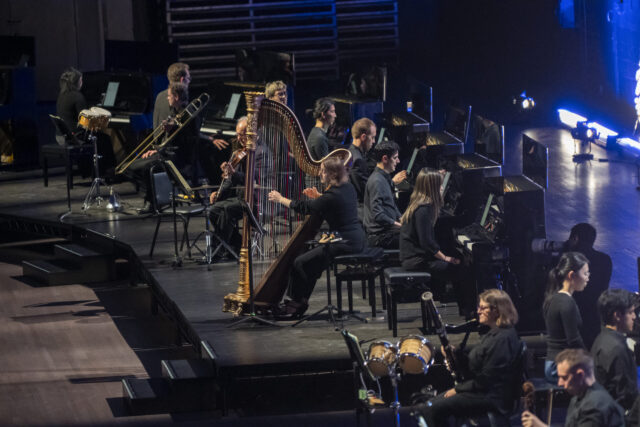
Harpist Miriam Overlach performs with fellow members of Klangforum Wien and emerging and established pianists from New York City (photo by Stephanie Berger)
Since no two musicians are playing the exact same thing, it feels as if there is a wave of motion flowing through the hall and hovering over the audience, a compelling choreography as the pianists gently shift their bodies up and down or to the right and left and the Klangforum Wien members stand up and sit down. The unintended vagaries of live performance in physical space add visual surprises; near me, one of the pianos seemed to be the slightest bit loose, so as the pianist hit the keys, abstract images shook on the top panel, adding a touch of lovely mystery. Everyone is dressed in different all-black outfits; the reflections of each pianist’s face in their instrument’s panel have an otherworldly glow.
I focused on flutist Vera Fischer, violinist Gunde Jäch-Micko, violoncellist Benedikt Leitner, saxophonist Gerald Preinfalk, and percussionist Lukas Schiske, who were closest to where I was sitting, although I made sure to swivel my head around to catch harpist Miriam Overlach, violinist Sophie Schafleitner, trombonist Mikael Rudolfsson, and others. Several times the string musicians stood and dragged their bows against cymbals, offering brief flashes of dissonance that enhance the ritualistic feel of the piece.
11,000 Strings is yet another unusual and fascinating sonic environment that the armory is renowned for housing, following such previous works as Karlheinz Stockhausen’s Inside Light and Tyshawn Sorey’s Monochromatic Light (Afterlife).
You don’t have to understand the details of the music to be swept away by its magic. For example, Haas notes in the program, “When a violin tunes its strings in perfectly intoned fifths, this interval is a tiny fraction (almost exactly one-fiftieth of a semitone) higher than the piano’s fifth. If each of the 50 pianos is tuned higher by this very small interval, then an absolutely perfect fifth is created, for example, between the C of the first piano and the G of the second piano. The same applies between the C of the second and the G of the third piano (one-fiftieth of a semitone higher), between the C of the third and the G of the fourth piano, and so on. After 50 pianos, the circle closes, and the fifth has risen by a semitone.”
What is more important is what he writes later: “11,000 Strings is not an experiment. It is music for the people who play the piece and for the people who hear it. You don’t experiment with people.”
[Mark Rifkin is a Brooklyn-born, Manhattan-based writer and editor; you can follow him on Substack here.]