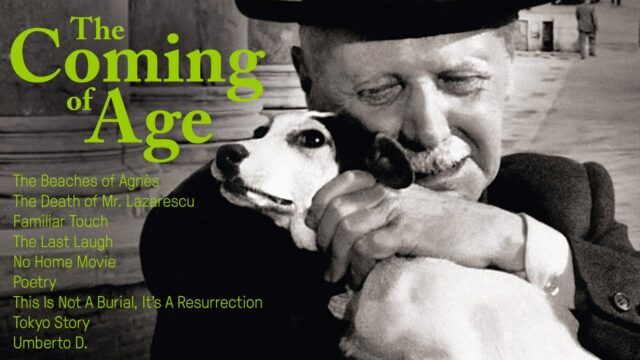
THE COMING OF AGE
Metrograph
7 Ludlow St. between Canal & Hester Sts.
October 12 – November 2
metrograph.com
The Metrograph series “‘The Coming of Age” is not a collection of works about young people discovering themselves as they advance from puberty to adolescence to adulthood. Instead, it explores films about people growing old.
“We’re aging: Older adults are the fastest growing age demographic globally and expected to double in size in the US by 2060. And yet our film culture clings to youth,” series curator Sarah Friedland said in a statement. “‘The Coming of Age’ liberates the genre from the strictures of youth to present an anti-ageist portrait of growing older in global cinema, drawing on my film-viewing research to prepare for the making of my feature debut, Familiar Touch. Presenting films from the silent era up through our current moment of seismic demographic shift, ‘The Coming of Age’ bears the name of Simone de Beauvoir’s seminal 1970 feminist book on aging and borrows the genre as a frame for seeing and celebrating older adults in the fullness and complexity of themselves. What links each film in this series is not aging as a subject but the aging subject’s perspective, showing old age in the diversity of its experience: as a time for pleasure, poetry, resistance, and even revenge.”
Running October 12 through November 2, the series includes a wide range of international selections, from Lemohang Jeremiah Mosese’s This Is Not a Burial, It’s a Resurrection and Yasujirô Ozu’s Tokyo Story to F. W. Murnau’s The Last Laugh and “Choreographies of Aging,” consisting of shorts by such directors as Kevin Jerome Everson, Barbara Hammer, and Friedland, who will take part in a postscreening discussion with director Wen Hu after the October 18 presentation. She will also be on hand October 12 to introduce Familiar Touch with star Kathleen Chalfant and critic Amy Taubin at 5:00 and then introduce Vittorio De Sica’s Umberto D. at 7:30.
Below is a closer look at four of the films.
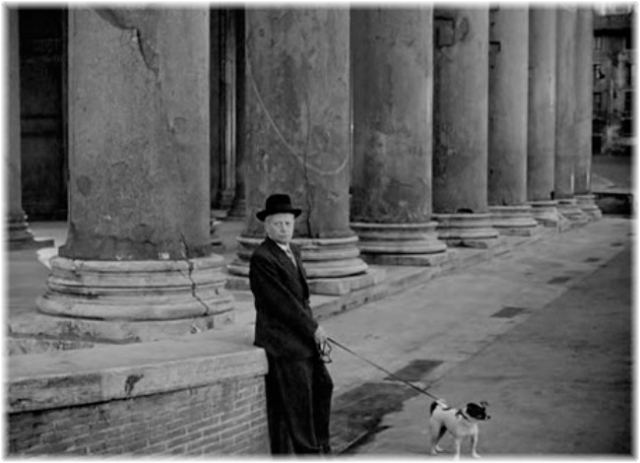
De Sica neorealist classic is the heartbreaking story of an elderly man and his faithful dog
UMBERTO D. (Vittorio De Sica, 1952)
Sunday, October 12, 7:30
Monday, October 20, 4:45
metrograph.com
You might never stop crying. Vittorio De Sica’s neorealist masterpiece Umberto D. stars Carlo Battisti (a professor whom De Sica saw one day and thought would be perfect for the lead role; it would be Battisti’s only film) as Umberto Domenico Ferrari, an elderly former bureaucrat who is too proud to sacrifice his dignity in order to pay his mean-spirited landlady (Lina Gennari), who rents out his room by the hour while he’s out walking his beloved dog, Flag, and trying to find some way to get money and food. Umberto D. is befriended by the boardinghouse maid (Maria Pia Casilio), who is pregnant with the child of one of two servicemen, neither of whom wants to have anything to do with her. As Umberto D.’s options start running out, he considers desperate measures to free himself from his loneliness and poverty. His relationship with Flag is one of the most moving in cinema history. Don’t miss this remarkable achievement, which was lovingly restored in 2002 for its fiftieth anniversary by eighty-six-year-old lighting specialist Vincenzo Verzini, who was known as Little Giotto.
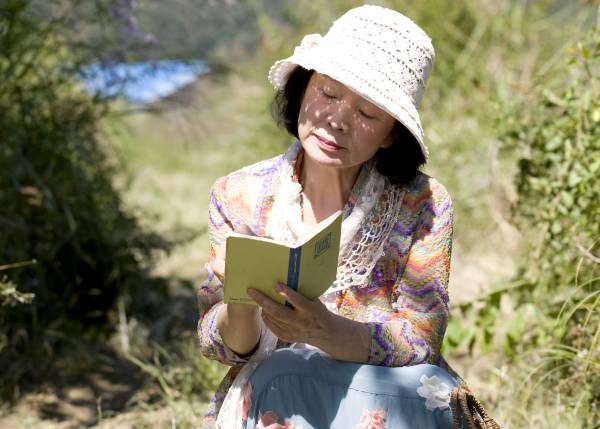
Yun Jung-hee returned to the screen for the first time in sixteen years in moving Poetry
POETRY (SHI) (Lee Chang-dong, 2010)
Friday, October 17, 3:30
Saturday, October 18, noon
www.kino.com/poetry
metrograph.com
Returning to the screen for the first time in sixteen years, legendary Korean actress Yun Jung-hee is mesmerizing in Lee Chang-dong’s beautiful, bittersweet, and poetic Poetry. Yun stars as Mija, a lovely but simple woman raising her teenage grandson, Wook (Lee David), and working as a maid for Mr. Kang (Kim Hi-ra), a Viagra-taking old man debilitated from a stroke. When she is told that Wook is involved in the tragic suicide of a classmate (Han Su-young), Mija essentially goes about her business as usual, not outwardly reacting while clearly deeply troubled inside. As the complications in her life grow, she turns to a community poetry class for solace, determined to finish a poem before the memory loss that is causing her to forget certain basic words overwhelms her. Winner of the Best Screenplay award at the 2010 Cannes Film Festival, Poetry is a gorgeously understated work, a visual, emotional poem that never drifts from its slow, steady pace. Writer-director Lee (Peppermint Candy, Secret Sunshine) occasionally treads a little too close to clichéd melodrama, but he always gets back on track, sharing the moving story of an unforgettable character. Throughout the film he offers no easy answers, leaving lots of room for interpretation, like poems themselves.
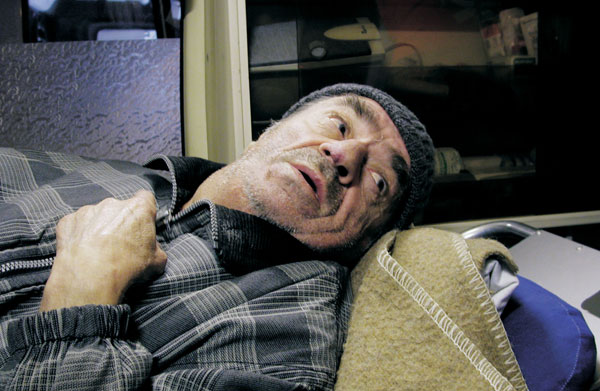
Ian Fiscuteanu brings to life the slow death of a unique character in Cristi Puiu’s very dark comedy
THE DEATH OF MR. LAZARESCU (Cristi Puiu, 2005)
Wednesday, October 22, 6:20
metrograph.com
Poor Mr. Lazarescu. He lives in a shoddy hovel of an apartment in Bucharest, where he drinks too much and gets out too little. He moves around very slowly and has trouble saying what’s on his mind, even to his three cats. His family is sick and tired of telling him to lay off the booze, so they ignore his complaints. Suffering from headaches and stomach pain, he phones for an ambulance several times, but it arrives only after a neighbor calls as well. Mr. Lazarescu then spends the rest of this very long night fading away as he is taken to hospital after hospital by the ambulance nurse, who gets involved in a seemingly endless battle with doctors to try to save him. Ian Fiscuteanu is sensationally realistic as Mr. Lazarescu; you’ll quickly forget that he’s not really a drunk, disgusting, dying old man. Luminita Gheorghiu is excellent as Mioara, the nurse who gets caught up in Mr. Lazarescu’s case. Winner of the Cannes Film Festival’s Un Certain Regard Award, cowriter-director Cristi Puiu’s very dark comedy is simply captivating; despite a slow start, it’ll pull you in with its well-choreographed scenes, documentary style, and careful camera movement. (Also look for the subtle and very specific naming of characters.) Using Éric Rohmer’s “Six Moral Tales” as inspiration, Puiu has said that The Death of Mr. Lazarescu is the first of his own “Six Stories from the Bucharest Suburbs,” this one dealing with “the love of humanity,” followed by 2010’s Aurora.
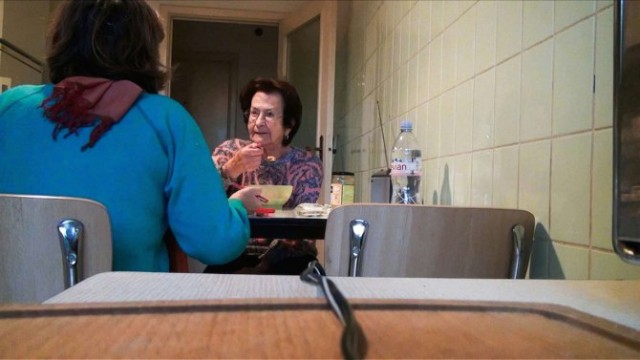
Chantal Akerman creates a unique profile of her mother in deeply personal No Home Movie
NO HOME MOVIE (Chantal Akerman, 2015)
Friday, October 24, 4:45
metrograph.com
icarusfilms.com
Chantal Akerman’s No Home Movie was meant to be a kind of public eulogy for her beloved mother, Natalia (Nelly) Akerman, who died in 2014 at the age of eighty-six, shortly after Chantal had completed shooting forty hours of material with her. But it also ended up becoming, in its own way, a public eulogy for the highly influential Belgian auteur herself, as she died on October 5, 2015, at the age of sixty-five, only a few months after the film screened to widespread acclaim at several festivals (except at Locarno, where it was actually booed). Her death was reportedly a suicide, following a deep depression brought on by the loss of her mother. No Home Movie primarily consists of static shots inside Nelly’s Brussels apartment as she goes about her usual business, reading, eating, preparing to go for a walk, and taking naps. Akerman sets down either a handheld camera or a smartphone and lets her mother walk in and out of the frame; Akerman very rarely moves the camera or follows her mother around, instead keeping it near doorways and windows. She’s simply capturing the natural rhythms and pace of an old woman’s life. Occasionally the two sit down together in the kitchen and eat while discussing family history and gossip, Judaism, WWII, and the Nazis. (The elder Akerman was a Holocaust survivor who spent time in Auschwitz.) They also Skype each other as Chantal travels to film festivals and other places. “I want to show there is no distance in the world,” she tells her mother, who Skypes back, “You always have such ideas! Don’t you, sweetheart.” In another exchange, the daughter says, “You think I’m good for nothing!” to which the mother replies, “Not at all! You know all sorts of things others don’t know.”
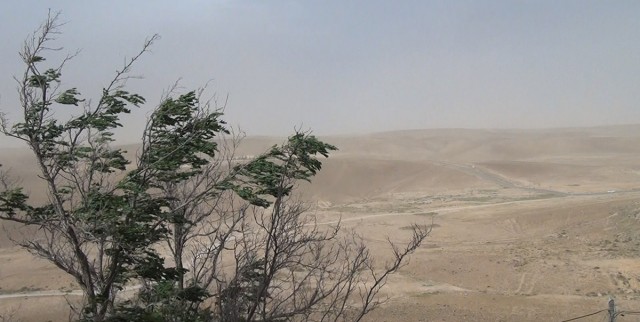
Shots of a tree fluttering in the Israeli wind enhance the peaceful calm of No Home Movie
Later they are joined by Chantal’s sister, Sylviane, as well as Nelly’s home aide. The film features long sections with no dialogue and nobody in the frame; Akerman opens the movie with a four-minute shot of a lone tree with green leaves fluttering in the wind in the foreground, the vast, empty landscape of Israel in the background, where occasionally a barely visible car turns off a far-away road. Akerman returns to Israel several times during the film, sometimes shooting out of a moving car; these sections serve as interludes about the passage of time as well as referencing her family’s Jewish past. At one point, Akerman makes potatoes for her mother that they eat in the kitchen, a direct reference to a scene in Akerman’s feminist classic, Jeanne Dielman, 23 Quai due Commerce, 1080 Bruxelles. Knowing about what happened to both mother and daughter postfilming casts a shadow over the documentary, especially when Chantal tells her mother, “I’m in a very, very good mood. . . . Let’s enjoy it; it’s not that common.” As the film nears its conclusion, there is almost total darkness, echoing the end of life. Through it all, Akerman is proud of her mother; reminiscing about kindergarten, she remembers, “And to everybody, I would say, this is my mother.” No Home Movie achieves that very same declaration, now for all the world to see and hear.
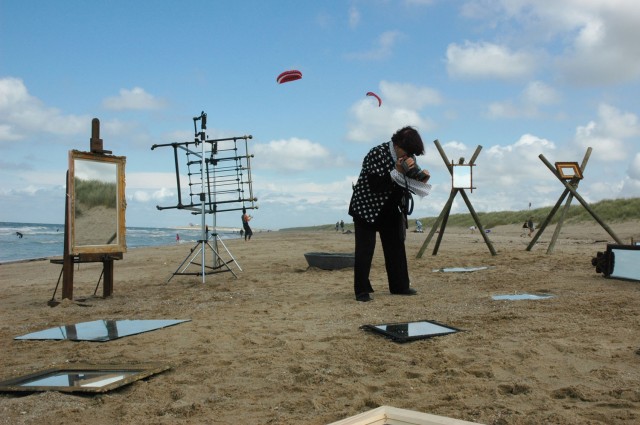
Agnès Varda takes an unusual approach to autobiography in The Beaches of Agnès
THE BEACHES OF AGNÈS (LES PLAGES D’AGNÈS) (Agnès Varda, 2008)
Friday, October 24, 2:00
Sunday, October 26, 11:00 am
metrograph.com
“The whole idea of fragmentation appeals to me,” filmmaker, photographer, and installation artist Agnès Varda says in the middle of her unusual cinematic autobiography, the César-winning documentary The Beaches of Agnès. “It corresponds so naturally to questions of memory. Is it possible to reconstitute this personality, this person Jean Vilar, who was so exceptional?” She might have been referring to her friend, the French actor and theater director, but the exceptional Belgian-French Varda might as well have been referring to herself. Later she explains, “My memories swarm around me like confused flies. I hesitate to remember all that. I don’t want to.” Fortunately for viewers, Varda (Jacquot de Nantes, The Gleaners and I) does delve into her past in the film, sharing choice tidbits from throughout her life and career, in creative and offbeat ways that are charmingly self-effacing. Using cleverly arranged film clips, re-creations, photographs, and an array of frames and mirrors, the eighty-year-old Varda discusses such colleagues as Jean-Luc Godard, Chris Marker, and Alain Resnais; shares personal details of her long relationship with Jacques Demy; visits her childhood home; rebuilds an old film set; speaks with her daughter, Rosalie Varda, and son, Mathieu Demy; talks about several of her classic films, including La Pointe Courte, Cléo from 5 to 7, and Vagabond; and, in her ever-present bangs, walks barefoot along beaches, fully aware that the camera is following her every move and reveling in it while also feigning occasional shyness. Filmmakers don’t generally write and direct documentaries about themselves, but unsurprisingly, the Nouvelle Vague legend and first woman to win an honorary Palme d’or makes The Beaches of Agnès about as artistic as it can get without becoming pretentious and laudatory.
[Mark Rifkin is a Brooklyn-born, Manhattan-based writer and editor; you can follow him on Substack here.]